







Question: In this problem, we consider the calculations for Ï p and Ï x for the particle in the box shown in Figure 17.5 in more
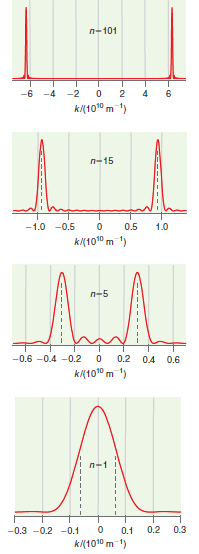
In this problem, we consider the calculations for σpand σxfor the particle in the box shown in Figure 17.5 in more detail. In particular, we want to determine how the absolute uncertainty Δpxand the relative uncertainty Δpx/pxof a single peak corresponding to either the most probable positive or negative momentum depends on the quantum number n.
a. First we must relate k and px. From E = p2x/2m and E = n2h2/8ma2, show that px = nh/2a.
b. Use the result from part (a) together with the relation linking the length of the box and the allowed wavelengths to obtain px = hk.
c. Relate Δ px and Δpx /px with k and Δk.
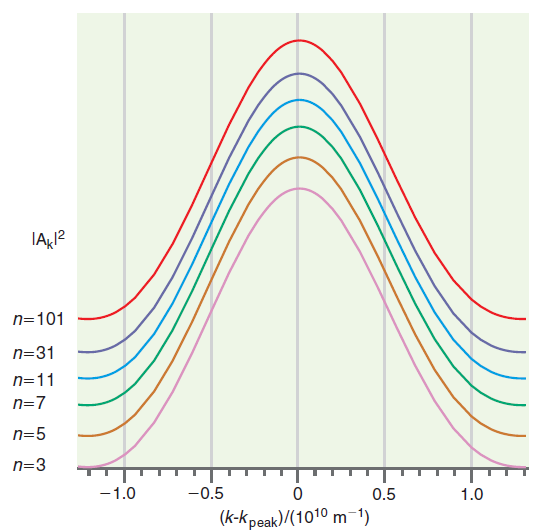
d. The following graph shows ˆ£Akˆ£2 versus k €“ k peak . By plotting the results of Figure 17.5 in this way, all peaks appear at the same value of the abscissa. Successive curves have been shifted upward to avoid overlap. Use the width of the ˆ£Akˆ£2 peak at half height as a measure of Δk. What can you conclude from this graph about the dependence of Δpx on n?
e. The following graph shows ˆ£Akˆ£2 versus k /n for n = 3, n = 5, n = 7, n = 11, n = 31, and n = 101. Use the width of the ˆ£Akˆ£2 peak at half height as a measure of Δk /n. Using the graphs, determine the dependence of Δpx /px on n. One way to do this is to assume that the width depends on n like (Δpx /px) = nα, where α is a constant to be determined. If this relationship holds, a plot of ln (Δpx /px) versus ln n will be linear and the slope will give the constant α.
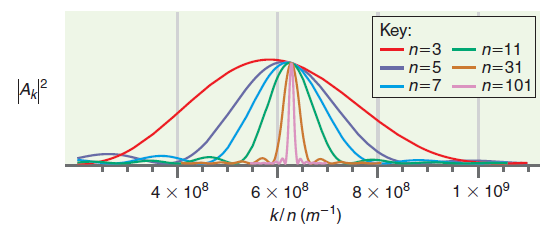
Figure 17.5
n=101 n=31 n=11 n=7 n=5 n=3 0.5 -1.0 -0.5 1.0 (k-kpeak)/(1010 m-1) Key: n=3 n=5 n=7 n=11 n=31 n=101 6 x 10⁸ kln (m-') 4 x 10⁸ 8 x 10⁸ 1 x 10⁹ 2.
Step by Step Solution
3.34 Rating (163 Votes )
There are 3 Steps involved in it
a b c d Because the half widths of the peaks for different n values are the ... View full answer

Get step-by-step solutions from verified subject matter experts
 Study Help