







Question: Multiple-Concept Example 9 reviews the concepts that play a role in this problem. Two forces are applied to a tree stump to pull it out
Multiple-Concept Example 9 reviews the concepts that play a role in this problem. Two forces are applied to a tree stump to pull it out of the ground. Force FA(vector) has a magnitude of 2240 newtons and points 34.0° south of east, while force FB(vector) has a magnitude of 3160 newtons and points due south. Using the component method, find the magnitude and direction of the resultant force FA(vector) + FB(vector) that is applied to the stump. Specify the direction with respect to due east.
Concept Example 9
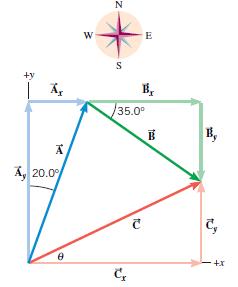
A jogger runs 145 m in a direction 20.0° east of north (displacement vector A(vector)) and then 105 m in a direction 35.0° south of east (displacement vector B(vector)). Using components, determine the magnitude and direction of the resultant vector C(vector) for these two displacements.
Reasoning Figure 1.22 shows the vectors A(vector) and B(vector), assuming that the y axis corresponds to the direction due north. The vectors are arranged in a tail-to-head fashion, with the resultant vector C(vector) drawn from the tail of A(vector) to the head of B(vector). The components of the vectors are also shown in the fi gure. Since C(vector) and its components form a right triangle (red in the drawing), we will use the Pythagorean theorem and trigonometry to express the magnitude and directional angle θ for C(vector) in terms of its components. The components of C(vector) will then be obtained from the components of A(vector) and B(vector) and the data given for these two vectors.
Knowns and Unknowns The data for this problem are listed in the table that follows:
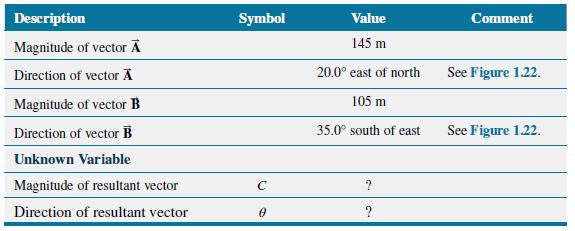
Description Symbol Value Comment Magnitude of vector A 145 m Direction of vector 20.0 east of north See Figure 1.22. Magnitude of vector B 105 m Direction of vector B 35.0 south of east See Figure 1.22. Unknown Variable Magnitude of resultant vector C Direction of resultant vector ?
Step by Step Solution
3.34 Rating (160 Votes )
There are 3 Steps involved in it
REASONING Using the component method for vector addition we will find the x compon... View full answer

Get step-by-step solutions from verified subject matter experts
 Study Help