







Question: Implement the 2-3+ tree, that is, a 2-3 tree where the internal nodes act only as placeholders. Your 2-3+ tree should implement the dictionary interface
Implement the 2-3+ tree, that is, a 2-3 tree where the internal nodes act only as placeholders. Your 2-3+ tree should implement the dictionary interface of Section 4.4.
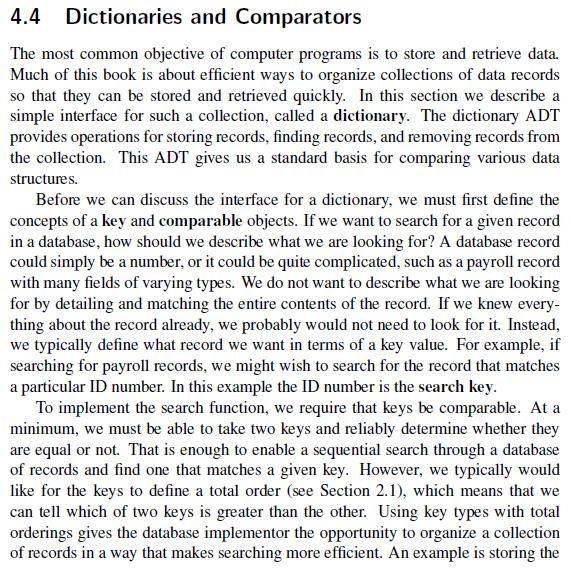
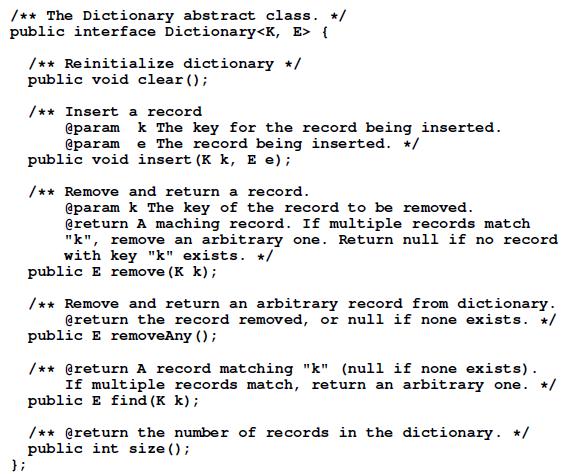
Dictionaries and Comparators The most common objective of computer programs is to store and retrieve data. Much of this book is about efficient ways to organize collections of data records so that they can be stored and retrieved quickly. In this section we describe a simple interface for such a collection, called a dictionary. The dictionary ADT provides operations for storing records, finding records, and removing records from the collection. This ADT gives us a standard basis for comparing various data structures. Before we can discuss the interface for a dictionary, we must first define the concepts of a key and comparable objects. If we want to search for a given record in a database, how should we describe what we are looking for? A database record could simply be a number, or it could be quite complicated, such as a payroll record with many fields of varying types. We do not want to describe what we are looking for by detailing and matching the entire contents of the record. If we knew every- thing about the record already, we probably would not need to look for it. Instead, we typically define what record we want in terms of a key value. For example, if searching for payroll records, we might wish to search for the record that matches a particular ID number. In this example the ID number is the search key. To implement the search function, we require that keys be comparable. At a minimum, we must be able to take two keys and reliably determine whether they are equal or not. That is enough to enable a sequential search through a database of records and find one that matches a given key. However, we typically would like for the keys to define a total order (see Section 2.1), which means that we can tell which of two keys is greater than the other. Using key types with total orderings gives the database implementor the opportunity to organize a collection of records in a way that makes searching more efficient. An example is storing the
Step by Step Solution
3.19 Rating (155 Votes )
There are 3 Steps involved in it
A 23 tree is a special case of a Btree where each node can have either one or two keys and two or three children The internal nodes act as placeholders to maintain the balance of the tree while the ac... View full answer

Get step-by-step solutions from verified subject matter experts
 Study Help