







Question: a. Show that n(t) = -g(t)i + (t)j and -n(t) = g(t)i - (t)j are both normal to the curve r(t) = (t)i + g(t)j
a. Show that n(t) = -g′(t)i + ƒ′(t)j and -n(t) = g′(t)i - ƒ′(t)j are both normal to the curve r(t) = ƒ(t)i + g(t)j at the point (ƒ(t), g(t)).
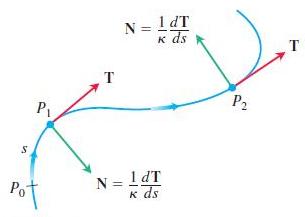
To obtain N for a particular plane curve, we can choose the one of n or -n from part (a) that points toward the concave side of the curve, and make it into a unit vector. (See Figure 13.19.) Apply this method to find N for the following curves.
In Figure 13.19
b. r(t) = ti + etj c. r(t) r(t) = 4 ti + tj, 2 t 2
Step by Step Solution
3.16 Rating (166 Votes )
There are 3 Steps involved in it
ANSWER a To show that the vectors nt and nt are both normal to the curve rt ti gtj at the point t gt ... View full answer

Get step-by-step solutions from verified subject matter experts
 Study Help