







Question: Refer to Problem 99. The points (3, 0), (1, 2), (3, 1), and (1, 3) are the vertices of a parallelogram ABCD. Data from problem
Refer to Problem 99. The points (−3, 0), (−1, −2), (3, 1), and (1, 3) are the vertices of a parallelogram ABCD.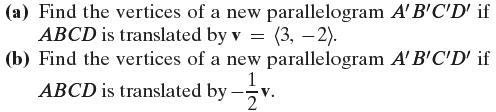
Data from problem 99
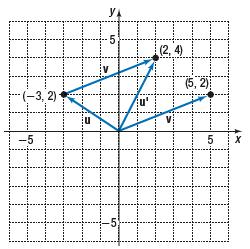
The field of computer graphics utilizes vectors to compute translations of points. For example, if the point (−3, 2), represented by vector u = (−3, 2), is to be translated by v = (5, 2), then the new location will be u = u + v = (−3, 2) + (5, 2) = (2, 4). So, the point (−3, 2) is translated by v to (2, 4) as shown in the figure.
(a) Determine the new coordinates of (3, −1) if it is translated by v = (−4, 5).
(b) Illustrate this translation graphically.
(a) Find the vertices of a new parallelogram ABCD is translated by v = (3,-2). (b) Find the vertices of a new parallelogram 1 ABCD is translated by -- v. 2 A'B'C'D' if A'B'C'D' if
Step by Step Solution
3.43 Rating (166 Votes )
There are 3 Steps involved in it

Get step-by-step solutions from verified subject matter experts
 Study Help