







Question: Taylors formula with n = 1 and a = 0 gives the linearization of a function at x = 0. With n = 2 and
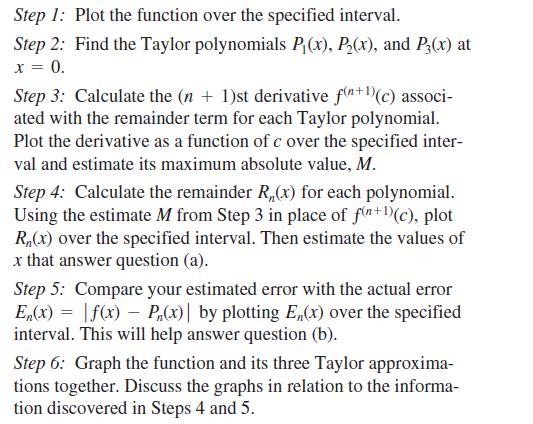
Taylor’s formula with n = 1 and a = 0 gives the linearization of a function at x = 0. With n = 2 and n = 3 we obtain the standard quadratic and cubic approximations. In these exercises we explore the errors associated with these approximations. We seek answers to two questions:
a. For what values of x can the function be replaced by each approximation with an error less than 10-2?
b. What is the maximum error we could expect if we replace the function by each approximation over the specified interval? Using a CAS, perform the following steps to aid in answering questions (a) and (b) for the functions and interval.
Using a CAS, perform the following steps to aid in answering questions (a) and (b) for the functions and interval.
f(x) = ex/sin 2x, |x| 2
Step by Step Solution
3.28 Rating (174 Votes )
There are 3 Steps involved in it

Get step-by-step solutions from verified subject matter experts
 Study Help