







Question: When Apollo 15 astronaut David Scott dropped a hammer and a feather on the moon to demonstrate that in a vacuum all bodies fall with
When Apollo 15 astronaut David Scott dropped a hammer and a feather on the moon to demonstrate that in a vacuum all bodies fall with the same (constant) acceleration, he dropped them from about 4 ft above the ground. The television footage of the event shows the hammer and the feather falling more slowly than on Earth, where, in a vacuum, they would have taken only half a second to fall the 4 ft. How long did it take the hammer and feather to fall 4 ft on the moon? To find out, solve the following initial value problem for s as a function of t. Then find the value of t that makes s equal to 0.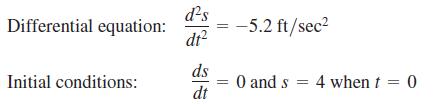
Differential equation: Initial conditions: d's dt ds dt = -5.2 ft/sec 0 and s 4 when t = 0
Step by Step Solution
3.38 Rating (148 Votes )
There are 3 Steps involved in it
ANSWER The differential equation governing the motion of the hammer and feather o... View full answer

Get step-by-step solutions from verified subject matter experts
 Study Help