







Question: The a periodic auto correlation function of a binary code is of interest in some synchronization applications. In computing it, the code is not assumed
The a periodic auto correlation function of a binary code is of interest in some synchronization applications. In computing it, the code is not assumed to periodically repeat itself, but (10.130) is applied only to the overlapping part. For example, with the 3-chip Barker code of Table 9.12 the computation is as follows:
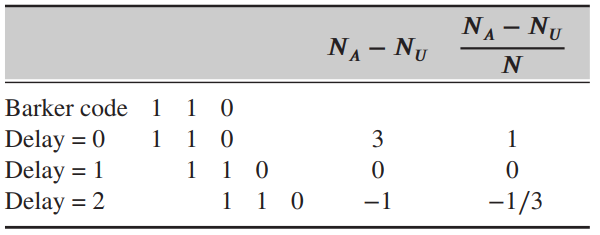 For negative delays, we need not perform the calculation because auto correlation functions are even.
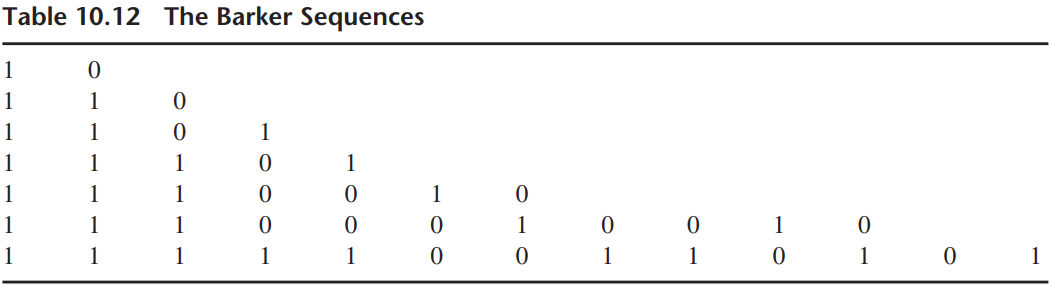
(a) Find the a periodic auto correlation functions of all the Barker sequences given in Table 9.12. What are the magnitudes of their maximum non-zero delay auto correlation values?
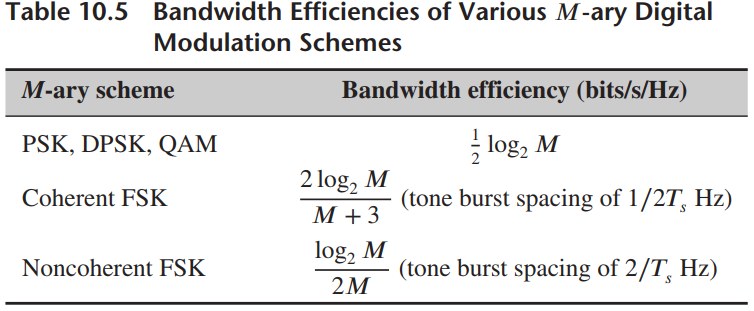
(b) Compute the a periodic auto correlation function of a 15-bit PN sequence. What is the magnitude of its maximum nonzero-delay auto correlation values? Note from Table 10.5 that this is not a Barker sequence.
NA- NU NA- NU 1 0 Barker code Delay = 0 Delay = 1 = 2 1 1 1 0 1 1 11 0 3 0 -1_ -1/3 Table 10.5 Bandwidth Efficiencies of Various M-ary Digital Modulation Schemes M-ary scheme Bandwidth efficiency (bits/s/Hz) PSK, DPSK, QAM log, M 2 log, M Coherent FSK (tone burst spacing of 1/27, Hz) M +3 log, M Noncoherent FSK (tone burst spacing of 2/T, Hz) 2M
Step by Step Solution
3.53 Rating (174 Votes )
There are 3 Steps involved in it
a Lengths 11 and 13 are not included reference should be to Table 1012 b Th... View full answer

Get step-by-step solutions from verified subject matter experts
 Study Help