







Question: Consider the transition matrix (a) Argue why in this case we should not hope for ergodicity. How does the chain evolve in this case? Show
Consider the transition matrix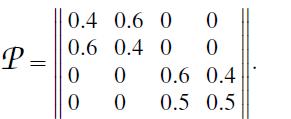
(a) Argue why in this case we should not hope for ergodicity. How does the chain evolve in this case? Show that Doeblin’s condition of Theorem 4 does not hold for this matrix.
(b) Let (π0, π1) and (˜ π0,˜ π1) be the stationary distributions for the two-state chains with the transition matrices
respectively. Argue that these distributions are also the limiting distributions for the two-state chains mentioned.
(c) For α ∈ [0,1], let the vector π(α) = α(π0, π1, 0, 0)+(1−α)(0, 0, ˜ π0, ˜ π1). Show that for any α ∈ [0,1], the distribution π(α) is stationary for the original chain.
(d) Let the initial distribution π0 = (π00, π01, π02, π03), and α = π00 +π01, the probability that the original chain started in one of the first two states. Show that πt, the distribution of the chain, converges to π(α).
(e) Explain all the facts above from a heuristic point of view. The main point is that the sets of states {0,1} and {2,3} do not communicate; that is, the process starting in the set {0,1} will never leave this set, and the same concerns {2,3}.
Step by Step Solution
3.35 Rating (155 Votes )
There are 3 Steps involved in it
a The classes of states 01 and 23 do not communicate and if for example the initial state is 0 the p... View full answer

Get step-by-step solutions from verified subject matter experts
 Study Help