







Question: Let (f in mathcal{S}_{T}) be a simple process and (M in mathcal{M}_{T}^{2, c}). Show that the definition of the stochastic integral (int_{0}^{T} f(s) d M_{S})
Let \(f \in \mathcal{S}_{T}\) be a simple process and \(M \in \mathcal{M}_{T}^{2, c}\). Show that the definition of the stochastic integral \(\int_{0}^{T} f(s) d M_{S}\) (cf. Definition 15.9) does not depend on the particular representation of the simple process (15.12).
Data From Definition 15.9
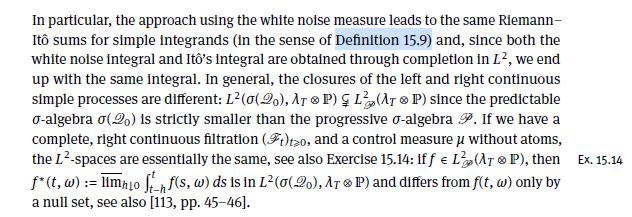
In particular, the approach using the white noise measure leads to the same Riemann- It sums for simple integrands (in the sense of Definition 15.9) and, since both the white noise integral and It's integral are obtained through completion in L, we end up with the same integral. In general, the closures of the left and right continuous simple processes are different: L((20), ATP) L(ATP) since the predictable o-algebra (20) is strictly smaller than the progressive -algebra P. If we have a complete, right continuous filtration (Ft)tzo, and a control measure without atoms, the L-spaces are essentially the same, see also Exercise 15.14: iff L(ATP), then Ex. 15.14 f*(t, w) := limno f(s, w) ds is in 1(0(20), ATP) and differs from f(t, w) only by a null set, see also [113, pp. 45-46].
Step by Step Solution
3.50 Rating (157 Votes )
There are 3 Steps involved in it

Get step-by-step solutions from verified subject matter experts
 Study Help