







Question: Let (mathcal{K}) be the set from Theorem 13.1. Show that for (w in mathcal{K}) the estimate (|w(t)| leqslant sqrt{t}), (t in[0,1]) holds. Data From Theorem
Let \(\mathcal{K}\) be the set from Theorem 13.1. Show that for \(w \in \mathcal{K}\) the estimate \(|w(t)| \leqslant \sqrt{t}\), \(t \in[0,1]\) holds.
Data From Theorem 13.1
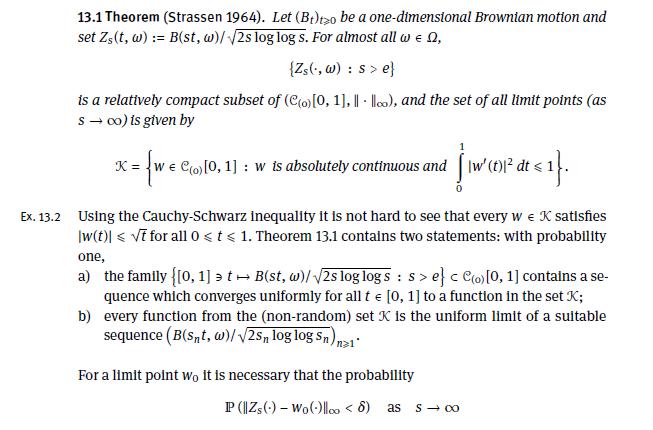
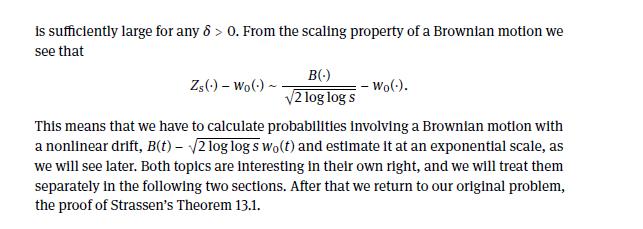
13.1 Theorem (Strassen 1964). Let (Bt)to be a one-dimensional Brownian motion and set Zs(t, w) := B(st, w)/2s log logs. For almost all w = Q, {Zs(., w): s> e} is a relatively compact subset of (e(o)[0, 1], || loo), and the set of all limit points (as s co) is given by K x = {w C (0) [0, 1] : W is absolutely continuous and w' (t)| Ex. 13.2 Using the Cauchy-Schwarz inequality it is not hard to see that every w K satisfies w(t)] t for all 0 < t < 1. Theorem 13.1 contains two statements: with probability one, a) the family [[0, 1] at B(st, w)/2s log logs: s>e} c Co) [0, 1] contains a se- quence which converges uniformly for all t = [0, 1] to a function in the set K; b) every function from the (non-random) set X is the uniform limit of a suitable sequence (B(snt, w)/2s, log log Sn) n1 For a limit point wo it is necessary that the probability P (Zs() - Woll
Step by Step Solution
3.36 Rating (165 Votes )
There are 3 Steps involved in it

Get step-by-step solutions from verified subject matter experts
 Study Help