







Question: Under otherwise the same model assumptions as in example 9.25, determine the stationary probabilities of the states 0,1 , and 2 introduced there on condition
Under otherwise the same model assumptions as in example 9.25, determine the stationary probabilities of the states 0,1 , and 2 introduced there on condition that the service time \(B\) is a constant \(\mu\); i.e., determine the stationary state probabilities of the loss system \(M / D / 1 / 0\) with unreliable server.
Data from Example 9.25
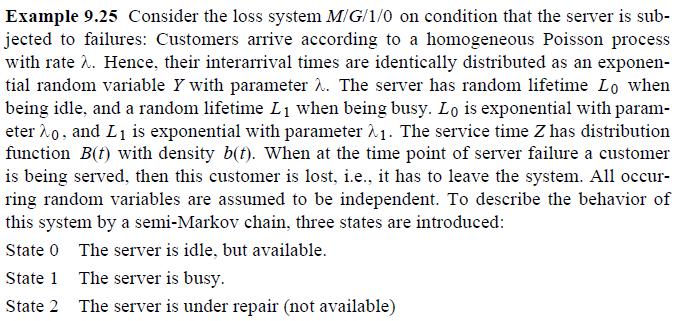
Example 9.25 Consider the loss system M/G/1/0 on condition that the server is sub- jected to failures: Customers arrive according to a homogeneous Poisson process with rate . Hence, their interarrival times are identically distributed as an exponen- tial random variable Y with parameter . The server has random lifetime Lo when being idle, and a random lifetime L when being busy. Lo is exponential with param- eter 20, and L1 is exponential with parameter 1. The service time Z has distribution function B(t) with density b(t). When at the time point of server failure a customer is being served, then this customer is lost, i.e., it has to leave the system. All occur- ring random variables are assumed to be independent. To describe the behavior of this system by a semi-Markov chain, three states are introduced: State 0 The server is idle, but available. State 1 The server is busy. State 2 The server is under repair (not available)
Step by Step Solution
There are 3 Steps involved in it

Get step-by-step solutions from verified subject matter experts
 Study Help