







Question: Verify the claim made in Example 21.9 using Its formula. Derive from the proof of Lemma 21.8 explicitly the form of the transformation and the
Verify the claim made in Example 21.9 using Itô’s formula.
Derive from the proof of Lemma 21.8 explicitly the form of the transformation and the coefficients in Example 21.9.
Integrate the condition (21.13) and retrace the steps of the proof of Lemma 21.8 from the end to the beginning.
Data From Lemma 21.8
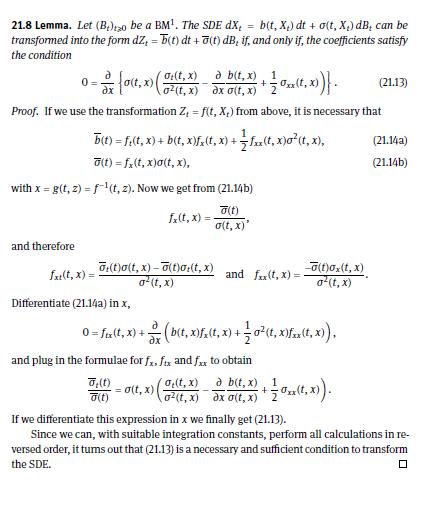
= 21.8 Lemma. Let (B)o be a BM. The SDE dX, b(t, x) dt + (t, X,) dB, can be transformed into the form dZ, = b(t) dt + (t) dB, if, and only if, the coefficients satisfy the condition 0:(t, x) a b(t, x) x) 02(t, x) dx a(t, x) Proof. If we use the transformation Z, = f(t, x) from above, it is necessary that b(t) = f(t, x)+b(t, x)fx(t, x) + fxx(t, x)(t, x), (t) = f(t, x)o(t, x), with x = g(t, z) = f(t, z). Now we get from (21.14b) (21.13) (21.14a) (21.14b) (t) fx(t, x)= (t, x)' and therefore (t)o(t, x)-(t):(t, x) -(t)ox(t, x) fxt(t, x)= and fxx(t, x)= a(t, x) a(t, x) Differentiate (21.14a) in x, 0 = fix(t, x) + (b(t, x)fx(t, x) + o(t, x)fxx (t, x)), and plug in the formulae for fx, fx and fxx to obtain J(t) = a(t, x) | (t) (t, x) b(t, x) 1 a(t, x) dx a(t, x) +10xx(t, x)). If we differentiate this expression in x we finally get (21.13). Since we can, with suitable integration constants, perform all calculations in re- versed order, it turns out that (21.13) is a necessary and sufficient condition to transform the SDE.
Step by Step Solution
3.33 Rating (153 Votes )
There are 3 Steps involved in it

Get step-by-step solutions from verified subject matter experts
 Study Help