







Question: We can use encapsulation within functions to delay evaluation in OCaml: Now given let rec next_int n = (n, Promise (fun() -> next_int (n +
We can use encapsulation within functions to delay evaluation in OCaml:
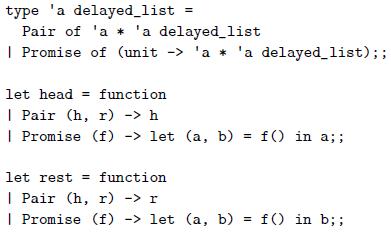
Now given
let rec next_int n = (n, Promise (fun() -> next_int (n + 1)));;
let naturals = Promise (fun() -> next_int (1));;
we have
head naturals;; ⇒ 1
head (rest naturals);; ⇒ 2
head (rest (rest naturals));; ⇒ 3
...
The delayed list naturals is effectively of unlimited length. It will be computed out only as far as actually needed. If a value is needed more than once, however, it will be recomputed every time. Show how to use pointers and assignment (Example 8.42) to memoize the values of a delayed_list, so that elements are computed only once.
type 'a delayed_list Pair of 'a * 'a delayed_list | Promise of (unit -> 'a * 'a delayed list);; let head = function | Pair (h, r) -> h | Promise (f) -> let (a, b) = f() in a; ; let rest = function | Pair (h, r) -> r | Promise (f) -> let (a, b) = f() in b; ; %3D
Step by Step Solution
3.39 Rating (161 Votes )
There are 3 Steps involved in it
type a memoizedlist MPair of a a memoizedlist ref MPromise of unit a a memoi... View full answer

Get step-by-step solutions from verified subject matter experts
 Study Help