







Question: Consider a market in which there are many potential buyers and sellers of used cars. Each potential seller has one car, which is either
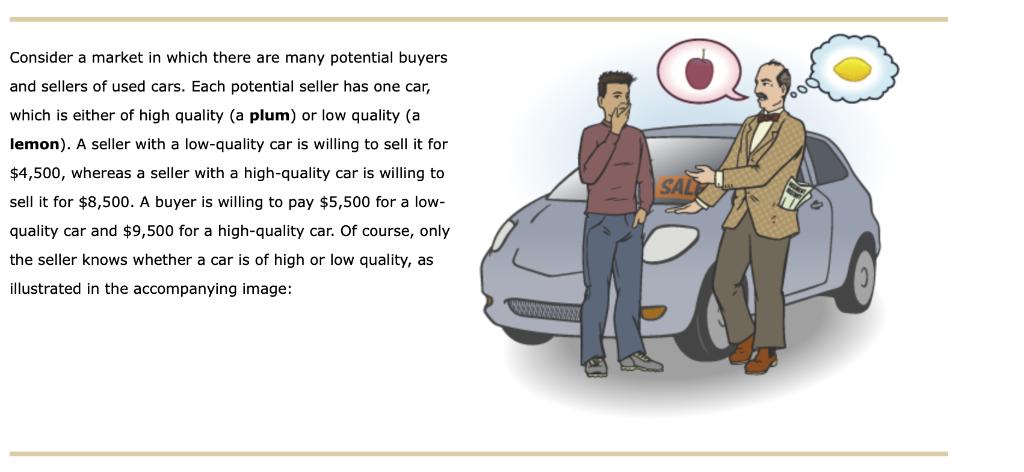
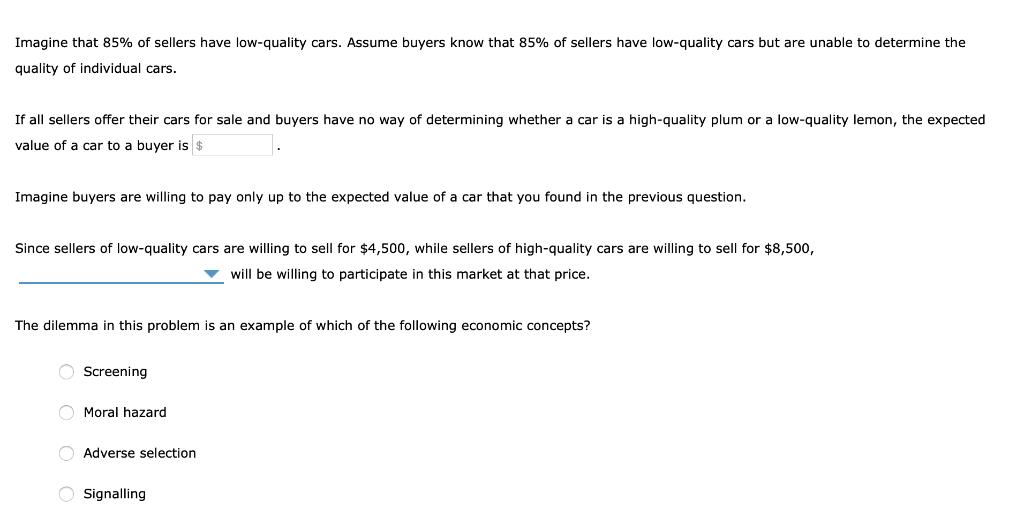
Consider a market in which there are many potential buyers and sellers of used cars. Each potential seller has one car, which is either of high quality (a plum) or low quality (a lemon). A seller with a low-quality car is willing to sell it for $4,500, whereas a seller with a high-quality car is willing to sell it for $8,500. A buyer is willing to pay $5,500 for a low- quality car and $9,500 for a high-quality car. Of course, only the seller knows whether a car is of high or low quality, as illustrated in the accompanying image: SAL Imagine that 85% of sellers have low-quality cars. Assume buyers know that 85% of sellers have low-quality cars but are unable to determine the quality of individual cars. If all sellers offer their cars for sale and buyers have no way of determining whether a car is a high-quality plum or a low-quality lemon, the expected value of a car to a buyer is $ Imagine buyers are willing to pay only up to the expected value of a car that you found in the previous question. Since sellers of low-quality cars are willing to sell for $4,500, while sellers of high-quality cars are willing to sell for $8,500, will be willing to participate in this market at that price. The dilemma in this problem is an example of which of the following economic concepts? O Screening Moral hazard Adverse selection Signalling
Step by Step Solution
There are 3 Steps involved in it
The detailed answer for the above question is provided below The ... View full answer

Get step-by-step solutions from verified subject matter experts
 Study Help