







Question: 0 Event B: The two cards are consecutive (i.e. Five of Spades, Six of Spades). i The probability of blackjack (Event A) has already been
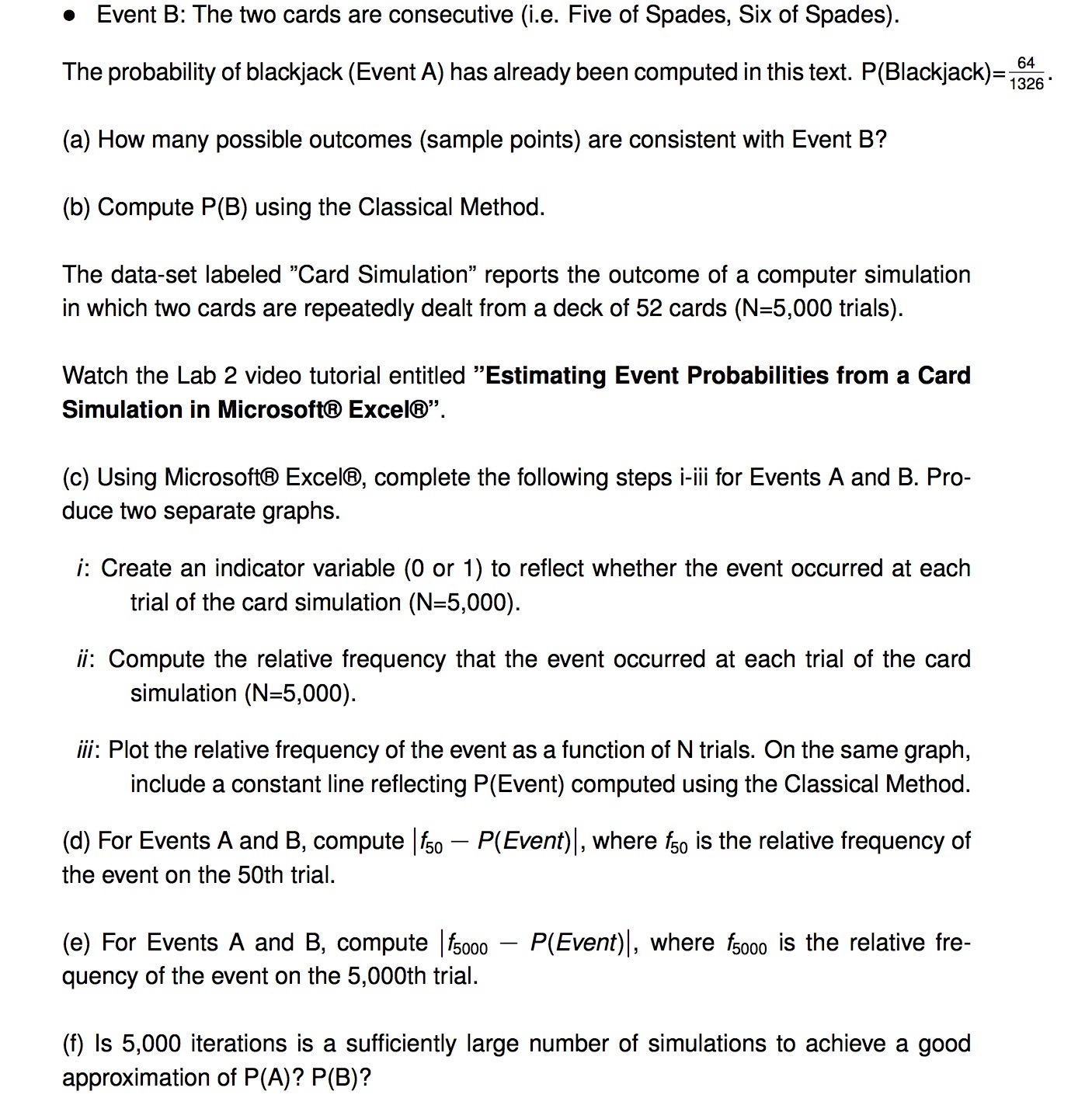
0 Event B: The two cards are consecutive (i.e. Five of Spades, Six of Spades). i The probability of blackjack (Event A) has already been computed in this text. P(Blackjack)=1326. (a) How many possible outcomes (sample points) are consistent with Event B? (b) Compute P(B) using the Classical Method. The data-set labeled "Card Simulation\" reports the outcome of a computer simulation in which two cards are repeatedly dealt from a deck of 52 cards (N=5,000 triais). Watch the Lab 2 video tutorial entitled \"Estimating Event Probabilities from a Card Simulation in Microsoft Excel". (c) Using Microsoft Excel, complete the following steps i-iii for Events A and B. Pro- duce two separate graphs. i: Create an indicator variabie (0 or 1) to reflect whether the event occurred at each trial of the card simulation (N=5,000). if: Compute the relative frequency that the event occurred at each trial of the card simulation (N=5,000). ir'r': Plot the relative frequency of the event as a function of N trials. On the same graph, include a constant line reflecting P(Event) computed using the Classical Method. (d) For Events A and B, compute |f5o P(Event)|, where 1'50 is the relative frequency of the event on the 50th trial. (e) For Events A and B, compute |f5ooo P(Event)|, where f5ooo is the relative fre- quency of the event on the 5,000th trial. (f) ls 5,000 iterations is a sufficiently large number of simulations to achieve a good approximation of P(A)? P(B)
Step by Step Solution
There are 3 Steps involved in it

Get step-by-step solutions from verified subject matter experts
 Study Help