







Question: 0 function? P5-14 ACTIVITY-BASE OFITABILAN e company is has shown Jans to Wa CTIVITY-BASED COSTING AND PRODUCT LINE PRO Percor is a grocery company with
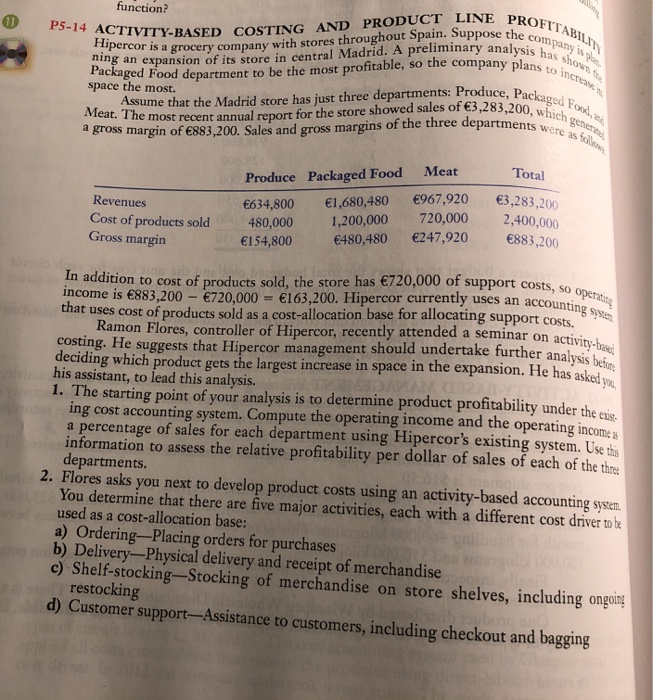
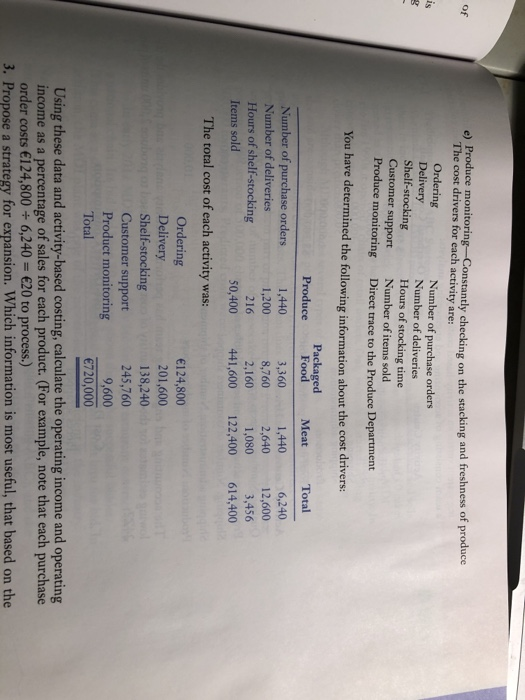
0 function? P5-14 ACTIVITY-BASE OFITABILAN e company is has shown Jans to Wa CTIVITY-BASED COSTING AND PRODUCT LINE PRO "Percor is a grocery company with stores throughout Spain. Suppose the ning an expansion of its store in central Madrid. A preliminary analysis Ickaged Food department to be the most profitable, so the company plane space the most. Assume that the Madrid store has just three departments: Produce. Part at. The most recent annual report for the store showed sales of 3,283,200. a gross margin of 883,200. Sales and gross margins of the three departments w backaged Food 200, which gener s were as Produce Packaged Food Meat Total Revenues Cost of products sold Gross margin 634,800 480,000 154,800 1,680,480 1,200,000 480,480 967,920 720,000 247,920 3,283,200 2,400,000 883.200 osts, so operating accounting system ar on activity-based maddition to cost of products sold, the store has 720,000 of support costs, so income is 883,200 - 720,000 = 163.200. Hipercor currently uses an accounti that uses cost of products sold as a cost-allocation base for allocating support costs. Ramon Flores, controller of Hipercor, recently attended a seminar on activi costing. He suggests that Hipercor management should undertake further analysis deciding which product gets the largest increase in space in the expansion. He has asked his assistant, to lead this analysis. 1. The starting point of your analysis is to determine product profitability under the ing cost accounting system. Compute the operating income and the operating income a percentage of sales for each department using Hipercor's existing system. Use this information to assess the relative profitability per dollar of sales of each of the thres departments. 2. Flores asks you next to develop product costs using an activity-based accounting system. You determine that there are five major activities, each with a different cost driver to be used as a cost-allocation base: a) Ordering-Placing orders for purchases b) Delivery--Physical delivery and receipt of merchandise c) Shelf-stocking-Stocking of merchandise on store shelves, including ongoing restocking d) Customer support-Assistance to customers, including checkout and bagging e) Produce monitoring-Constantly checking on the stacking and freshness of produce The cost drivers for each activity are: Ordering Number of purchase orders Delivery Number of deliveries Shelf-stocking Hours of stocking time Customer support Number of items sold Produce monitoring Direct trace to the Produce Department You have determined the following information about the cost drivers: Produce Packaged Food Meat Total Number of purchase orders Number of deliveries Hours of shelf-stocking Items sold 1,440 1,200 216 50,400 3,360 8 ,760 2,160 441,600 1,440 2,640 1,080 122,400 6,240 12,600 3,456 614,400 The total cost of each activity was: Ordering Delivery bongo Shelf-stocking Customer support Product monitoring Total 124,800 201,600 138,240 245,760 9,600 720,000 Using these data and activity-based costing, calculate the operating income and operating income as a percentage of sales for each product. (For example, note that each purchase order costs 124,800 + 6,240 = 20 to process.) 3. Propose a strategy for expansion. Which information is most useful, that based on the
Step by Step Solution
There are 3 Steps involved in it

Get step-by-step solutions from verified subject matter experts
 Study Help