







Question: 0 In this problem we will examine a braking mecha- nism based on a combination of induction and the Lorentz force on the conductor
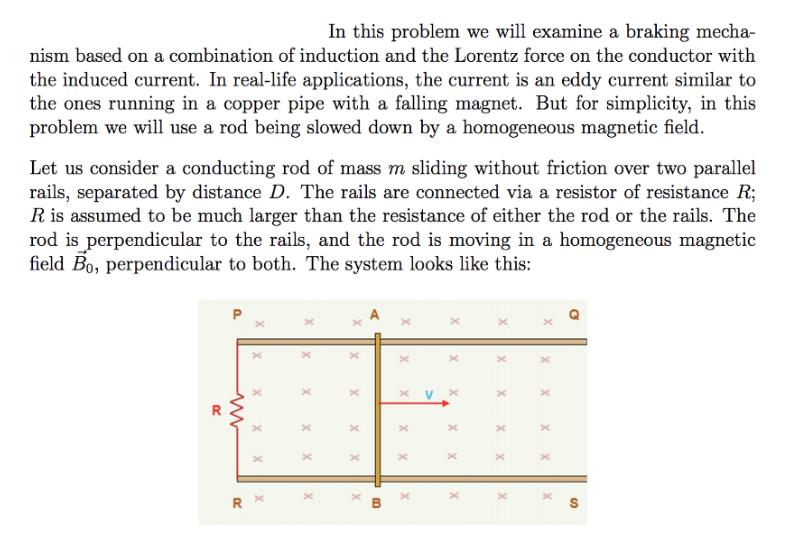
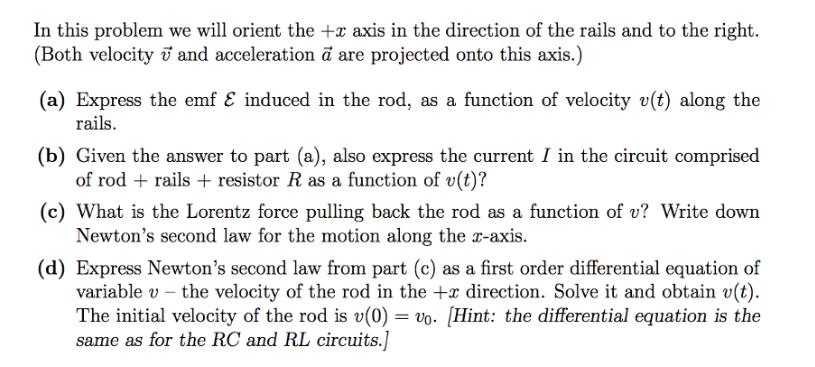
0 In this problem we will examine a braking mecha- nism based on a combination of induction and the Lorentz force on the conductor with the induced current. In real-life applications, the current is an eddy current similar to the ones running in a copper pipe with a falling magnet. But for simplicity, in this problem we will use a rod being slowed down by a homogeneous magnetic field. Let us consider a conducting rod of mass m sliding without friction over two parallel rails, separated by distance D. The rails are connected via a resistor of resistance R; R is assumed to be much larger than the resistance of either the rod or the rails. The rod is perpendicular to the rails, and the rod is moving in a homogeneous magnetic field Bo, perpendicular to both. The system looks like this: X X x x x x x x . X X w R X x x x X X x RX X x x X m x x x S In this problem we will orient the +x axis in the direction of the rails and to the right. (Both velocity and acceleration a are projected onto this axis.) (a) Express the emf & induced in the rod, as a function of velocity v(t) along the rails. (b) Given the answer to part (a), also express the current I in the circuit comprised of rod + rails + resistor R as a function of v(t)? (c) What is the Lorentz force pulling back the rod as a function of v? Write down Newton's second law for the motion along the x-axis. (d) Express Newton's second law from part (c) as a first order differential equation of variable - the velocity of the rod in the +x direction. Solve it and obtain v(t). The initial velocity of the rod is v(0)=vo. [Hint: the differential equation is the same as for the RC and RL circuits.]
Step by Step Solution
There are 3 Steps involved in it
a The emf induced in the rod can be expressed using Faradays law of electromagnetic induction The em... View full answer

Get step-by-step solutions from verified subject matter experts
 Study Help