







Question: 0 {No answer given) (No answer given} The direction of propagation of the wave The orientation of the electric component of the wave The orientation

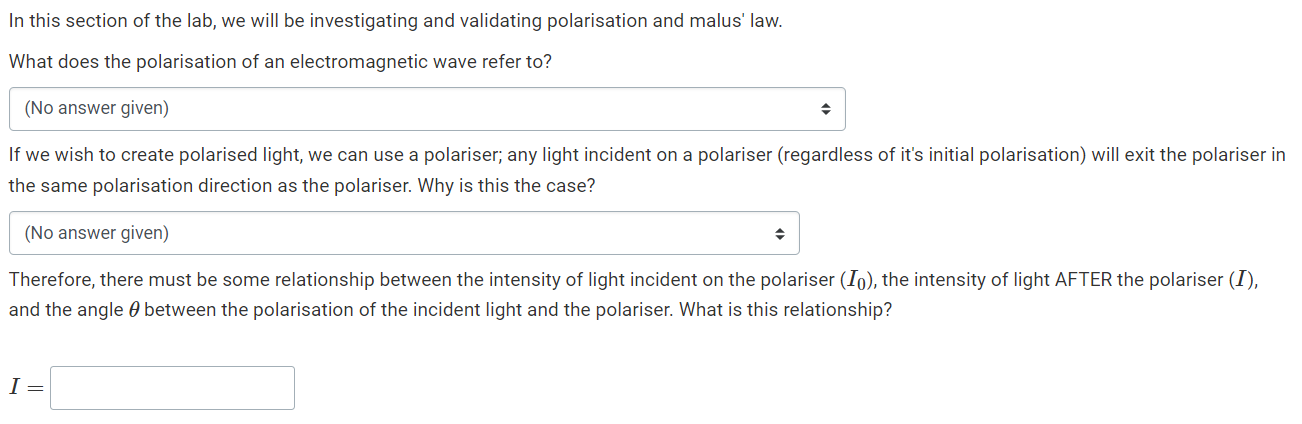

0 {No answer given) (No answer given} The direction of propagation of the wave The orientation of the electric component of the wave The orientation of the magnetic component of the wave The angle between the orientation of the magnetic component and electric component of the wave In this section of the lab, we will be investigating and validating polarisation and malus' law. What does the polarisation of an electromagnetic wave refer to? (No answer given) If we wish to create polarised light, we can use a polariser; any light incident on a polariser (regardless of it's initial polarisation) will exit the polariser in the same polarisation direction as the polariser. Why is this the case? (No answer given) Therefore, there must be some relationship between the intensity of light incident on the polariser (To), the intensity of light AFTER the polariser (I), and the angle 0 between the polarisation of the incident light and the polariser. What is this relationship? I =(No answer given) The polariser only transmits light polarised along it's polarisation axis, and absorbs the rest. riser (Io) The polariser rotates the polarisation of the incident light to match that of the polariser. lationship The polariser acts as a wave generator and creates new EM waves with a certain polarisation
Step by Step Solution
There are 3 Steps involved in it

Get step-by-step solutions from verified subject matter experts
 Study Help