


Question: 00:29 Back Ch. 5 (Case Study).docx International Financial Reporting Standards (IFRS) The current reporting standard for financial statements in the United States is U.S. GAAP

00:29 Back Ch. 5 (Case Study).docx International
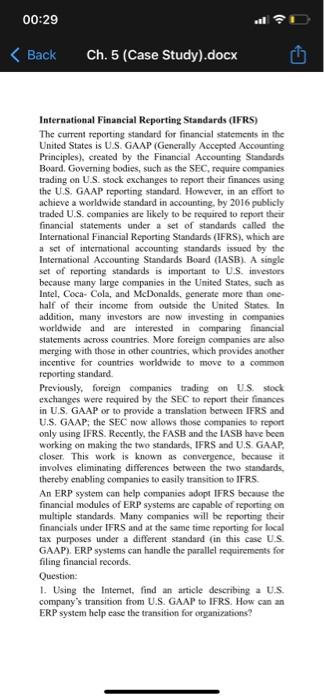
00:29 Back Ch. 5 (Case Study).docx International Financial Reporting Standards (IFRS) The current reporting standard for financial statements in the United States is U.S. GAAP (Generally Accepted Accounting Principles), created by the Financial Accounting Standards Board. Governing bodies, such as the SEC, require companies trading on U.S. stock exchanges to report their finances using the U.S. GAAP reporting standard. However, in an effort to achieve a worldwide standard in accounting, by 2016 publicly traded U.S. companies are likely to be required to report their financial statements under a set of standards called the International Financial Reporting Standards (IFRS), which are a set of international accounting standards issued by the International Accounting Standards Board (IASB). A single set of reporting standards is important to U.S. investors because many large companies in the United States, such as Intel, Coca-Cola, and McDonalds, generate more than one- half of their income from outside the United States. In addition, many investors are now investing in companies worldwide and are interested in comparing financial statements across countries. More foreign companies are also merging with those in other countries, which provides another incentive for countries worldwide to move to a common reporting standard. Previously, foreign companies trading on U.S. stock exchanges were required by the SEC to report their finances in U.S. GAAP or to provide a translation between IFRS and U.S. GAAP; the SEC now allows those companies to report only using IFRS. Recently, the FASB and the IASB have been working on making the two standards, IFRS and U.S. GAAP, closer. This work is known as convergence, because it involves eliminating differences between the two standards, thereby enabling companies to easily transition to IFRS. An ERP system can help companies adopt IFRS because the financial modules of ERP systems are capable of reporting on multiple standards. Many companies will be reporting their financials under IFRS and at the same time reporting for local tax purposes under a different standard (in this case U.S. GAAP). ERP systems can handle the parallel requirements for filing financial records. Question: 1. Using the Internet, find an article describing a U.S. company's transition from U.S. GAAP to IFRS. How can an ERP system help ease the transition for organizations? 00:30 Back Questions (Ch. 6).docx Questions: 1. Suppose you are a manager of Fitter's Accounting and Finance department. What human resources information do you think you would need to effectively manage your Accounting and Finance employees? 2. List the steps in a typical recruiting process. Highlight the steps that involve interaction with the potential job candidate. Identify problems in the process that might lead a candidate to develop a negative opinion of the company. How might an effective information system reduce the potential for these problems? Incorporate into your answer experiences you may have had in looking for a job. 00:30 Back Questions (Ch. 7).docx Questions: 1. Explain the a) Basic flowcharting symbols techniques b) Process model c) process boundaries d) Process mapping e) Event process chain (EPC) 1) Process improvement g) The relationship between ERP implementation and change management 2. Why is it important to understand your current business processes before trying to improve them

Step by Step Solution

There are 3 Steps involved in it

1 Expert Approved Answer
Step: 1 Unlock blur-text-image

Question Has Been Solved by an Expert!

Get step-by-step solutions from verified subject matter experts

Step: 2 Unlock
Step: 3 Unlock

Students Have Also Explored These Related General Management Questions!