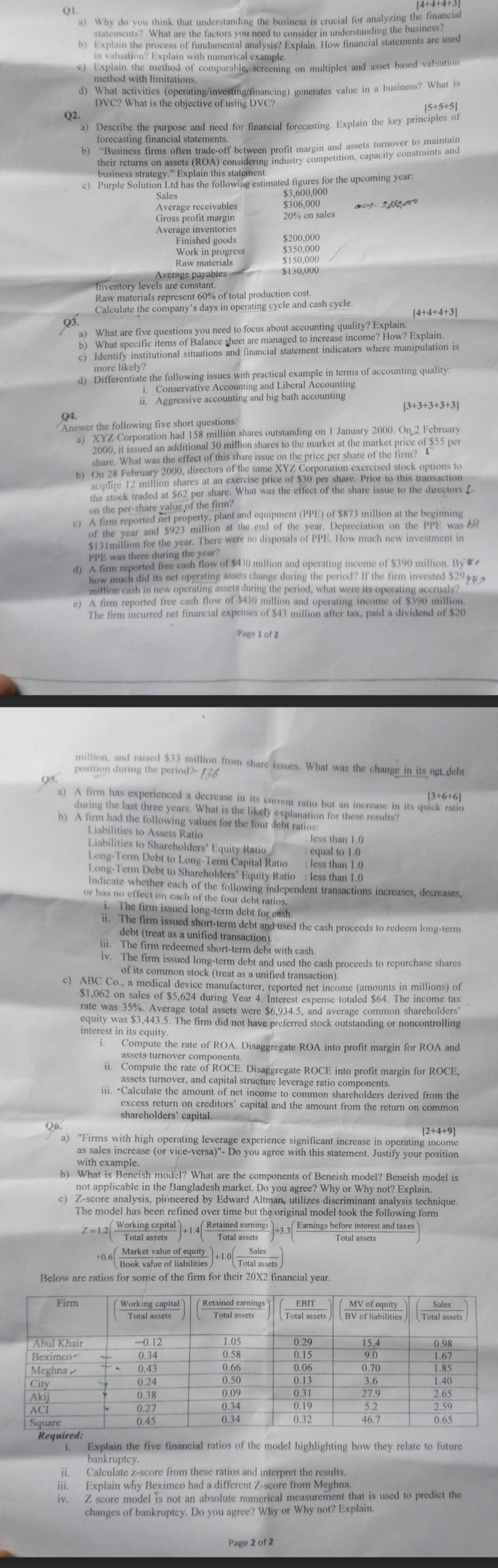
Question: 01. [4+4+4+3) a) Why do you think that understanding the business is crucial for analyzing the financial statements? What are the factors you need to
01. [4+4+4+3) a) Why do you think that understanding the business is crucial for analyzing the financial statements? What are the factors you need to consider in understanding the business? b) Explain the process of fundamental analysis? Explain. How financial statements are used in valuation? Explain with numerical example. ) Explain the method of comparable, screening on multiples and asset based valuation method with limitations. d) What activities (operating/investing/financing) generates value in a business? What is DVC? What is the objective of using DVC? 15+5+5) Q2. a) Describe the purpose and need for financial forecasting. Explain the key principles of forecasting financial statements. b) "Business firms often trade-off between profit margin and assets turnover to maintain their returns on assets (ROA) considering industry competition, capacity constraints and business strategy." Explain this statement. c) Purple Solution Lid has the following estimated figures for the upcoming year: Sales $3,600,000 Average receivables $306,000 way. 2890.000 Gross profit margin 20% on sales Average inventories Finished goods $200,000 Work in progress $350,000 Raw materials $150,000 Average payables $130,000 Inventory levels are constant. Raw materials represent 60% of total production cost. Calculate the company's days in operating cycle and cash cycle. |4+4+4+3] a) What are five questions you need to focus about accounting quality? Explain. b) What specific items of Balance sheet are managed to increase income? How? Explain. c) Identify institutional situations and financial statement indicators where manipulation is more likely? d) Differentiate the following issues with practical example in terms of accounting quality: i. Conservative Accounting and Liberal Accounting ii. Aggressive accounting and big bath accounting (3+3+3+3+3] 04. Answer the following five short questions: a) XYZ Corporation had 158 million shares outstanding on 1 January 2000. On, 2 February 2000, it issued an additional 30 million shares to the market at the market price of $55 per share. What was the effect of this share issue on the price per share of the firm? b) On 28 February 2000, directors of the same XYZ Corporation exercised stock options to acquire 12 million shares at an exercise price of $30 per share. Prior to this transaction the stock traded at $62 per share. What was the effect of the share issue to the directors & on the per-share value of the firm? c) A firm reported net property, plant and equipment (PPE) of $873 million at the beginning of the year and $923 million at the end of the year. Depreciation on the PPE was 297 $131 million for the year. There were no disposals of PPE. How much new investment in PPE was there during the year? d) A firm reported free cash flow of $430 million and operating income of $390 million. By " how much did its net operating assets change during the period? If the firm invested $2952 million cash in new operating assets during the period, what were its operating accruals? e) A firm reported free cash flow of $430 million and operating income of $390 million. The firm incurred net financial expenses of $43 million after tax, paid a dividend of $20 Page 1 of 2 million, and raised $33 million from share issues. What was the change in its net debt position during the period?-(36 a) A firm has experienced a decrease in its current ratio but an increase in its quick ratio 13+6+61 during the last three years. What is the likely explanation for these results? b) A firm had the following values for the four debt ratios: Liabilities to Assets Ratio Liabilities to Shareholders' Equity Ratio : less than 1.0 Long-Term Debt to Long-Term Capital Ratio : equal to 1.0 : less than 1.0 Long-Term Debt to Shareholders' Equity Ratio : less than 1.0 Indicate whether each of the following independent transactions increases, decreases, or has no effect on each of the four debt ratios. i. The firm issued long-term debt for cash. ii. The firm issued short-term debt and used the cash proceeds to redeem long-term debt (treat as a unified transaction). iii. The firm redeemed short-term debt with cash. iv. The firm issued long-term debt and used the cash proceeds to repurchase shares of its common stock (treat as a unified transaction). c) ABC Co., a medical device manufacturer, reported net income (amounts in millions) of $1,062 on sales of $5,624 during Year 4. Interest expense totaled $64. The income tax rate was 35%. Average total assets were $6,934.5, and average common shareholders' equity was $3,443.5. The firm did not have preferred stock outstanding or noncontrolling interest in its equity. i. Compute the rate of ROA. Disaggregate ROA into profit margin for ROA and assets turnover components. ii. Compute the rate of ROCE. Disaggregate ROCE into profit margin for ROCE, assets turnover, and capital structure leverage ratio components. iii. .Calculate the amount of net income to common shareholders derived from the excess return on creditors' capital and the amount from the return on common shareholders' capital. Q6. [2+4+91 "Firms with high operating leverage experience significant increase in operating income as sales increase (or vice-versa)"- Do you agree with this statement. Justify your position with example. b) What is Beneish model? What are the components of Beneish model? Beneish model is not applicable in the Bangladesh market. Do you agree? Why or Why not? Explain. c) Z-score analysis, pioneered by Edward Altman, utilizes discriminant analysis technique. The model has been refined over time but the original model took the following form Z =1.2 Working capital +1.4 Retained earnings 43 3/Earnings before interest and taxes Total assets Total assets Total assets +0.6- Market value of equity Sales (Book value of liabilities ) Total assets Below are ratios for some of the firm for their 20X2 financial year. Firm Working capital Retained earnings EBIT MV of equity Sales Total assets Total assets Total assets ) (BV of liabilities ) Total assets Abul Khair -0.12 1.05 0.29 15.4 0.98 Beximco 0.34 0.58 0.15 90 1.67 Meghna / 0.43 0.66 0.06 0.70 1.85 City 0.24 0.50 0.13 3.6 1.40 Akij 0.38 0.09 0.31 27.9 2.65 ACI 0.27 0.34 0.19 5.2 2.59 Square 0.45 0.34 0.32 46.7 0.65 Required: Explain the five financial ratios of the model highlighting how they relate to future bankruptcy. ii. Calculate z-score from these ratios and interpret the results. iii. Explain why Beximco had a different Z-score from Meghna. iv. Z, score model is not an absolute numerical measurement that is used to predict the changes of bankruptcy. Do you agree? Why or Why not? Explain. Page 2 of 2
Step by Step Solution
There are 3 Steps involved in it
1 Expert Approved Answer
Step: 1 Unlock
Question Has Been Solved by an Expert!
Get step-by-step solutions from verified subject matter experts
Step: 2 Unlock
Step: 3 Unlock
Students Have Also Explored These Related Finance Questions!