







Question: 01: Is the relationship between a main sequence star's temperature and luminosity a direct or inverse relationship? What about the relationship between (B-V) and luminosity?
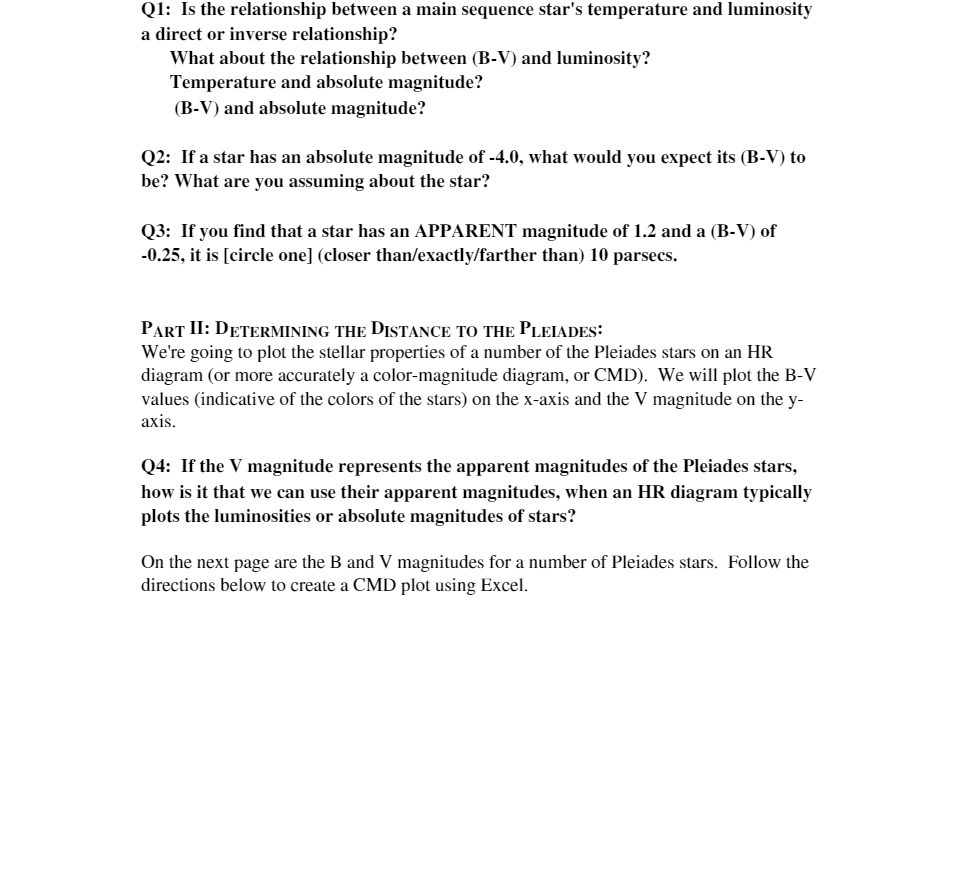
01: Is the relationship between a main sequence star's temperature and luminosity a direct or inverse relationship? What about the relationship between (B-V) and luminosity? Temperature and absolute magnitude? (B-V} and absolute magnitude? 02: If a star has an absolute magnitude of 4.0, what would you expect its (B-V} to be? What are you assuming about the star? Q3: If you find that a star has an APPARENT magnitude of 1.2 and a (B-V} of 41.25., it is [circle one] {closer thanfexactlyffarther than) 10 parsecs. PART 11: DETERMINING THE DISTANCE To THE PLEIAoEs= We're going to plot the stellar properties of a number of the Pleiades stars on an HR diagram {or more accurater a colormagnitude diagram, or CMD}. We will plot the 3H! values (indicative of the colors of the stars) on the xaxis and the V magnitude on the y axis. Q4: If the V magnitude represents the apparent magnitudes of the Pleiades stars, how is it that we can use their apparent magnitudes, when an HR diagram typically plots the luminosities or absolute magnitudes of stars? On the next page are the B and V magnitudes for a number of Pleiades stars. Follow the directions below to create a CMD plot using Excel
Step by Step Solution
There are 3 Steps involved in it

Get step-by-step solutions from verified subject matter experts
 Study Help