







Question: 01 Why does Light bend in Water? 10 Points The fundamental principle to understanding optics: from mirrors to mirages, and from rainbows to the multi-colored
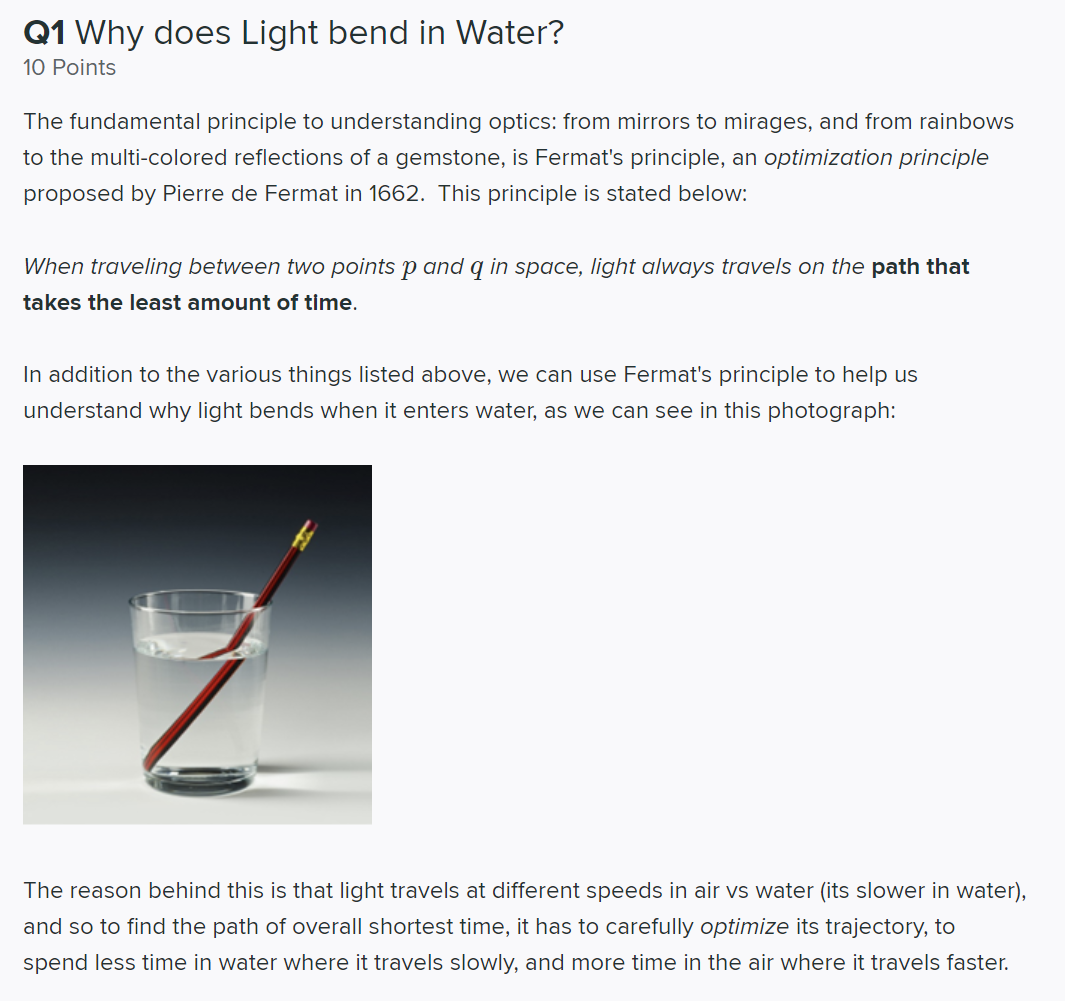
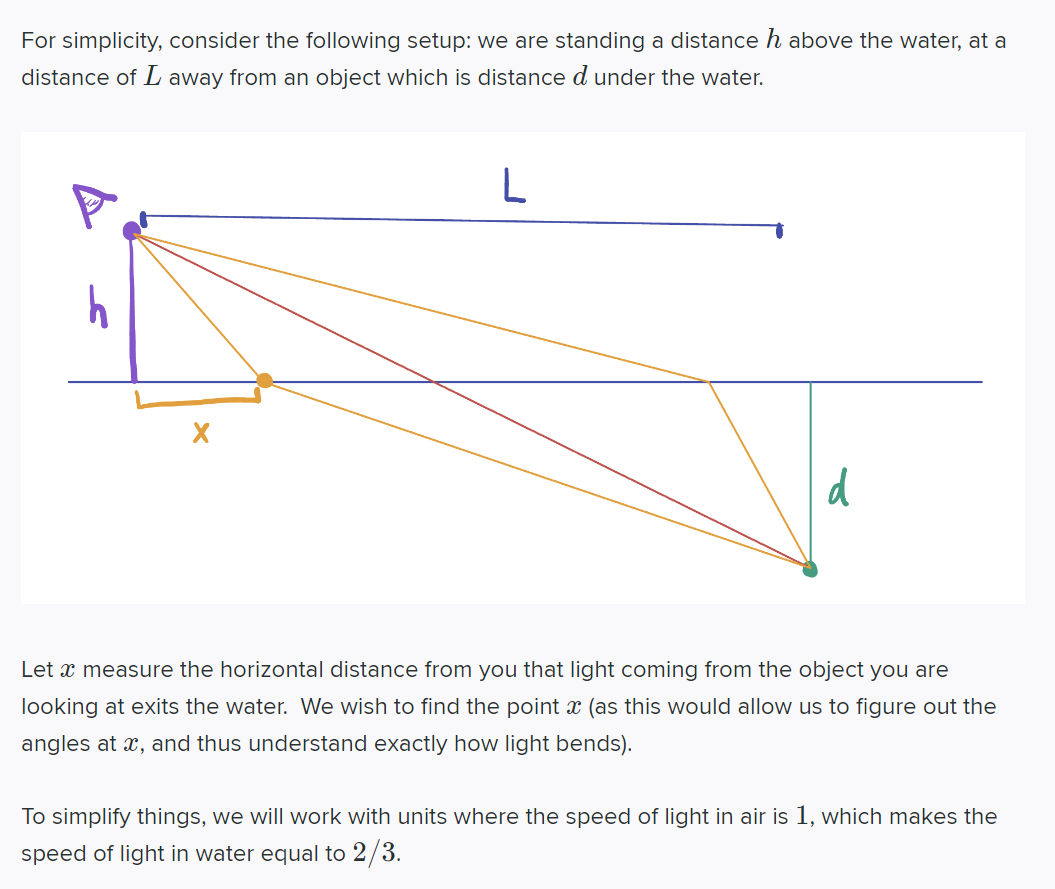
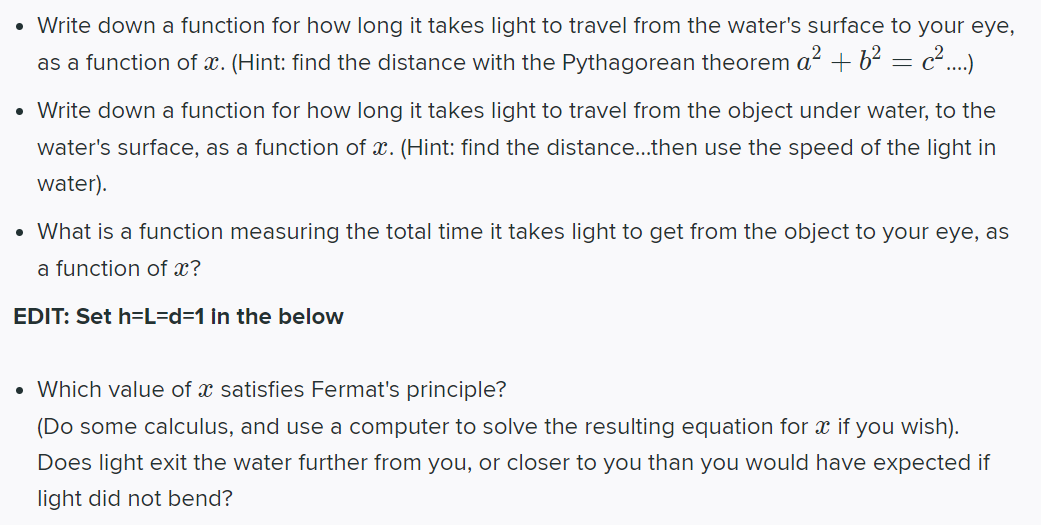
01 Why does Light bend in Water? 10 Points The fundamental principle to understanding optics: from mirrors to mirages, and from rainbows to the multi-colored reflections of a gemstone, is Fermat's principle, an optimization principle proposed by Pierre de Fermat in 1662. This principle is stated below: When troveiing between two points p and q in space, iight oiwoys troveis on the path that takes the least amount of time. In addition to the various things listed above, we can use Fermat's principle to help us understand why light bends when it enters water, as we can see in this photograph: The reason behind this is that light travels at different speeds in air vs water (its slower in water), and so to find the path of overall shortest time, it has to carefully optimize its trajectory, to spend less time in water where it travels slowly, and more time in the air where it travels faster. For simplicity, consider the following setup: we are standing a distance it above the water, at a distance of L away from an object which is distance d under the water. 9' L Let :I: measure the horizontal distance from you that light coming from the object you are looking at exits the water. We wish to find the point 3: [as this would allow us to figure out the angles at m, and thus understand exactly how light bends). To simplify things, we will work with units where the speed of light in air is 1, which makes the speed of light in water equal to 2/3. - Write down a function for how long it takes light to travel from the water's surface to your eye, 2 ....) - Write down a function for how long it takes light to travel from the object under water, to the as a function of SB. (Hint: find the distance with the Pythagorean theorem {12 + 52 = c water's surface, as a function of :L'. (Hint: find the distance...then use the speed ofthe light in water). - What is a function measuring the total time it takes light to get from the object to your eye, as a function of m? EDIT: Set h=L=d=1 In the below - Which value of :1? satisfies Fermat's principle? (Do some calculus, and use a computer to solve the resulting equation for it: if you wish). Does light exit the water further from you, or closer to you than you would have expected if light did not bend
Step by Step Solution
There are 3 Steps involved in it

Get step-by-step solutions from verified subject matter experts
 Study Help