







Question: 0.5 = 1. Suppose that there are only two countries, Poundland and Dollarland. The currency used in Poundland is called pound (denoted by ), and
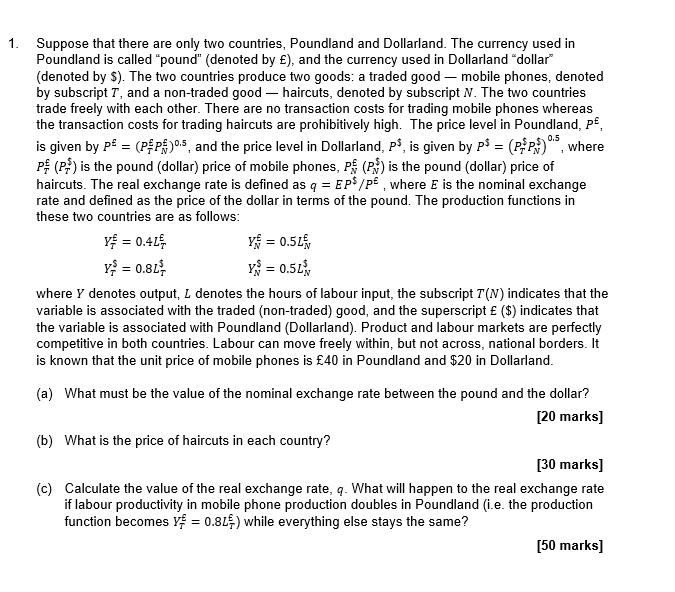
0.5 = 1. Suppose that there are only two countries, Poundland and Dollarland. The currency used in Poundland is called "pound" (denoted by ), and the currency used in Dollarland "dollar (denoted by $). The two countries produce two goods: a traded good mobile phones, denoted by subscript 7, and a non-traded good haircuts, denoted by subscript N. The two countries trade freely with each other. There are no transaction costs for trading mobile phones whereas the transaction costs for trading haircuts are prohibitively high. The price level in Poundland, PE, is given by pf = (PPS)0.5, and the price level in Dollarland, PS, is given by P$ = (PP), where PE (P) is the pound (dollar) price of mobile phones, P (P) is the pound (dollar) price of haircuts. The real exchange rate is defined as q = EPS/P, where E is the nominal exchange = E rate and defined as the price of the dollar in terms of the pound. The production functions in these two countries are as follows: Y = 0.42 Yf = 0.52 Y = 0.81 Y = 0.5L where y denotes output, L denotes the hours of labour input, the subscript T(N) indicates that the variable is associated with the traded (non-traded) good, and the superscript ($) indicates that the variable is associated with Poundland (Dollarland). Product and labour markets are perfectly competitive in both countries. Labour can move freely within, but not across, national borders. It is known that the unit price of mobile phones is 40 in Poundland and $20 in Dollarland. = = (a) What must be the value of the nominal exchange rate between the pound and the dollar? [20 marks] (b) What is the price of haircuts in each country? [30 marks] (c) Calculate the value of the real exchange rate, q. What will happen to the real exchange rate if labour productivity in mobile phone production doubles in Poundland (i.e. the production function becomes y = 0.82) while everything else stays the same? [50 marks] 0.5 = 1. Suppose that there are only two countries, Poundland and Dollarland. The currency used in Poundland is called "pound" (denoted by ), and the currency used in Dollarland "dollar (denoted by $). The two countries produce two goods: a traded good mobile phones, denoted by subscript 7, and a non-traded good haircuts, denoted by subscript N. The two countries trade freely with each other. There are no transaction costs for trading mobile phones whereas the transaction costs for trading haircuts are prohibitively high. The price level in Poundland, PE, is given by pf = (PPS)0.5, and the price level in Dollarland, PS, is given by P$ = (PP), where PE (P) is the pound (dollar) price of mobile phones, P (P) is the pound (dollar) price of haircuts. The real exchange rate is defined as q = EPS/P, where E is the nominal exchange = E rate and defined as the price of the dollar in terms of the pound. The production functions in these two countries are as follows: Y = 0.42 Yf = 0.52 Y = 0.81 Y = 0.5L where y denotes output, L denotes the hours of labour input, the subscript T(N) indicates that the variable is associated with the traded (non-traded) good, and the superscript ($) indicates that the variable is associated with Poundland (Dollarland). Product and labour markets are perfectly competitive in both countries. Labour can move freely within, but not across, national borders. It is known that the unit price of mobile phones is 40 in Poundland and $20 in Dollarland. = = (a) What must be the value of the nominal exchange rate between the pound and the dollar? [20 marks] (b) What is the price of haircuts in each country? [30 marks] (c) Calculate the value of the real exchange rate, q. What will happen to the real exchange rate if labour productivity in mobile phone production doubles in Poundland (i.e. the production function becomes y = 0.82) while everything else stays the same? [50 marks]
Step by Step Solution
There are 3 Steps involved in it

Get step-by-step solutions from verified subject matter experts
 Study Help