







Question: 0.7 In Section 10.7.1 we questioned whether the linear relationship between receipts, price, and advertising expenditure is likely to be realistic and suggested instead a
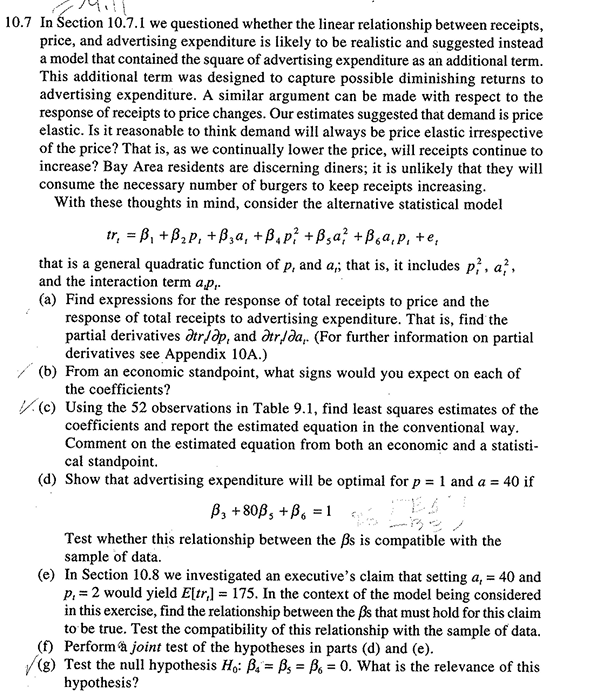
0.7 In Section 10.7.1 we questioned whether the linear relationship between receipts, price, and advertising expenditure is likely to be realistic and suggested instead a model that contained the square of advertising expenditure as an additional term. This additional term was designed to capture possible diminishing returns to advertising expenditure. A similar argument can be made with respect to the response of receipts to price changes. Our estimates suggested that demand is price elastic. Is it reasonable to think demand will always be price elastic irrespective of the price? That is, as we continually lower the price, will receipts continue to increase? Bay Area residents are discerning diners; it is unlikely that they will consume the necessary number of burgers to keep receipts increasing. With these thoughts in mind, consider the alternative statistical model trt=1+2pt+3at+4pt2+5at2+6atpt+et that is a general quadratic function of pt and at; that is, it includes pt2,at2, and the interaction term atpr. (a) Find expressions for the response of total receipts to price and the response of total receipts to advertising expenditure. That is, find the partial derivatives trl/pt and trt/ar. (For further information on partial derivatives see Appendix 10A.) (b) From an economic standpoint, what signs would you expect on each of the coefficients? 1/. (c) Using the 52 observations in Table 9.1, find least squares estimates of the coefficients and report the estimated equation in the conventional way. Comment on the estimated equation from both an economic and a statistical standpoint. (d) Show that advertising expenditure will be optimal for p=1 and a=40 if 3+805+6=1 Test whether this relationship between the s is compatible with the sample of data. (e) In Section 10.8 we investigated an executive's claim that setting at=40 and pt=2 would yield E[trt]=175. In the context of the model being considered in this exercise, find the relationship between the s that must hold for this claim to be true. Test the compatibility of this relationship with the sample of data. (f) Performa joint test of the hypotheses in parts (d) and (e). (g) Test the null hypothesis H0:4=5=6=0. What is the relevance of this hypothesis? 0.7 In Section 10.7.1 we questioned whether the linear relationship between receipts, price, and advertising expenditure is likely to be realistic and suggested instead a model that contained the square of advertising expenditure as an additional term. This additional term was designed to capture possible diminishing returns to advertising expenditure. A similar argument can be made with respect to the response of receipts to price changes. Our estimates suggested that demand is price elastic. Is it reasonable to think demand will always be price elastic irrespective of the price? That is, as we continually lower the price, will receipts continue to increase? Bay Area residents are discerning diners; it is unlikely that they will consume the necessary number of burgers to keep receipts increasing. With these thoughts in mind, consider the alternative statistical model trt=1+2pt+3at+4pt2+5at2+6atpt+et that is a general quadratic function of pt and at; that is, it includes pt2,at2, and the interaction term atpr. (a) Find expressions for the response of total receipts to price and the response of total receipts to advertising expenditure. That is, find the partial derivatives trl/pt and trt/ar. (For further information on partial derivatives see Appendix 10A.) (b) From an economic standpoint, what signs would you expect on each of the coefficients? 1/. (c) Using the 52 observations in Table 9.1, find least squares estimates of the coefficients and report the estimated equation in the conventional way. Comment on the estimated equation from both an economic and a statistical standpoint. (d) Show that advertising expenditure will be optimal for p=1 and a=40 if 3+805+6=1 Test whether this relationship between the s is compatible with the sample of data. (e) In Section 10.8 we investigated an executive's claim that setting at=40 and pt=2 would yield E[trt]=175. In the context of the model being considered in this exercise, find the relationship between the s that must hold for this claim to be true. Test the compatibility of this relationship with the sample of data. (f) Performa joint test of the hypotheses in parts (d) and (e). (g) Test the null hypothesis H0:4=5=6=0. What is the relevance of this hypothesis
Step by Step Solution
There are 3 Steps involved in it

Get step-by-step solutions from verified subject matter experts
 Study Help