







Question: 09:33 N NNOO N 40% MATH133 - Unit 3 Point-values: Question Point-value You earned Comments 20 2 20 3 20 4 20 5 20 Total
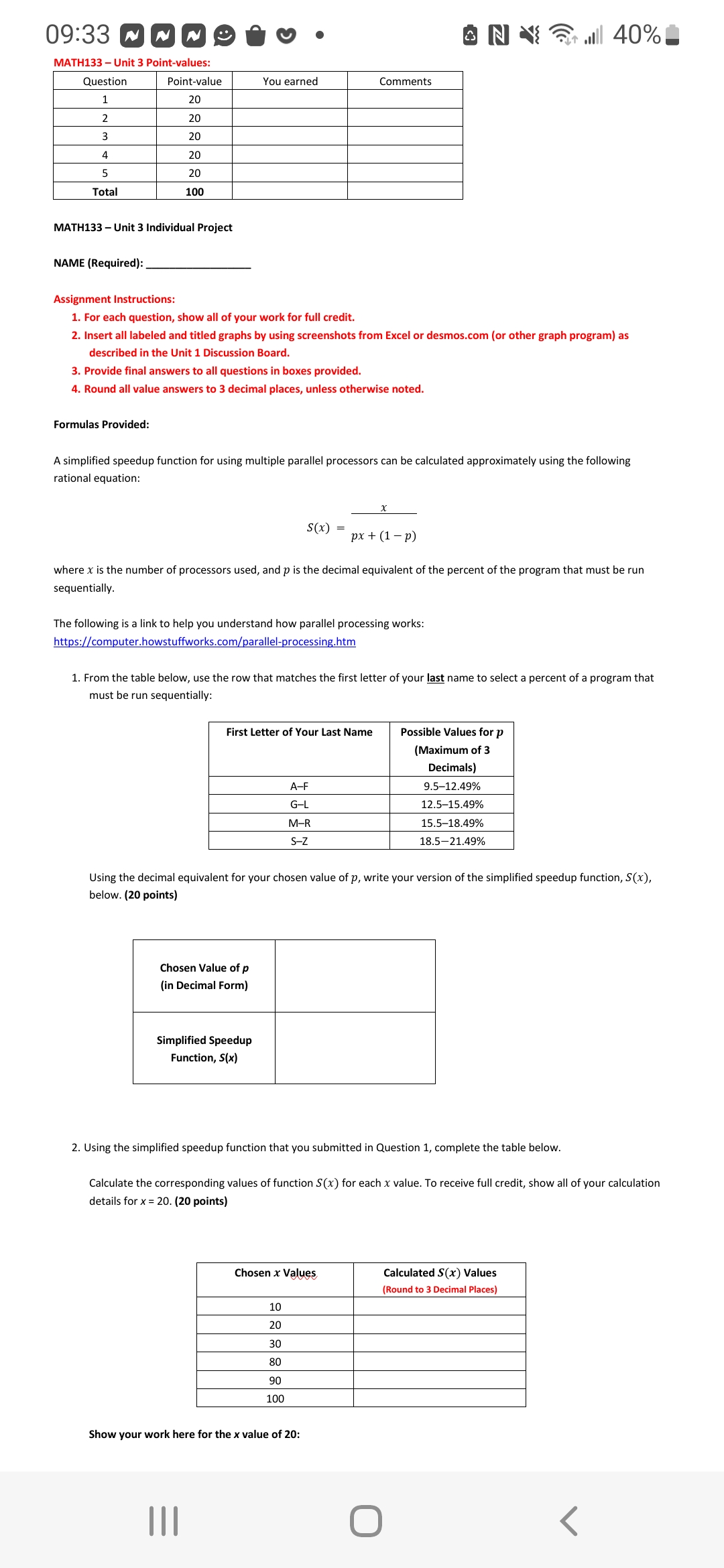
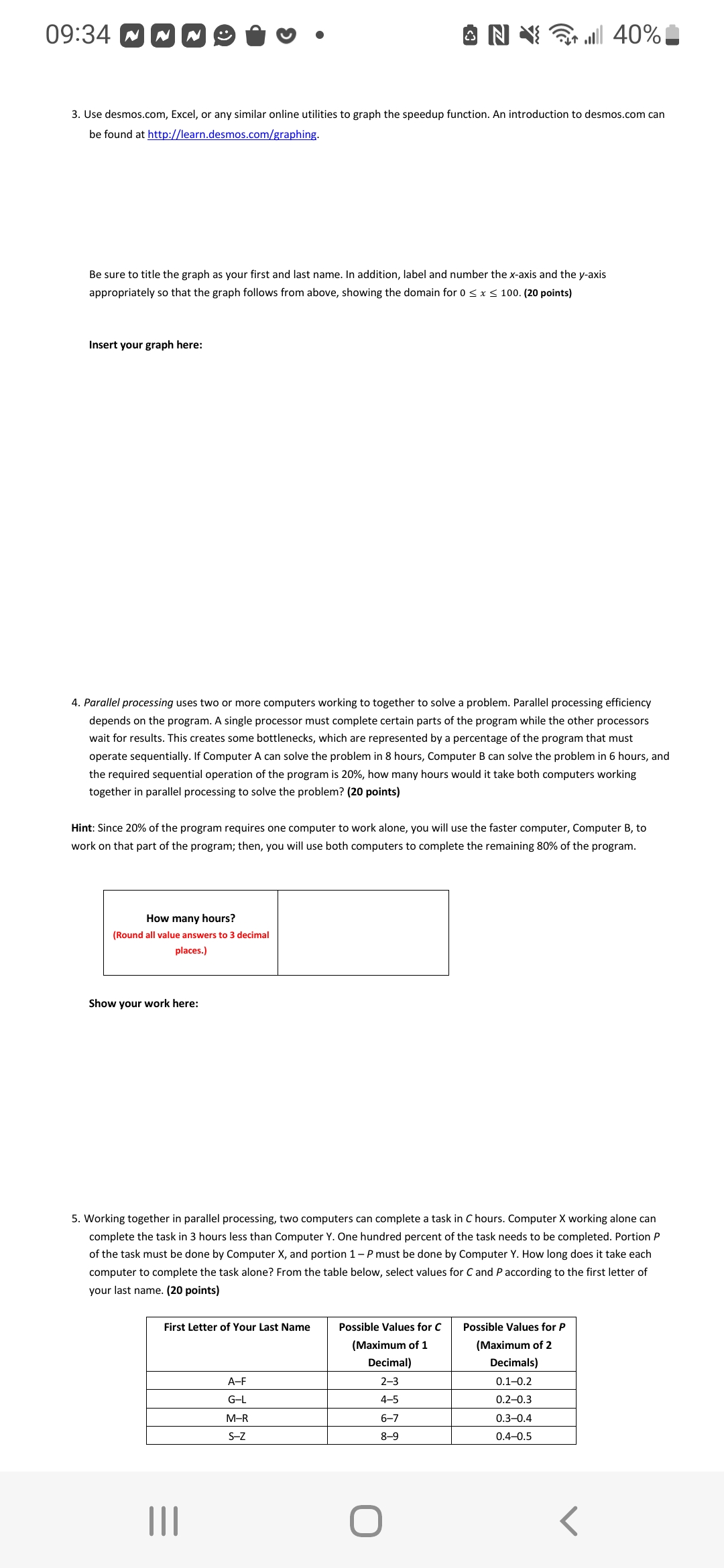
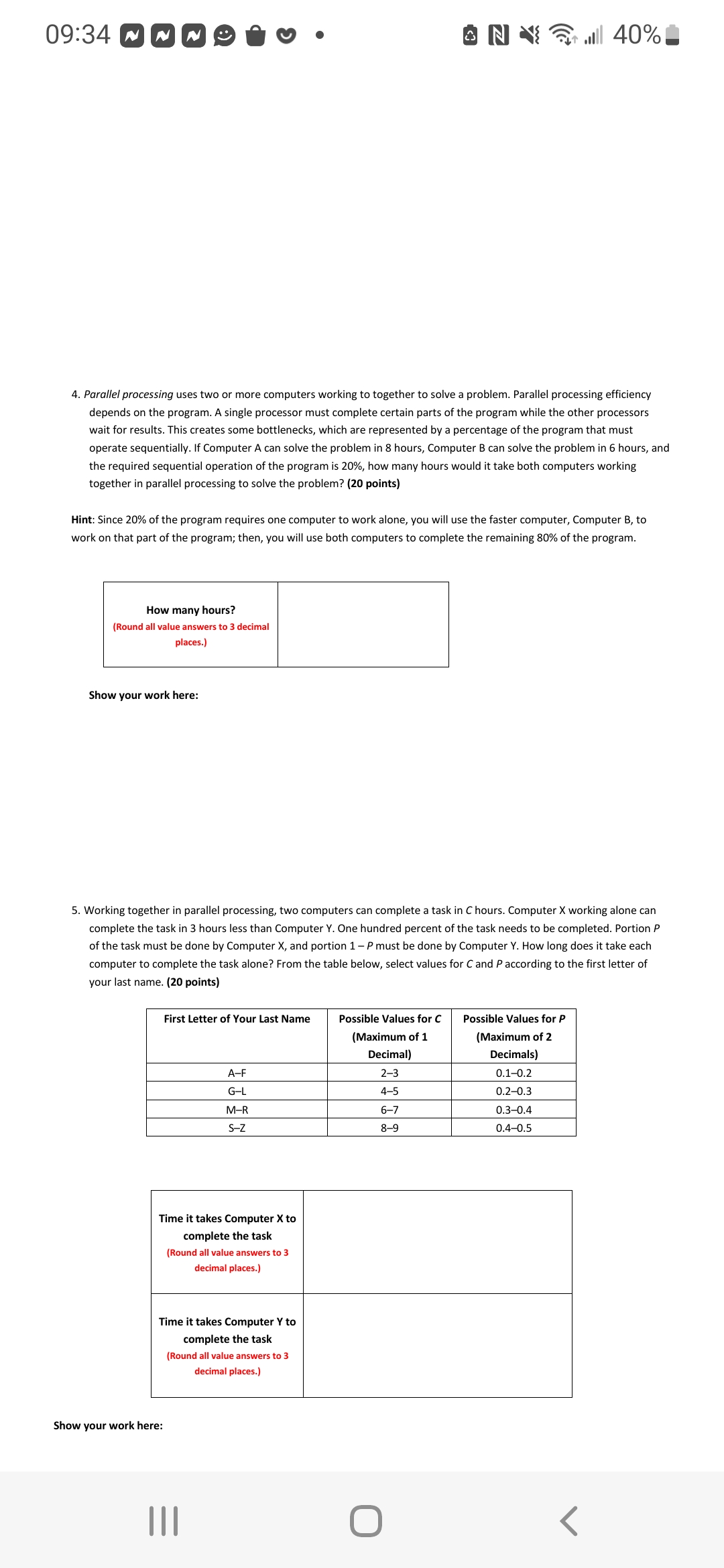
09:33 N NNOO N 40% MATH133 - Unit 3 Point-values: Question Point-value You earned Comments 20 2 20 3 20 4 20 5 20 Total 100 MATH133 - Unit 3 Individual Project NAME (Required): Assignment Instructions: 1. For each question, show all of your work for full credit. 2. Insert all labeled and titled graphs by using screenshots from Excel or desmos.com (or other graph program) as described in the Unit 1 Discussion Board. 3. Provide final answers to all questions in boxes provided. 4. Round all value answers to 3 decimal places, unless otherwise noted. Formulas Provided: A simplified speedup function for using multiple parallel processors can be calculated approximately using the following rational equation: S (x ) = px + (1 - p) where x is the number of processors used, and p is the decimal equivalent of the percent of the program that must be run sequentially. The following is a link to help you understand how parallel processing works: https://computer.howstuffworks.com/parallel-processing.htm 1. From the table below, use the row that matches the first letter of your last name to select a percent of a program that must be run sequentially: First Letter of Your Last Name Possible Values for p (Maximum of 3 Decimals A-F 9.5-12.49% G-L 12.5-15.49% M-R 15.5-18.49% S - Z 18.5-21.49% Using the decimal equivalent for your chosen value of p, write your version of the simplified speedup function, S(x), below. (20 points) Chosen Value of p (in Decimal Form) Simplified Speedup Function, S(x) 2. Using the simplified speedup function that you submitted in Question 1, complete the table below. Calculate the corresponding values of function S(x) for each x value. To receive full credit, show all of your calculation details for x = 20. (20 points) Chosen x Values Calculated S(x) Values (Round to 3 Decimal Places) 10 20 30 80 90 100 Show your work here for the x value of 20: O0934 out: 9 i 9 IE] Ni nd\" 40%| 3. Use desmoscom, Excel, or any similar online utilities to graph the speedup function. An introduction to desmos.com can befound athtt : learn.desmos.com ra hin . Be sure to title the graph as your first and last name. In addition, label and number the xeaxis and the yards appropriately so that the graph follows from above, showing the domain for u S x s 100. (20 points) Insert your graph here: 4. Parallel processing uses two or more computers working to together to solve a problem. Parallel processing efciency depends on the program. A single processor must complete certain parts of the program while the other processors wait for results. This creates some bottlenecks, which are represented by a percentage of the program that must operate sequentially. If Computer A can solve the problem in 8 hours, Computer B can solve the problem in 6 hours, and the required sequential operation of the program is 20%, how many hours would it take both computers working together in parallel processing to solve the problem? (10 points) HIM: Since 20% of the program requires one computer to work alone, you will use the faster computer, Computer B, to work on that part of the program,- then, you will use both computers to complete the remaining 80% of the program. How many hours? (Round all value answers to 3 decimal places.) Show your work here: 5. Working together in parallel processing, two computers can complete a task in C hours. Computer X working alone can complete the task in 3 hours less than Computer 'l'. One hundred percent ofthe task needs to be completed. Portion P of the task must be done by Computer X, and portion 1 P must he clone by Computer Y. How long does it take each computer to complete the task alone? From the table below, select values for C and P according to the first letter of your last name. (20 points) First Letter of Your last Name Posslble Values for E Posslhle Values for P (Maxlmum of 1 (Maximum of 1 Decimal] Decimals] AF 23 0.10.2 GL 45 0.20.3 MR 6-7 0.30.4 52 89 0.40.5 Ill 0
Step by Step Solution
There are 3 Steps involved in it

Get step-by-step solutions from verified subject matter experts
 Study Help