







Question: 0C Once released at Earth's surface, a molecule diffuses upward through the troposphere and at any time may be removed by chemical reaction with other
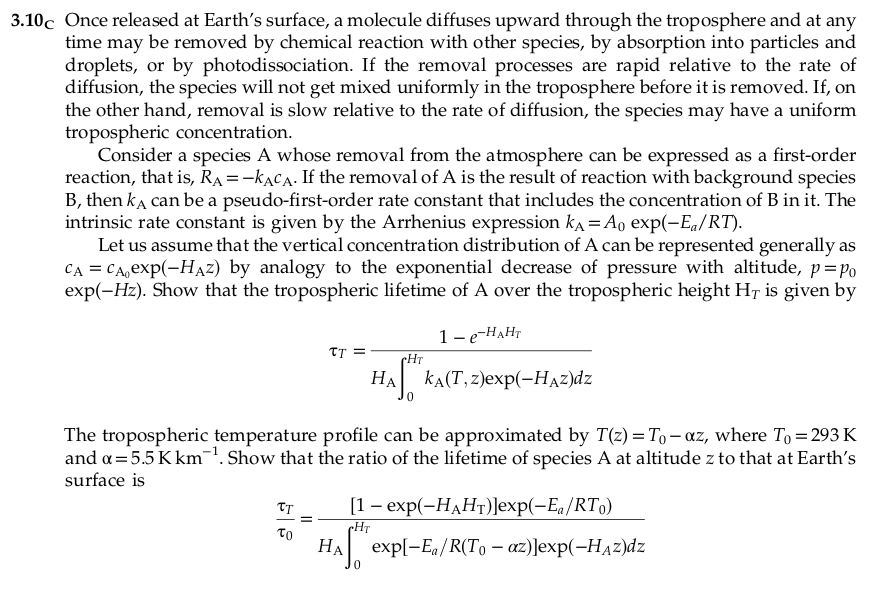
0C Once released at Earth's surface, a molecule diffuses upward through the troposphere and at any time may be removed by chemical reaction with other species, by absorption into particles and droplets, or by photodissociation. If the removal processes are rapid relative to the rate of diffusion, the species will not get mixed uniformly in the troposphere before it is removed. If, on the other hand, removal is slow relative to the rate of diffusion, the species may have a uniform tropospheric concentration. Consider a species A whose removal from the atmosphere can be expressed as a first-order reaction, that is, RA=kAcA. If the removal of A is the result of reaction with background species B, then kA can be a pseudo-first-order rate constant that includes the concentration of B in it. The intrinsic rate constant is given by the Arrhenius expression kA=A0exp(Ea/RT). Let us assume that the vertical concentration distribution of A can be represented generally as cA=cA0exp(HAz) by analogy to the exponential decrease of pressure with altitude, p=p0 exp(Hz). Show that the tropospheric lifetime of A over the tropospheric height HT is given by T=HA0HTkA(T,z)exp(HAz)dz1eHAHT The tropospheric temperature profile can be approximated by T(z)=T0z, where T0=293K and =5.5Kkm1. Show that the ratio of the lifetime of species A at altitude z to that at Earth's surface is 0T=HA0HTexp[Ea/R(T0z)]exp(HAz)dz[1exp(HAHT)]exp(Ea/RT0)
Step by Step Solution
There are 3 Steps involved in it

Get step-by-step solutions from verified subject matter experts
 Study Help