







Question: 1. Solve the following: a. State the Nyquist sampling theorem. b. Consider the analog signal x(t) = 2cos (200t) i. Determine the minimum sampling
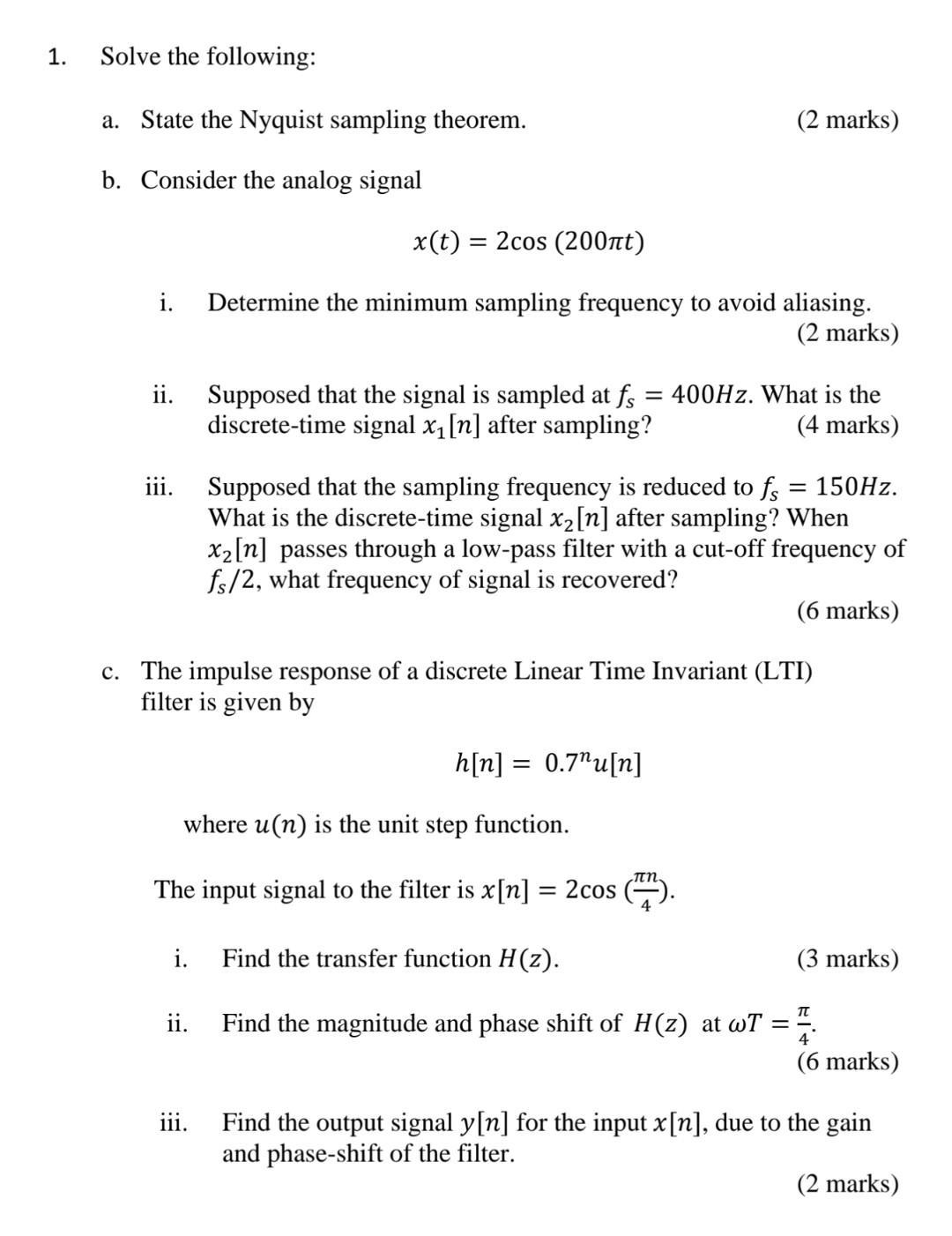
1. Solve the following: a. State the Nyquist sampling theorem. b. Consider the analog signal x(t) = 2cos (200t) i. Determine the minimum sampling frequency to avoid aliasing. (2 marks) ii. iii. i. Supposed that the signal is sampled at fs discrete-time signal x [n] after sampling? ii. c. The impulse response of a discrete Linear Time Invariant (LTI) filter is given by h[n] where u(n) is the unit step function. The input signal to the filter is x[n] = 2cos Find the transfer function H(z). Find the magnitude and phase shift of H(z) at wT iii. Supposed that the sampling frequency is reduced to fs = 150Hz. What is the discrete-time signal x [n] after sampling? When x [n] passes through a low-pass filter with a cut-off frequency of fs/2, what frequency of signal is recovered? (6 marks) (2 marks) = 400Hz. What is the (4 marks) = 0.7"u[n] (3 marks) TT 4 (6 marks) Find the output signal y[n] for the input x[n], due to the gain and phase-shift of the filter. (2 marks)
Step by Step Solution
3.49 Rating (169 Votes )
There are 3 Steps involved in it
The Nyquist Sampling Theorem states that in order to perfectly reconstruct a continuoustime signal f... View full answer

Get step-by-step solutions from verified subject matter experts
 Study Help