



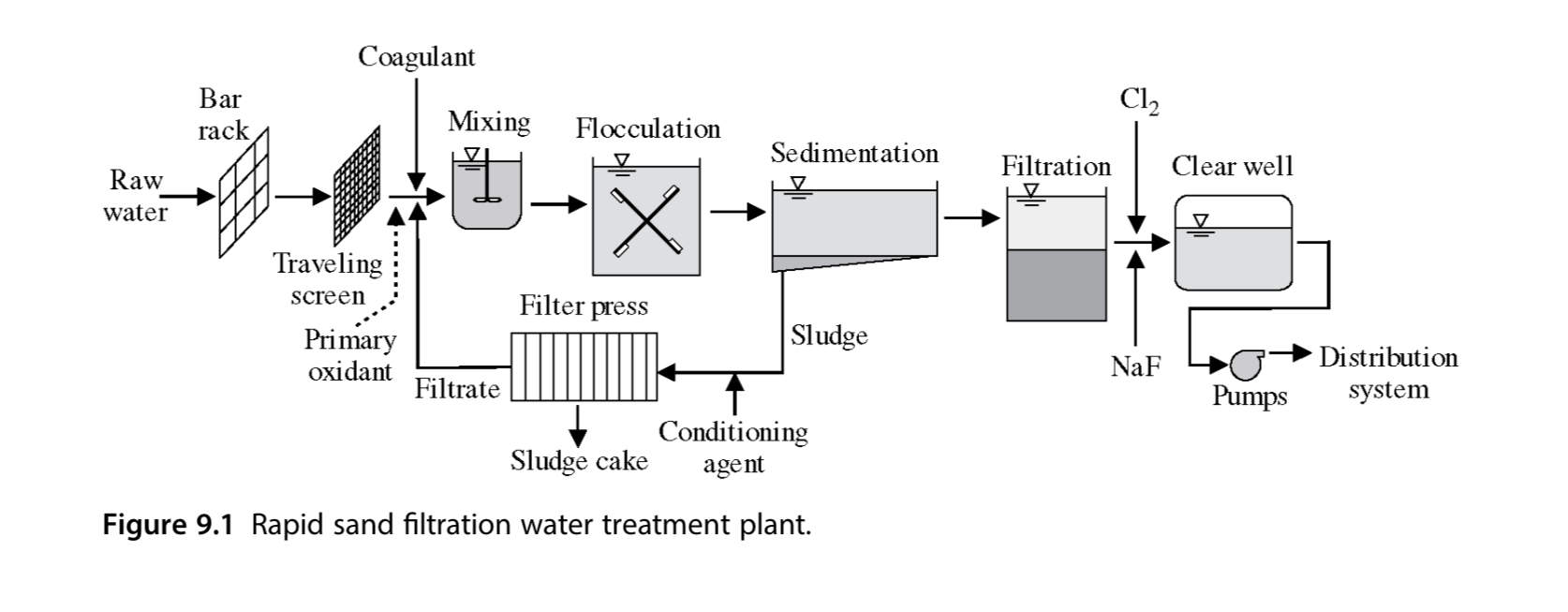
Question: 1 0 . 3 5 Perform a mass balance for a water treatment plant with the treatment sequence indicated in Figure 9 . 1 .
Perform a mass balance for a water treatment plant with the treatment sequence indicated in Figure Ignore screenings removed from the bar rack and traveling screen. Use the following information.
Influent flow influent SS
Assume that the sg of all chemical and other solids is
Alum is the coagulant added to achieve a concentration of The concentration of the alum feed is There is sufficient alkalinity in the water to react with the alum and form the precipitate which does not hydrate.
The sedimentation basin removes of the SS
The underflow from the sedimentation basin contains SS at
The remainder of the suspended particles are removed in the rapid sand filter.
The filter backwash uses of the product water from the filter. The filter backwash water is returned ahead of the mixing unit. Assume that the backwash flow rate is continuous.
Chlorine is added at to the effluent before discharge to the clear well. Fluoride is added as NaF from a dry feeder to achieve a concentration of in the effluent before discharge to the clear well.
The vacuum filter achieves a cake content of solids by weight. The vacuum captures of the influent solids. A polymer is added to the influent sludge at a dose rate of kg polymertonne of solids. The concentration of polymer in the polymer feed is
Determine the flows and SS concentrations before and after each unit. Also determine the mass feed rates of chlorine and sodium fluoride to be added on a daily basis.
Figure Rapid sand filtration water treatment plant.
Step by Step Solution
There are 3 Steps involved in it
1 Expert Approved Answer
Step: 1 Unlock

Question Has Been Solved by an Expert!
Get step-by-step solutions from verified subject matter experts
Step: 2 Unlock
Step: 3 Unlock