







Question: 1 0 . 3 - 7 . * A company will soon be introducing a new product into a very competitive market and is currently
A company will soon be introducing a new product into
a very competitive market and is currently planning its marketing
strategy. The decision has been made to introduce the product in
three phases. Phase will feature making a special introductory of
fer of the product to the public at a greatly reduced price to attract
firsttime buyers. Phase will involve an intensive advertising cam
paign to persuade these firsttime buyers to continue purchasing the
product at a regular price. It is known that another company will
be introducing a new competitive product at about the time that
phase will end. Therefore, phase will involve a followup ad
vertising and promotion campaign to try to keep the regular pur
chasers from switching to the competitive product.
A total of $ million has been budgeted for this marketing
campaign. The problem now is to determine how to allocate this
money most effectively to the three phases. Let denote the initial
share of the market expressed as a percentage attained in phase
the fraction of this market share that is retained in phase and
the fraction of the remaining market share that is retained in
phase Use dynamic programming to determine how to allocate
the $ million to maximize the final share of the market for the new
product, ie to maximize
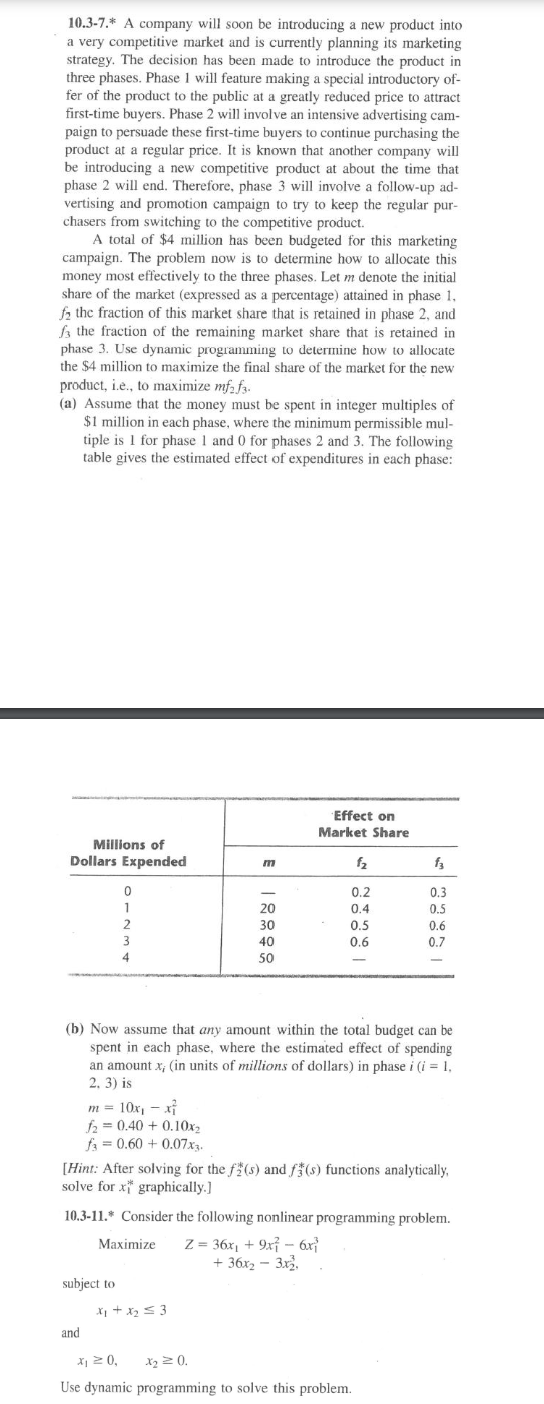
a Assume that the money must be spent in integer multiples of
$ million in each phase, where the minimum permissible mul
tiple is for phase and for phases and The following
table gives the estimated effect of expenditures in each phase:
b Now assume that any amount within the total budget can be
spent in each phase, where the estimated effect of spending
an amount in units of millions of dollars in phase
is
Hint: After solving for the and functions analytically,
solve for graphically.
Consider the following nonlinear programming problem.
Maximize
subject to
and
Use dynamic programming to solve this problem.
Step by Step Solution
There are 3 Steps involved in it
1 Expert Approved Answer
Step: 1 Unlock

Question Has Been Solved by an Expert!
Get step-by-step solutions from verified subject matter experts
Step: 2 Unlock
Step: 3 Unlock
 Study Help