







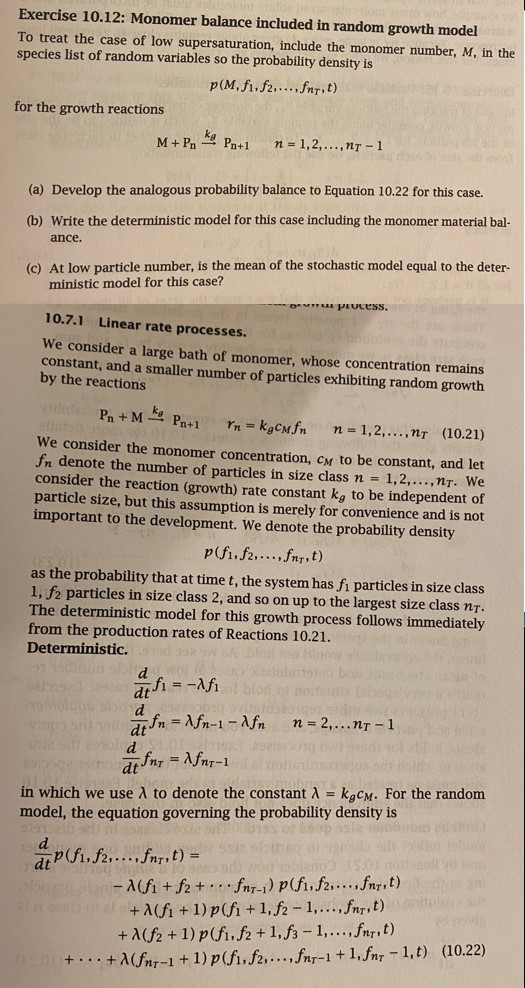
Question: 1 0 . 7 . 1 Linear rate processes. We consider a large bath of monomer, whose concentration remains constant, and a smaller number of
Linear rate processes.
We consider a large bath of monomer, whose concentration remains
constant, and a smaller number of particles exhibiting random growth
by the reactions
dots,
We consider the monomer concentration, to be constant, and let
denote the number of particles in size class dots, We
consider the reaction growth rate constant to be independent of
particle size, but this assumption is merely for convenience and is not
important to the development. We denote the probability density
dots,
as the probability that at time the system has particles in size class
particles in size class and so on up to the largest size class
The deterministic model for this growth process follows immediately
from the production rates of Reactions
Deterministic.
in which we use to denote the constant For the random
model, the equation governing the probability density is
dots,
dots,
dots,
dots,
cdotsdots,
Step by Step Solution
There are 3 Steps involved in it
1 Expert Approved Answer
Step: 1 Unlock

Question Has Been Solved by an Expert!
Get step-by-step solutions from verified subject matter experts
Step: 2 Unlock
Step: 3 Unlock
 Study Help