



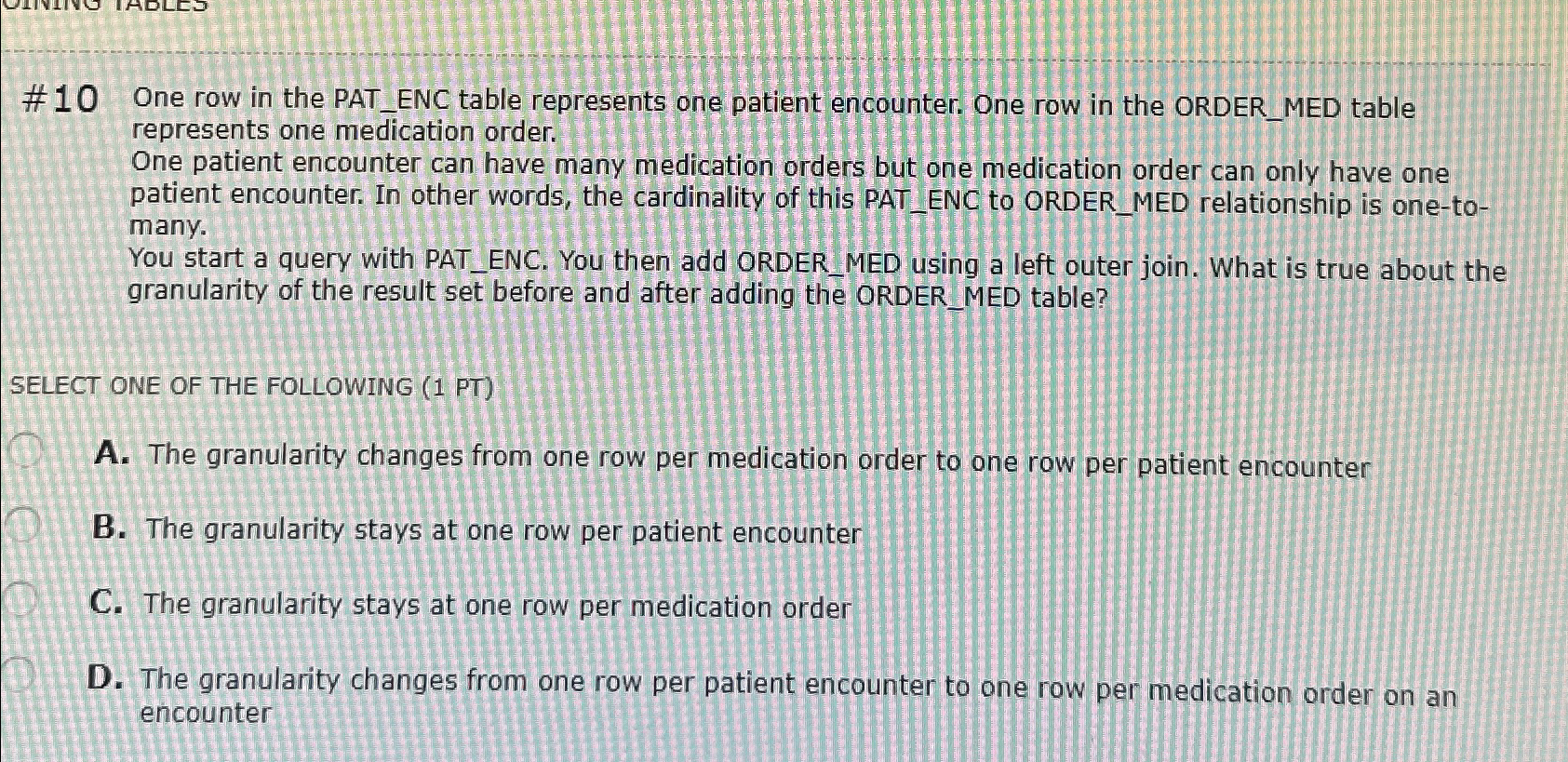
Question: # 1 0 One row in the PAT _ ENC table represents one patient encounter. One row in the ORDER _ MED table represents one
# One row in the PATENC table represents one patient encounter. One row in the ORDERMED table represents one medication order.
One patient encounter can have many medication orders but one medication order can only have one patient encounter. In other words, the cardinality of this PATENC to ORDERMED relationship is onetomany.
You start a query with PATENC. You then add ORDERMED using a left outer join. What is true about the granularity of the result set before and after adding the ORDERMED table?
SELECT ONE OF THE FOLLOWING PT
A The granularity changes from one row per medication order to one row per patient encounter
B The granularity stays at one row per patient encounter
C The granularity stays at one row per medication order
D The granularity changes from one row per patient encounter to one row per medication order on an encounter
Step by Step Solution
There are 3 Steps involved in it
1 Expert Approved Answer
Step: 1 Unlock

Question Has Been Solved by an Expert!
Get step-by-step solutions from verified subject matter experts
Step: 2 Unlock
Step: 3 Unlock