



Question: ( 1 0 points ) a . What is the underlying assumption for setting a single objective of value maximization for a firm? b .
points
a What is the underlying assumption for setting a single objective of value maximization
for a firm?
b Is value maximization a proper objective that benefits society as a whole or a flawed
one? How do the agency theory's and the stakeholder theory's answers to this question
differ?
c Can the modern fim have multiple objectives? If so what is the critical information
needed for achieving the goals of the firm? If not, why?
d Please discuss the approaches of the agency theory and the stakeholder theory to the
modern firm's objectives in light of the increased focus on ESG and CSR
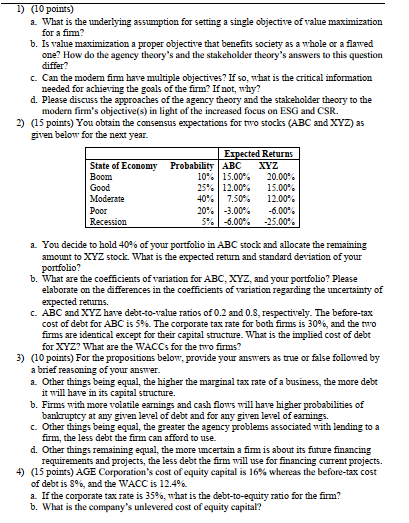
points You obtain the consensus expectations for two stocks ABC and XYZ as
given below for the next year.
a You decide to hold of your portfolio in ABC stock and allocate the remaining
amount to XYZ stock. What is the expected return and standard deviation of your
portfolio?
b What are the coefficients of variation for ABC, and your portfolio? Please
elaborate on the differences in the coefficients of variation regarding the uncertainty of
expected returns.
c ABC and have debttovalue ratios of and respectively. The beforetax
cost of debt for ABC is The corporate tax rate for both firms is and the two
firms are identical except for their capital structure. What is the implied cost of debt
for XYZ What are the WACCs for the two firms?
points For the propositions below, provide your answers as true or false followed by
a brief reasoning of your answer.
a Other things being equal, the higher the marginal tax rate of a business, the more debt
it will have in its capital structure.
b Firms with more volatile earnings and cash flows will have higher probabilities of
bankruptcy at any given level of debt and for any given level of earnings.
c Other things being equal, the greater the agency problems associated with lending to a
firm, the less debt the firm can afford to use.
d Other things remaining equal, the more uncertain a firm is about its future financing
requirements and projects, the less debt the firm will use for financing current projects.
points AGE Corporation's cost of equity capital is whereas the beforetax cost
of debt is and the WACC is
a If the corporate tax rate is what is the debttoequity ratio for the firm?
b What is the company's unlevered cost of equity capital?
Step by Step Solution
There are 3 Steps involved in it
1 Expert Approved Answer
Step: 1 Unlock

Question Has Been Solved by an Expert!
Get step-by-step solutions from verified subject matter experts
Step: 2 Unlock
Step: 3 Unlock