







Question: ( 1 0 points ) Problem 2 . Example 8 - 1 in the textbook Maximizing the Selectivity for the Famous Trambouze Reactions Reactant A
points Problem Example in the textbook
Maximizing the Selectivity for the Famous Trambouze Reactions
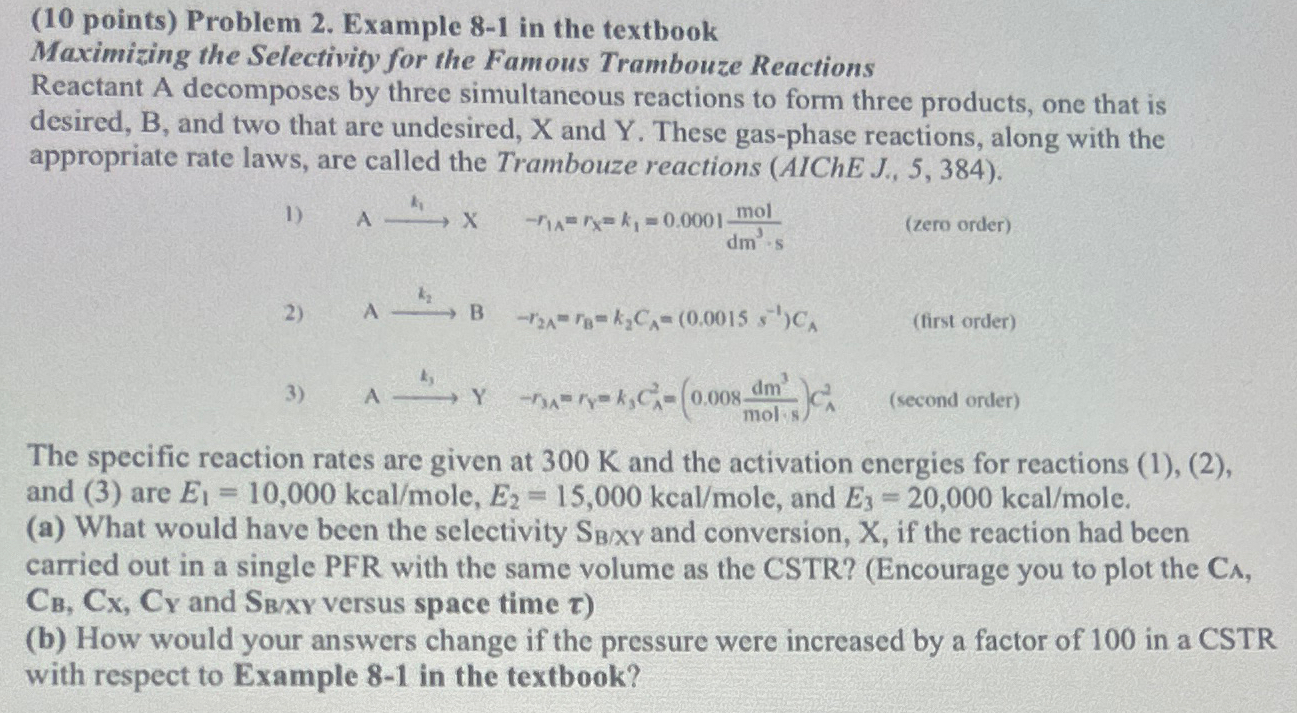
Reactant A decomposes by three simultaneous reactions to form three products, one that is desired, B and two that are undesired, and These gasphase reactions, along with the appropriate rate laws, are called the Trambouze reactions AIChE J
zero order
first order
second order
The specific reaction rates are given at and the activation energies for reactions and are kcaole,kcaole, and kcaole.
a What would have been the selectivity and conversion, if the reaction had been carried out in a single PFR with the same volume as the CSTREncourage you to plot the CA and versus space time
b How would your answers change if the pressure were increased by a factor of in a CSTR with respect to Example in the textbook?
Step by Step Solution
There are 3 Steps involved in it
1 Expert Approved Answer
Step: 1 Unlock

Question Has Been Solved by an Expert!
Get step-by-step solutions from verified subject matter experts
Step: 2 Unlock
Step: 3 Unlock
 Study Help