







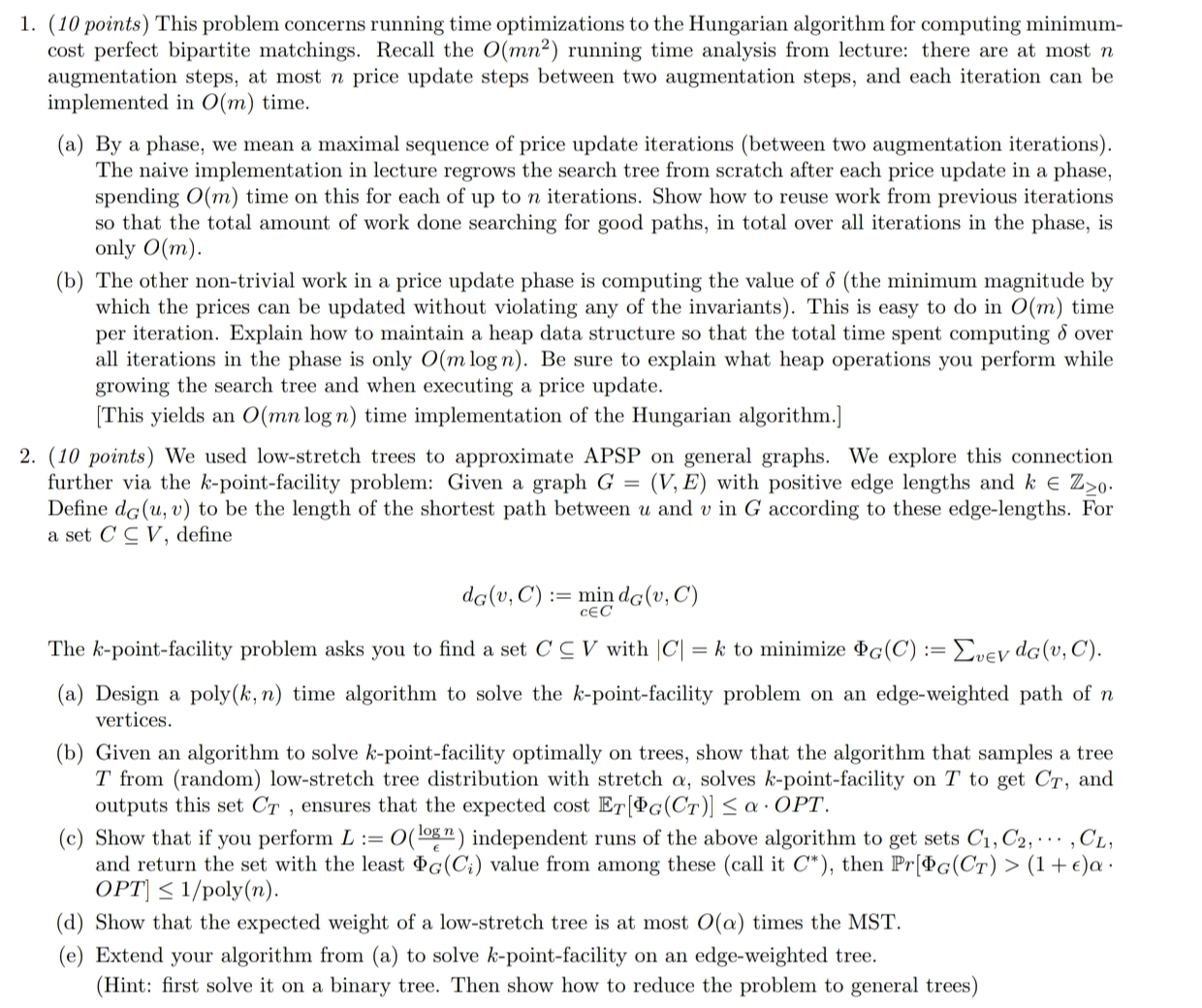
Question: ( 1 0 points ) This problem concerns running time optimizations to the Hungarian algorithm for computing minimum - cost perfect bipartite matchings. Recall the
points This problem concerns running time optimizations to the Hungarian algorithm for computing minimum
cost perfect bipartite matchings. Recall the running time analysis from lecture: there are at most
augmentation steps, at most price update steps between two augmentation steps, and each iteration can be
implemented in time.
a By a phase, we mean a maximal sequence of price update iterations between two augmentation iterations
The naive implementation in lecture regrows the search tree from scratch after each price update in a phase,
spending time on this for each of up to iterations. Show how to reuse work from previous iterations
so that the total amount of work done searching for good paths, in total over all iterations in the phase, is
only
b The other nontrivial work in a price update phase is computing the value of the minimum magnitude by
which the prices can be updated without violating any of the invariants This is easy to do in time
per iteration. Explain how to maintain a heap data structure so that the total time spent computing over
all iterations in the phase is only Be sure to explain what heap operations you perform while
growing the search tree and when executing a price update.
This yields an time implementation of the Hungarian algorithm.
points We used lowstretch trees to approximate APSP on general graphs. We explore this connection
further via the pointfacility problem: Given a graph with positive edge lengths and
Define to be the length of the shortest path between and in according to these edgelengths. For
a set CsubeV, define
:
The pointfacility problem asks you to find a set CsubeV with to minimize :
a Design a poly time algorithm to solve the pointfacility problem on an edgeweighted path of
vertices.
b Given an algorithm to solve pointfacility optimally on trees, show that the algorithm that samples a tree
from random lowstretch tree distribution with stretch solves pointfacility on to get and
outputs this set ensures that the expected cost
c Show that if you perform : independent runs of the above algorithm to get sets cdots,
and return the set with the least value from among these call it then
OPT
d Show that the expected weight of a lowstretch tree is at most times the MST
e Extend your algorithm from a to solve pointfacility on an edgeweighted tree.
Hint: first solve it on a binary tree. Then show how to reduce the problem to general trees
give solution in detail by proof each and every step
Step by Step Solution
There are 3 Steps involved in it
1 Expert Approved Answer
Step: 1 Unlock

Question Has Been Solved by an Expert!
Get step-by-step solutions from verified subject matter experts
Step: 2 Unlock
Step: 3 Unlock
 Study Help