Question: 1 1 . 2 Theorem. Suppose that V is open in R 2 , that ( a , b ) If f is C 1

11.2 Theorem. Suppose that V is open in R2, that (a,b)
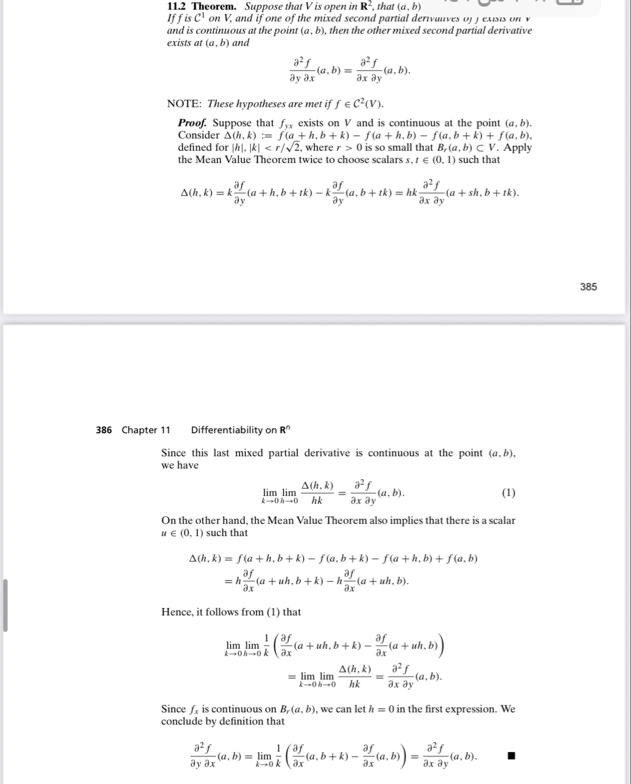
If f is C1 on V, and if one of the mixed second partial derivauves of / exsus on v and is continuous at the point (a,b), then the other mixed second partial derivative exists at (a,b) and
del2fdelydelx(a,b)=del2fdelxdely(a,b)
NOTE: These hypotheses are met if finC2(V).
Proof. Suppose that fyx exists on V and is continuous at the point (a,b). Consider (h,k):=f(ah,bk)-f(ah,b)-f(a,bk)f(a,b), defined for r>0Br(a,b)subVs,tin(0,1)(h,k)=kdelfdely(ah,btk)-kdelfdely(a,btk)=hkdel2fdelxdely(ash,btk).Rna,blimk0limh0(h,k)hk=del2fdelxdely(a,b)uin(0,1)(h,k)=f(ah,bk)-f(a,bk)-f(ah,b)f(a,b)
=hdelfdelx(auh,bk)-hdelfdelx(auh,b)limk0h0limk1k(delfdelx(auh,bk)-delfdelx(auh,b))
=limk0limh0(h,k)hk=del2fdelxdely(a,b)fxBr(a,b)h=0del2fdelydelx(a,b)=limk01k(delfdelx(a,bk)-delfdelx(a,b))=del2fdelxdely(a,b)|h|,|k|, where r>0isso small that Br(a,b)subV. Apply the Mean Value Theorem twice to choose scalars s,tin(0,1) such that
(h,k)=kdelfdely(ah,btk)-kdelfdely(a,btk)=hkdel2fdelxdely(ash,btk).
385
386 Chapter 11 Differentiability onRn
Since this last mixed partial derivative is continuous at the point (a,b),we have
limk0limh0(h,k)hk=del2fdelxdely(a,b)
On the other hand, the Mean Value Theorem also implies that there is a scalar uin(0,1) such that
(h,k)=f(ah,bk)-f(a,bk)-f(ah,b)f(a,b)
=hdelfdelx(auh,bk)-hdelfdelx(auh,b)
Hence, it follows from (1) that
limk0h0limk1k(delfdelx(auh,bk)-delfdelx(auh,b))
=limk0limh0(h,k)hk=del2fdelxdely(a,b)
Since fxis continuous onBr(a,b),we can let h=0in the first expression. We conclude by definition that
del2fdelydelx(a,b)=limk01k(delfdelx(a,bk)-delfdelx(a,b))=del2fdelxdely(a,b)
1 1 . 2 Theorem. Suppose that V is open in R 2 ,

Step by Step Solution

There are 3 Steps involved in it

1 Expert Approved Answer
Step: 1 Unlock blur-text-image

Question Has Been Solved by an Expert!

Get step-by-step solutions from verified subject matter experts

Step: 2 Unlock
Step: 3 Unlock

Students Have Also Explored These Related Mathematics Questions!