







Question: 1 1 8 Chapter Three Linear Programming: Formulation and Applications company cannot sell them. TrendLines can produce less than the forecasted demand, however, since the
Chapter Three Linear Programming: Formulation and Applications
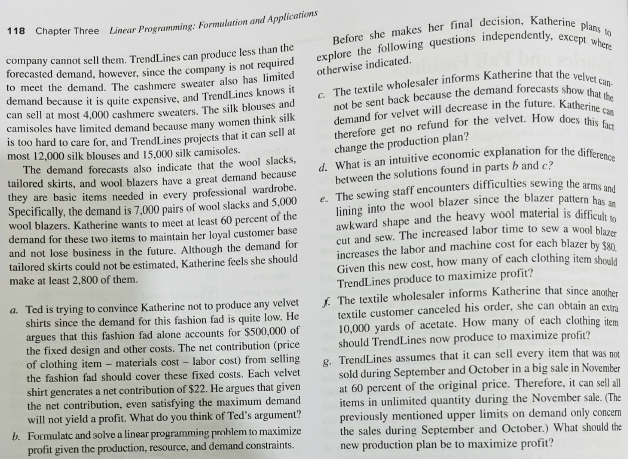
company cannot sell them. TrendLines can produce less than the
forecasted demand, however, since the company is not required
to meet the demand. The cashmere sweater also has limited
demand because it is quite expensive, and TrendLines knows it
can sell at most cashmere sweaters. The silk blouses and
camisoles have limited demand because many women think silk
is too hard to care for, and TrendLines projects that it can sell at
most silk blouses and silk camisoles.
The demand forecasts also indicate that the wool slacks,
tailored skirts, and wool blazers have a great demand because
they are basic items needed in every professional wardrobe.
Specifically, the demand is pairs of wool slacks and
wool blazers. Katherine wants to meet at least percent of the
demand for these two items to maintain her loyal customer base
and not lose business in the future. Although the demand for
tailored skirts could not be estimated, Katherine feels she should
make at least of them.
a Ted is trying to convince Katherine not to produce any velvet
shirts since the demand for this fashion fad is quite low. He
argues that this fashion fad alone accounts for $ of
the fixed design and other costs. The net contribution price
of clothing item materials cost labor cost from selling
the fashion fad should cover these fixed costs. Each velvet
shirt generates a net contribution of $ He argues that given
the net contribution, even satisfying the maximum demand
will not yield a profit. What do you think of Ted's argument?
b Formulatc and solve a linear programming problem to maximize
profit given the production, resource, and demand constraints.
Before she makes her final decision, Katherine plans
explore the following questions independently, except where
otherwise indicated.
c The textile wholesaler informs Katherine that the velvet can
not be sent back because the demand forecasts show that the
demand for velvet will decrease in the future. Katherine
therefore get no refund for the velvet. How does this fact
change the production plan?
d What is an intuitive economic explanation for the difference
between the solutions found in parts and
The sewing staff encounters difficulties sewing the arms and
lining into the wool blazer since the blazer pattern has an
awkward shape and the heavy wool material is difficult to
cut and sew. The increased labor time to sew a wool blazer
increases the labor and machine cost for each blazer by $
Given this new cost, how many of each clothing item should
TrendLines produce to maximize profit?
f The textile wholesaler informs Katherine that since another
textile customer canceled his order, she can obtain an extra
yards of acetate. How many of each clothing item
should TrendLines now produce to maximize profit?
g TrendLines assumes that it can sell every item that was not
sold during September and October in a big sale in November
at percent of the original price. Therefore, it can sell all
items in unlimited quantity during the November sale. The
previously mentioned upper limits on demand only concern
the sales during September and October. What should the
new production plan be to maximize profit?
Step by Step Solution
There are 3 Steps involved in it
1 Expert Approved Answer
Step: 1 Unlock

Question Has Been Solved by an Expert!
Get step-by-step solutions from verified subject matter experts
Step: 2 Unlock
Step: 3 Unlock
 Study Help