







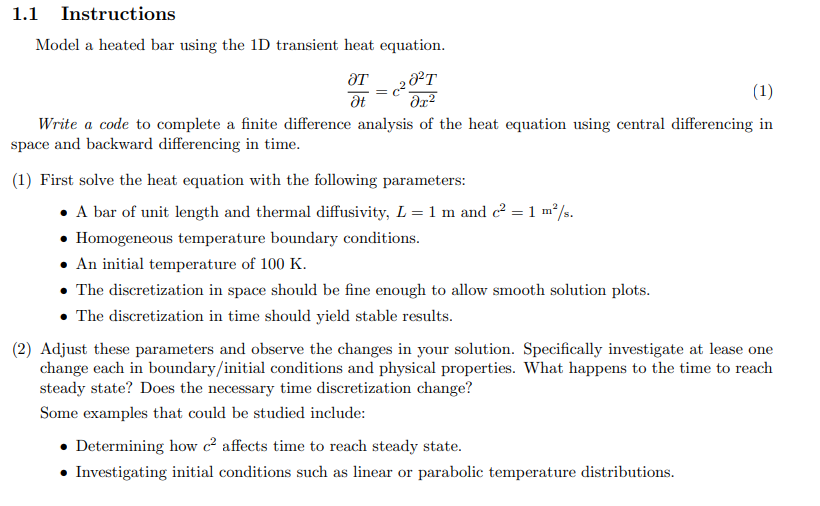
Question: 1 . 1 Instructions Model a heated bar using the 1 D transient heat equation. [ frac { partial T } {
Instructions
Model a heated bar using the D transient heat equation.
fracpartial Tpartial tcfracpartial Tpartial x
Write a code to complete a finite difference analysis of the heat equation using central differencing in space and backward differencing in time.
First solve the heat equation with the following parameters:
A bar of unit length and thermal diffusivity, Lmathrm~m and cmathrm~mmathrms
Homogeneous temperature boundary conditions.
An initial temperature of K
The discretization in space should be fine enough to allow smooth solution plots.
The discretization in time should yield stable results.
Adjust these parameters and observe the changes in your solution. Specifically investigate at lease one change each in boundaryinitial conditions and physical properties. What happens to the time to reach steady state? Does the necessary time discretization change?
Some examples that could be studied include:
Determining how c affects time to reach steady state.
Investigating initial conditions such as linear or parabolic temperature distributions.
CANNOT USE OR REFERENCE CFL NUMBERS OR UPWINDING OR CRANKNICKELSON METHODS.
Step by Step Solution
There are 3 Steps involved in it
1 Expert Approved Answer
Step: 1 Unlock

Question Has Been Solved by an Expert!
Get step-by-step solutions from verified subject matter experts
Step: 2 Unlock
Step: 3 Unlock
 Study Help