







Question: 1. [-/1 Points] DETAILS OSCOLPHYS2016 25.5.WA.031.TUTORIAL. MY NOTES ASK YOUR TEACHER PRACTICE ANOTHER A beam of light containing red (660 nm) and violet (410 nm)
![1. [-/1 Points] DETAILS OSCOLPHYS2016 25.5.WA.031.TUTORIAL. MY NOTES ASK YOUR TEACHER](https://s3.amazonaws.com/si.experts.images/answers/2024/07/668a7257a1f14_271668a72578a5b8.jpg)

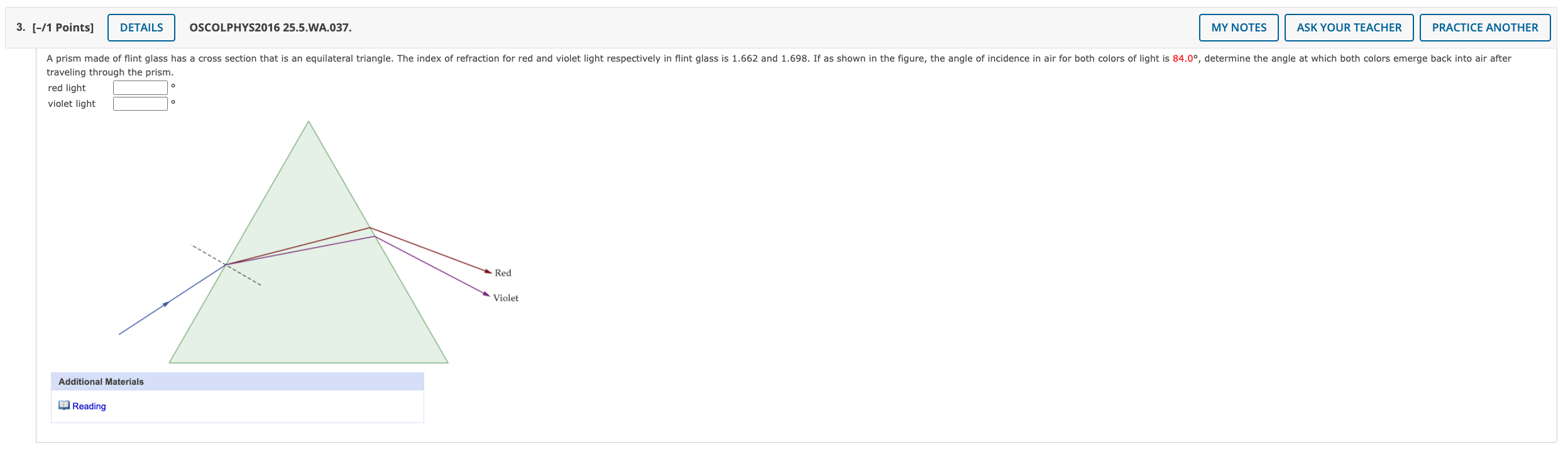






1. [-/1 Points] DETAILS OSCOLPHYS2016 25.5.WA.031.TUTORIAL. MY NOTES ASK YOUR TEACHER PRACTICE ANOTHER A beam of light containing red (660 nm) and violet (410 nm) wavelengths travels from air, through a flat piece of crown glass 2.30 cm thick, and then back to air. (a) If the beam has an angle of incidence of 22.20 in air, determine the angle at which the two colors of light emerge from the crown glass. The index of refraction respectively for red and violet light in crown glass is 1.512 and 1.530. (Enter a number to three decimal places.) red violet (b) Determine the distance separating the red and violet light as it emerges from the glass. cm Additional Materials Reading Tutorial2. [-/1 Points] DETAILS OSCOLPHYS2016 25.5.WA.032. MY NOTES ASK YOUR TEACHER PRACTICE ANOTHER The index of refraction for blue and orange light in crown glass are respectively 1.524 and 1.514. The index of refraction for blue and orange light in flint glass are respectively 1.684 and 1.665. Based on this information, answer the following. (a) What is the percent difference between the speed of blue light and orange light in crown glass? % (b) What is this percent difference in flint glass? % (c) Which material is more dispersive? O crown glass O flint glass Additional Materials ReadingMY NOTES ASK YOUR TEACHER PRACTICE ANOTHER 3. [-/1 Points] DETAILS OSCOLPHYS2016 25.5.WA.037. A prism made of flint glass has a cross section that is an equilateral triangle. The index of refraction for red and violet light respectively in flint glass is 1.662 and 1.698. If as shown in the figure, the angle of incidence in air for both colors of light is 84.0, determine the angle at which both colors emerge back into air after traveling through the prism. red light violet light Red Violet Additional Materials Reading4. [-/1 Points] DETAILS OSCOLPHYS2016 25.6.WA.039.TUTORIAL. MY NOTES ASK YOUR TEACHER PRACTICE ANOTHER You place an object 23.6 cm in front of a diverging lens which has a focal length with a magnitude of 12.8 cm. Determine how far in front of the lens the object should be placed in order to produce an image that is reduced by a factor of 4.25. Icm Additional Materials Reading Tutorial5. [-/1 Points] DETAILS OSCOLPHYS2016 25.6.WA.040. MY NOTES ASK YOUR TEACHER PRACTICE ANOTHER What is the focal length of 1.55 D reading glasses found on the rack in a drugstore? cm Additional Materials Reading6. [-/1 Points] DETAILS OSCOLPHYS2016 25.6.WA.041. MY NOTES ASK YOUR TEACHER PRACTICE ANOTHER If a converging lens forms a real, inverted image 22.0 cm to the right of the lens when the object is placed 31.0 cm to the left of a lens, determine the focal length of the lens. cm Additional Materials Reading7. [-/1 Points] DETAILS OSCOLPHYS2016 25.7.WA.051. MY NOTES ASK YOUR TEACHER PRACTICE ANOTHER (a) Calculate the focal length of the mirror formed by the convex side of a shiny spoon that has a 2.07 cm radius of curvature. m (b) What is its power in diopters? D Additional Materials Reading8. [-/1 Points] DETAILS OSCOLPHYS2016 25.7.WA.052. MY NOTES ASK YOUR TEACHER PRACTICE ANOTHER The image of an object is 11.0 cm behind a convex mirror when the object is far from the mirror. (a) Determine the absolute value of the distance from the mirror to the image when the object is placed 3.6 cm in front of the mirror. cm (b) Is the image behind or in front of the mirror? O in front of O behind Additional Materials Reading9. [-/1 Points] DETAILS OSCOLPHYS2016 25.7.WA.055. MY NOTES ASK YOUR TEACHER PRACTICE ANOTHER If when an object is placed 12.6 cm in front of a mirror the image is located 20.6 cm behind the mirror, determine the following. (a) the focal length of the mirror cm (b) if the mirror is concave or convex O concave convex Additional Materials Reading
Step by Step Solution
There are 3 Steps involved in it

Get step-by-step solutions from verified subject matter experts
 Study Help