





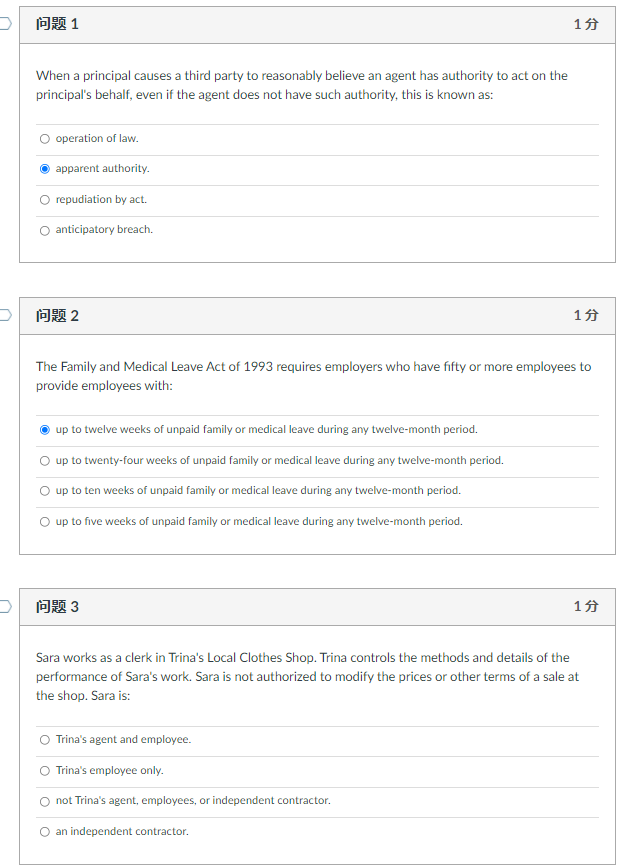
Question: 1 1 When a principal causes a third party to reasonably believe an agent has authority to act on the principal's behalf, even if the
1 1 When a principal causes a third party to1 1 When a principal causes a third party to1 1 When a principal causes a third party to

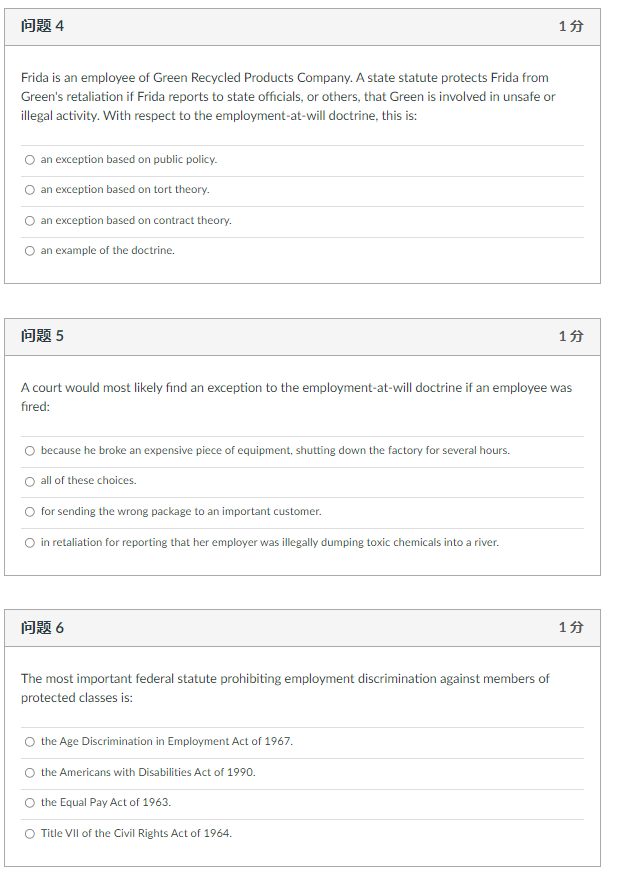
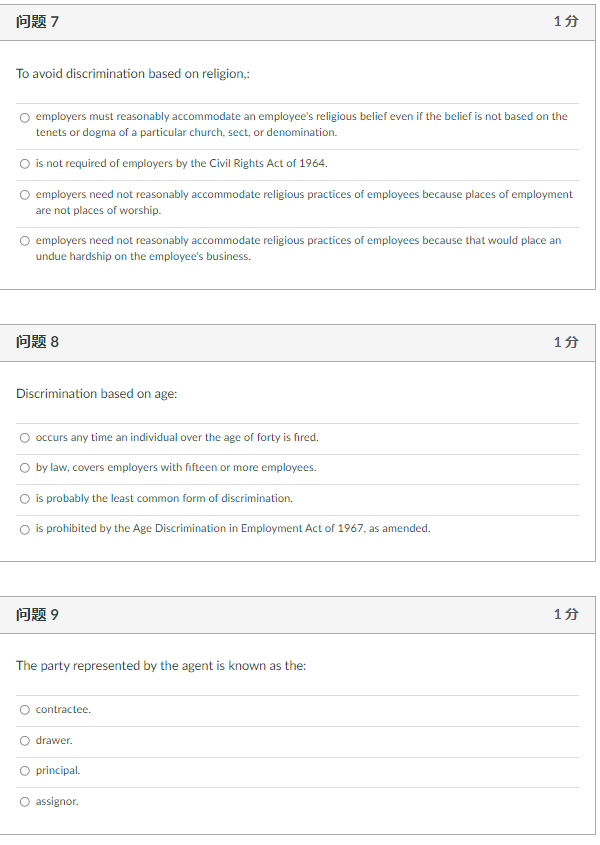
1 1 When a principal causes a third party to reasonably believe an agent has authority to act on the principal's behalf, even if the agent does not have such authority, this is known as: operation of law. apparent authority repudiation by act. anticipatory breach. 2 1 The Family and Medical Leave Act of 1993 requires employers who have fifty or more employees to provide employees with: up to twelve weeks of unpaid family or medical leave during any twelve-month period. up to twenty-four weeks of unpaid family or medical leave during any twelve-month period. up to ten weeks of unpaid family or medical leave during any twelve-month period. up to five weeks of unpaid family or medical leave during any twelve-month period. 3 18 Sara works as a clerk in Trina's Local Clothes Shop. Trina controls the methods and details of the performance of Sara's work. Sara is not authorized to modify the prices or other terms of a sale at the shop. Sara is: Trina's agent and employee. Trina's employee only. not Trina's agent, employees, or independent contractor. an independent contractor. 4 18 Frida is an employee of Green Recycled Products Company. A state statute protects Frida from Green's retaliation if Frida reports to state officials, or others, that Green is involved in unsafe or illegal activity. With respect to the employment-at-will doctrine, this is: an exception based on public policy. an exception based on tort theory. an exception based on contract theory. an example of the doctrine. 5 1 A court would most likely find an exception to the employment-at-will doctrine if an employee was fired: because he broke an expensive piece of equipment, shutting down the factory for several hours. all of these choices. for sending the wrong package to an important customer. O in retaliation for reporting that her employer was illegally dumping toxic chemicals into a river. 6 1 The most important federal statute prohibiting employment discrimination against members of protected classes is: the Age Discrimination in Employment Act of 1967. the Americans with Disabilities Act of 1990. the Equal Pay Act of 1963. Title VII of the Civil Rights Act of 1964. 7 1 To avoid discrimination based on religion: employers must reasonably accommodate an employee's religious belief even if the belief is not based on the tenets or dogma of a particular church, sect, or denomination. is not required of employers by the Civil Rights Act of 1964. employers need not reasonably accommodate religious practices of employees because places of employment are not places of Worship O employers need not reasonably accommodate religious practices of employees because that would place an undue hardship on the employee's business. 8 17 1 Discrimination based on age: occurs any time an individual over age of forty is fired. O by law, covers employers with fifteen or more employees. O is probably the least common form of discrimination. is prohibited by the Age Discrimination in Employment Act of 1967, as amended. 9 1 The party represented by the agent is known as the: contractee. drawer. principal. O assignor
Step by Step Solution

There are 3 Steps involved in it

1 Expert Approved Answer
Step: 1 Unlock blur-text-image

Question Has Been Solved by an Expert!

Get step-by-step solutions from verified subject matter experts

Step: 2 Unlock
Step: 3 Unlock

Students Have Also Explored These Related General Management Questions!