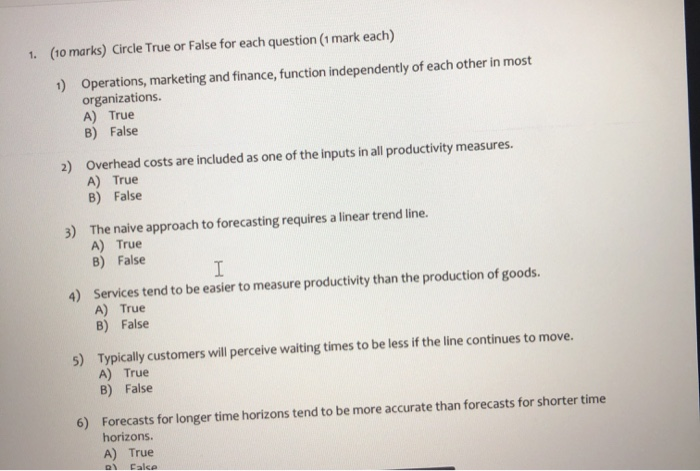
Question: 1. (10 marks) Circle True or False for each question (1 mark each) 1) Operations, marketing and finance, function independently of each other in most
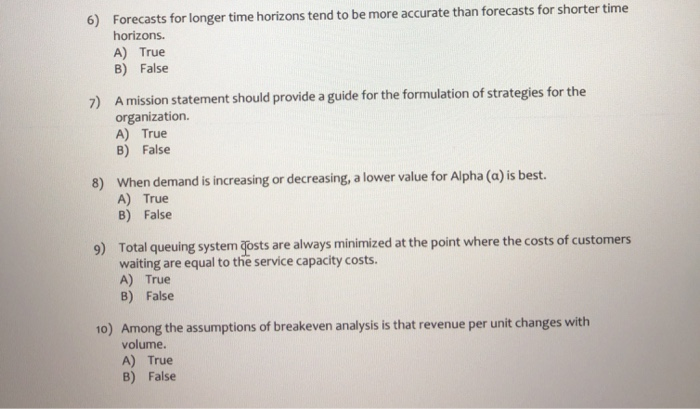
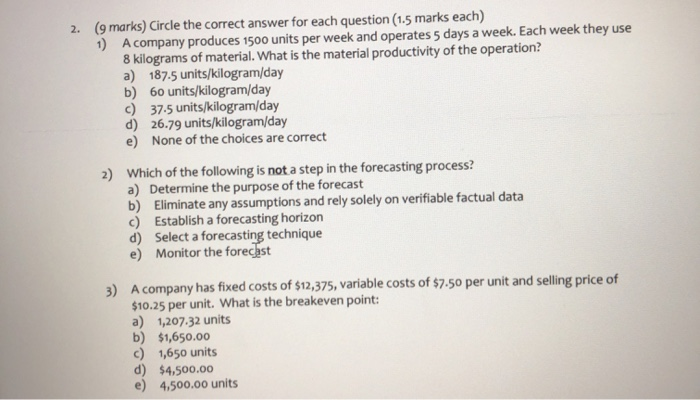
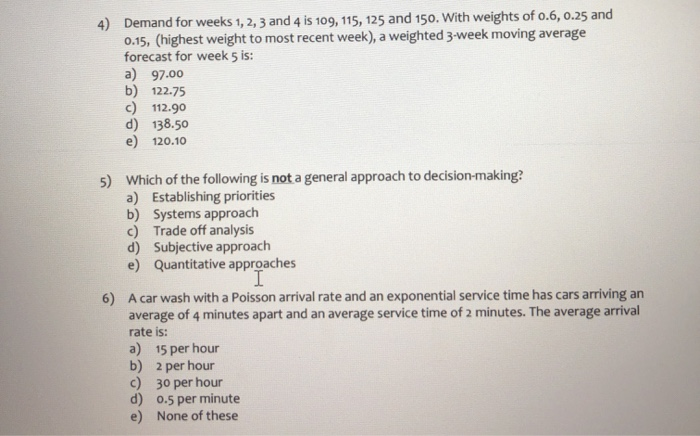
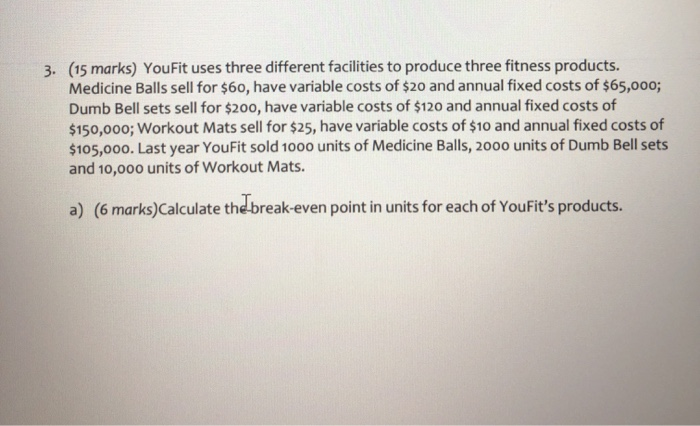
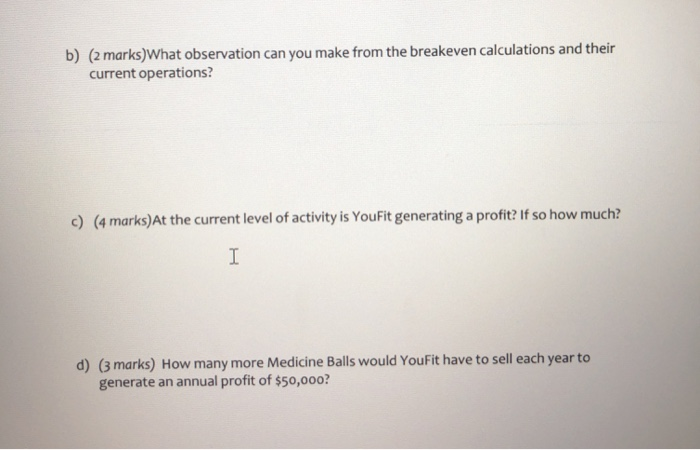
1. (10 marks) Circle True or False for each question (1 mark each) 1) Operations, marketing and finance, function independently of each other in most organizations. A) True B) False 2) Overhead costs are included as one of the inputs in all productivity measures. A) True B) False 3) The naive approach to forecasting requires a linear trend line. A) True B) False I 4) Services tend to be easier to measure productivity than the production of goods. A) True B) False 5) Typically customers will perceive waiting times to be less if the line continues to move. A) True B) False 6) Forecasts for longer time horizons tend to be more accurate than forecasts for shorter time horizons. A) True False 6) Forecasts for longer time horizons tend to be more accurate than forecasts for shorter time horizons. A) True B) False 7) A mission statement should provide a guide for the formulation of strategies for the organization. A) True B) False 8) When demand is increasing or decreasing, a lower value for Alpha (a) is best. A) True B) False 9) Total queuing system (osts are always minimized at the point where the costs of customers waiting are equal to the service capacity costs. A) True B) False 10) Among the assumptions of breakeven analysis is that revenue per unit changes with volume. A) True B) False 2. (9 marks) Circle the correct answer for each question (1.5 marks each) 1) A company produces 1500 units per week and operates 5 days a week. Each week they use 8 kilograms of material. What is the material productivity of the operation? a) 187.5 units/kilogram/day b) 60 units/kilogram/day c) 37.5 units/kilogram/day d) 26.79 units/kilogram/day e) None of the choices are correct 2) Which of the following is not a step in the forecasting process? a) Determine the purpose of the forecast b) Eliminate any assumptions and rely solely on verifiable factual data c) Establish a forecasting horizon d) Select a forecasting technique e) Monitor the forecast 3) A company has fixed costs of $12,375, variable costs of $7.50 per unit and selling price of $10.25 per unit. What is the breakeven point: a) 1,207.32 units b) $1,650.00 c) 1,650 units d) $4,500.00 4,500.00 units 4) Demand for weeks 1, 2, 3 and 4 is 109, 115, 125 and 150. With weights of 0.6, 0.25 and 0.15, (highest weight to most recent week), a weighted 3-week moving average forecast for week 5 is: a) 97.00 b) 122.75 c) 112.90 d) 138.50 e) 120.10 5) Which of the following is not a general approach to decision-making? a) Establishing priorities b) Systems approach c) Trade off analysis d) Subjective approach e) Quantitative approaches I 6) A car wash with a Poisson arrival rate and an exponential service time has cars arriving an average of 4 minutes apart and an average service time of 2 minutes. The average arrival rate is: a) 15 per hour b) 2 per hour c) 30 per hour d) 0.5 per minute e) None of these 3. (15 marks) YouFit uses three different facilities to produce three fitness products. Medicine Balls sell for $60, have variable costs of $20 and annual fixed costs of $65,000; Dumb Bell sets sell for $200, have variable costs of $120 and annual fixed costs of $150,000; Workout Mats sell for $25, have variable costs of $10 and annual fixed costs of $105,000. Last year YouFit sold 1000 units of Medicine Balls, 2000 units of Dumb Bell sets and 10,000 units of Workout Mats. a) (6 marks)Calculate the break-even point in units for each of YouFit's products. b) (2 marks)What observation can you make from the breakeven calculations and their current operations? c) (4 marks)At the current level of activity is YouFit generating a profit? If so how much? I d) (3 marks) How many more Medicine Balls would YouFit have to sell each year to generate an annual profit of $50,000









 Study Help