







Question: 1. (10 points) This question is a follow up from the last question in homework #2. You do not need the data to answer. The
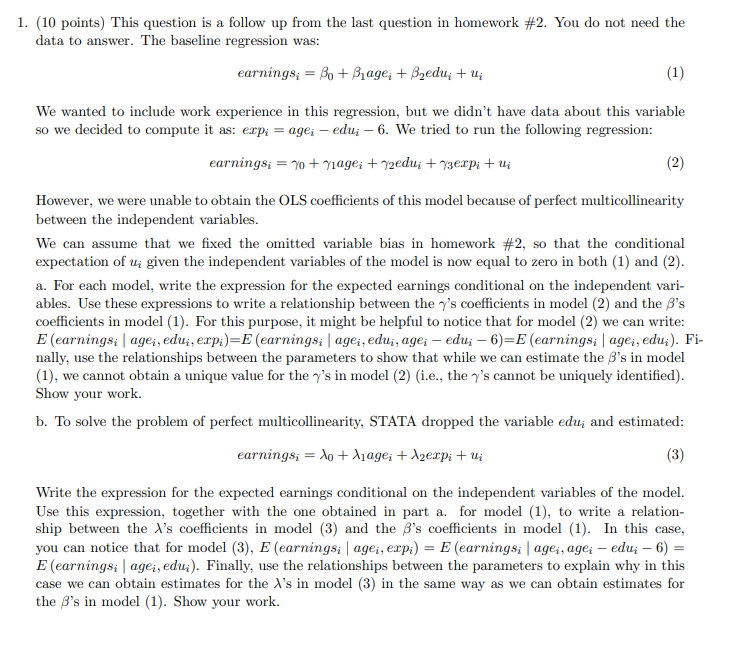
1. (10 points) This question is a follow up from the last question in homework #2. You do not need the data to answer. The baseline regression was: earnings; = Bo + Bage; + Byedu; + u; (1) We wanted to include work experience in this regression, but we didn't have data about this variable so we decided to compute it as: exp; = age; - edu; - 6. We tried to run the following regression: earnings; = 70 + nage; + 7edui + verpi + u; (2) However, we were unable to obtain the OLS coefficients of this model because of perfect multicollinearity between the independent variables. We can assume that we fixed the omitted variable bias in homework #2, so that the conditional expectation of u; given the independent variables of the model is now equal to zero in both (1) and (2). a. For each model, write the expression for the expected earnings conditional on the independent vari- ables. Use these expressions to write a relationship between the y's coefficients in model (2) and the B's coefficients in model (1). For this purpose, it might be helpful to notice that for model (2) we can write: E (earnings; | age, edui, exp;)=E (earnings; | age;, edus, age; - edu; - 6)=E (earnings; | age, edu;). Fi- nally, use the relationships between the parameters to show that while we can estimate the B's in model (1), we cannot obtain a unique value for the y's in model (2) (i.e., the y's cannot be uniquely identified). Show your work. b. To solve the problem of perfect multicollinearity, STATA dropped the variable edu; and estimated: earnings; = do + Mage; + Azerpi + u; (3) Write the expression for the expected earnings conditional on the independent variables of the model. Use this expression, together with the one obtained in part a. for model (1), to write a relation- ship between the A's coefficients in model (3) and the 's coefficients in model (1). In this case, you can notice that for model (3), E (earnings, | ages, expi) = E (earnings; | age;, age; - edu; - 6) = E (earnings; | ages, edu;). Finally, use the relationships between the parameters to explain why in this case we can obtain estimates for the A's in model (3) in the same way as we can obtain estimates for the B's in model (1). Show your work
Step by Step Solution
There are 3 Steps involved in it

Get step-by-step solutions from verified subject matter experts
 Study Help