







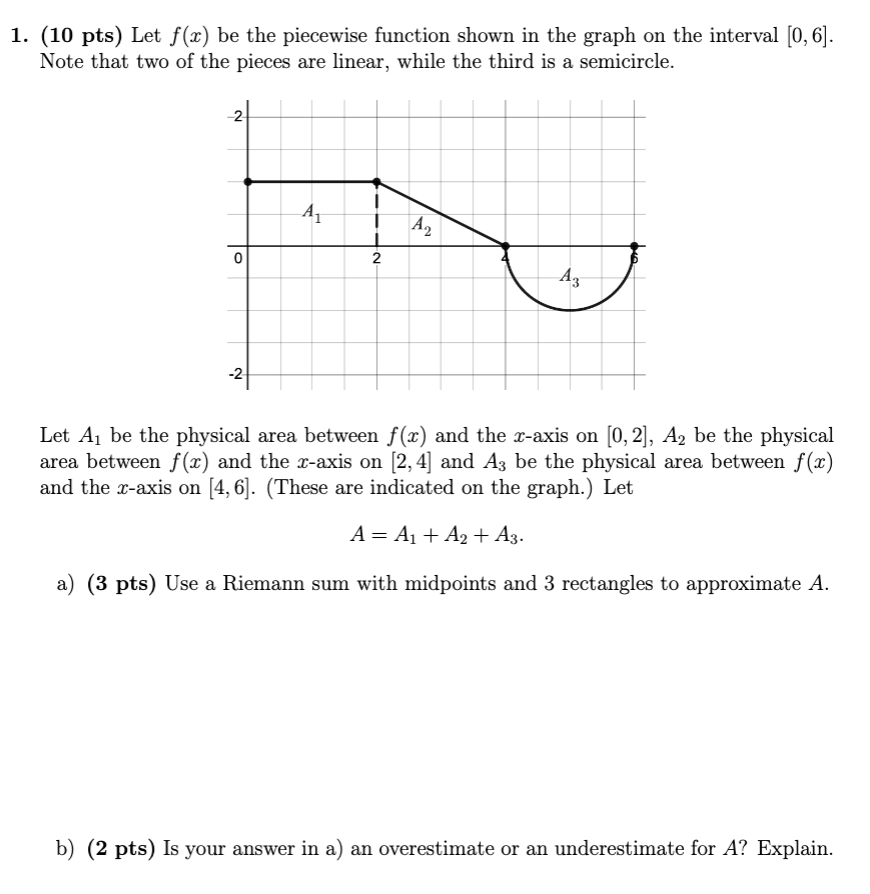
Question: 1. (10 pts) Let f (it) be the piecewise function shown in the graph on the interval [0, 6]. Note that two of the pieces
![in the graph on the interval [0, 6]. Note that two of](https://s3.amazonaws.com/si.experts.images/answers/2024/06/66651d539374e_67566651d537fc13.jpg)
![the pieces are linear, while the third is a semicircle. Let A]](https://s3.amazonaws.com/si.experts.images/answers/2024/06/66651d53ebbaa_67566651d53cbad1.jpg)
![be the physical area between x) and the sat-axis on ID, 2],](https://s3.amazonaws.com/si.experts.images/answers/2024/06/66651d543e73b_67666651d542b6f8.jpg)
1. (10 pts) Let f (it) be the piecewise function shown in the graph on the interval [0, 6]. Note that two of the pieces are linear, while the third is a semicircle. Let A] be the physical area between x) and the sat-axis on ID, 2], A2 be the physical area between f (:c) and the x-axis on [2.4] and A3 be the physical area between f (x) and the x-axis on [4, 6]. (Those are indicated on the graph.) Let A=A1+A2+A3. a) (3 pts) Use a Riemann sum with midpoints and 3 rectangles to approximate A. b) (2 pts) Is your answer in a) an overestimate or an underestimate for A? Explain. 6 c) (2 pts) Express / f(l') (in: in terms of A], A2, and A3. Explain why it is different a from A. 6 d) (3 pts) Use geometric area formulae to calculate / f (:6) dz. 0
Step by Step Solution
There are 3 Steps involved in it

Get step-by-step solutions from verified subject matter experts
 Study Help