







Question: 1. [11 Points] OSCOLPHYSZMG ZS.4.WA.OZT.TUTORIAL. ASK YOUR TEACHER PRACTICE ANOTHER A customemade compound microscope (see the figure below) with an objective lens with a focal
![1. [11 Points] OSCOLPHYSZMG ZS.4.WA.OZT.TUTORIAL. ASK YOUR TEACHER PRACTICE ANOTHER A](https://s3.amazonaws.com/si.experts.images/answers/2024/07/66897b6912d03_05666897b68eb23d.jpg)
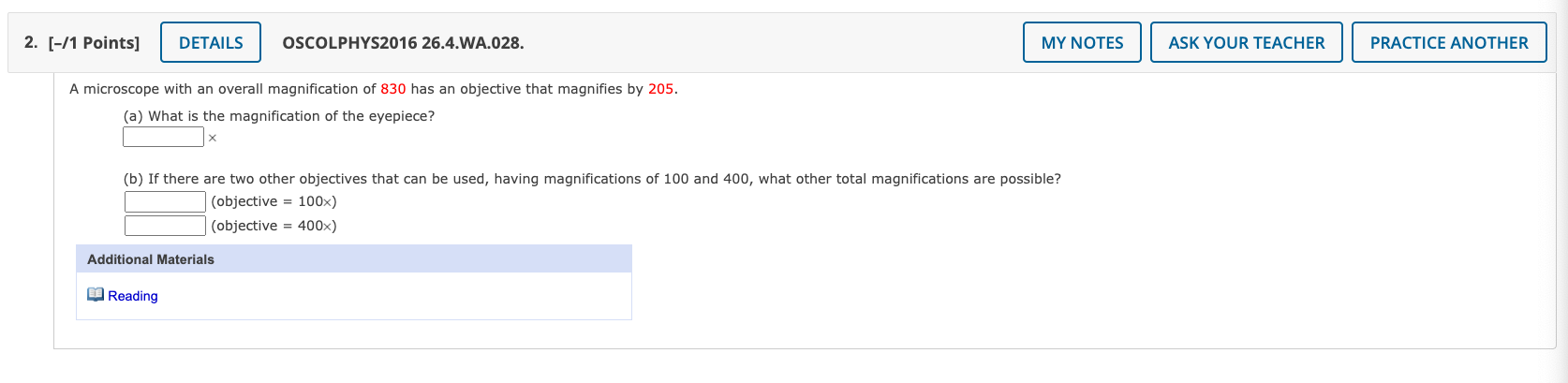

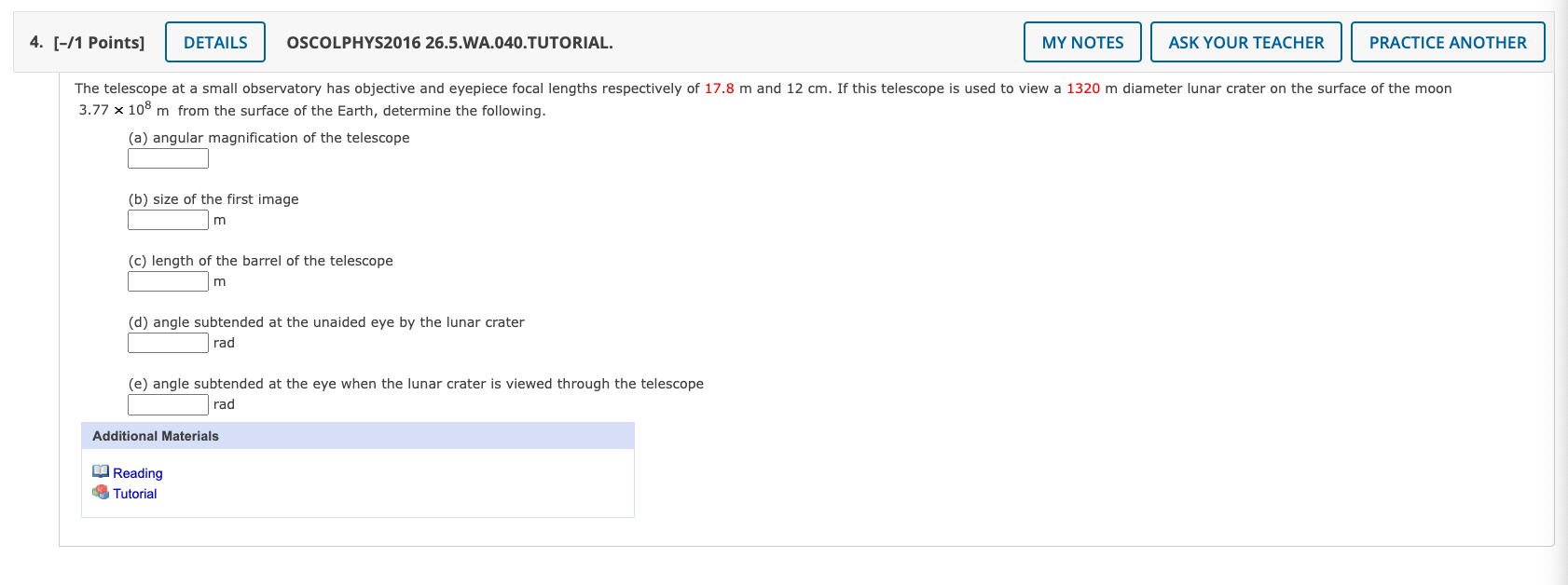


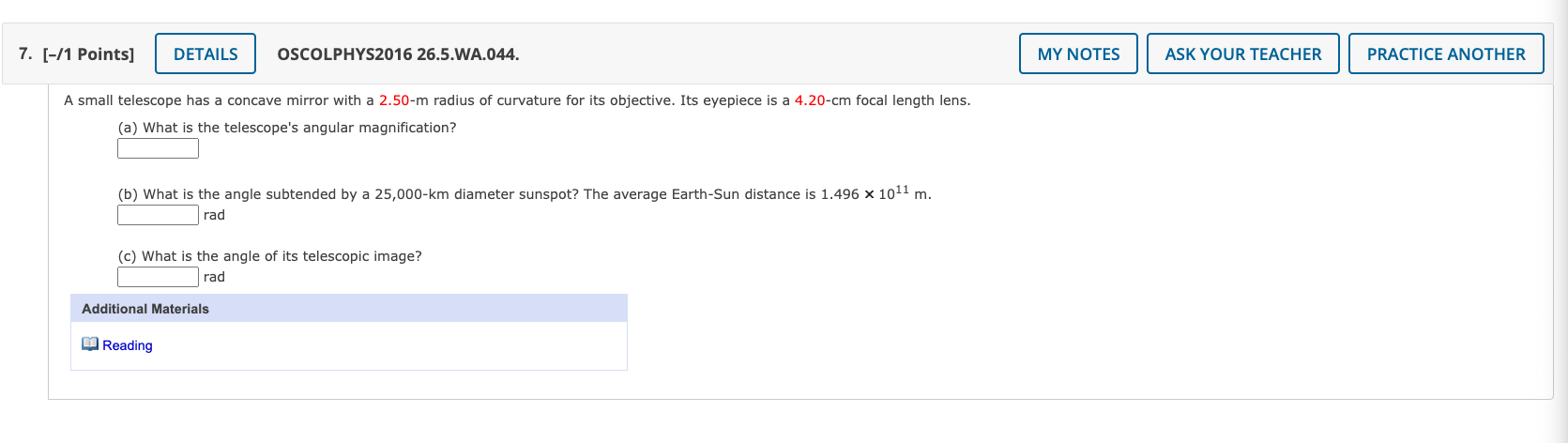
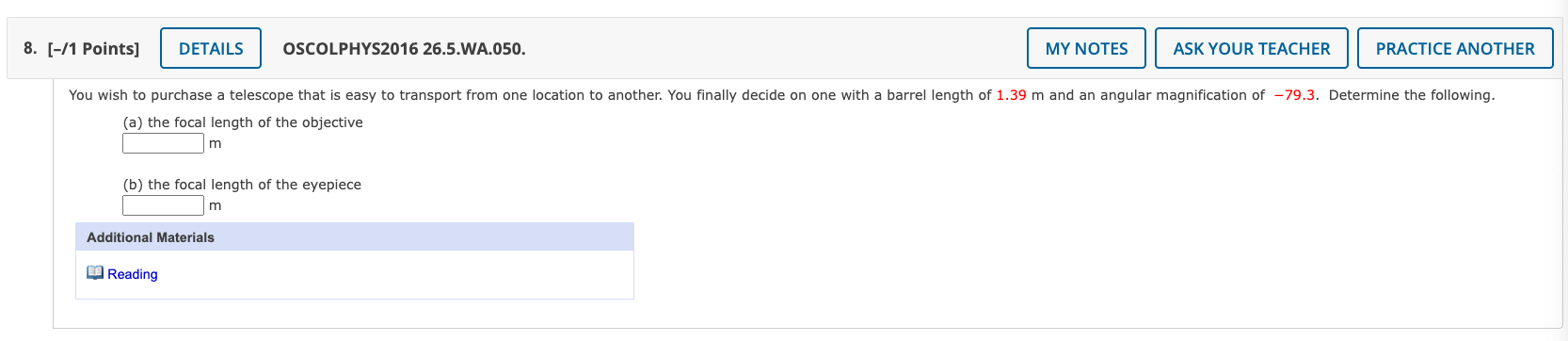

1. [11 Points] OSCOLPHYSZMG ZS.4.WA.OZT.TUTORIAL. ASK YOUR TEACHER PRACTICE ANOTHER A customemade compound microscope (see the figure below) with an objective lens with a focal length of 4.00 cm, an eyepiece lens with a focal length of 6.45 cm and a barrel length of 26.0 cm is used to View a 0.100 cm specimen mounted on a microscope slide. Since the microscope is customrmade. it varies slightly from a standard production microscope in that the object distance for the objective is so much larger than the focal length ofthe objective that we cannot set the object distance for the objective equal to the focal length of the objective. However. the image formed by the objective is close enough to the focal point of the eyepiece that we are justied in setting the object distance for the eyepiece equal to the focal length of the eyepiece. Finally, the microscope is being used by a lab technician with a near point of 31.5 cm. (Use the exact values you enter to make later calculations.) Obiective lens Object i l?\" r r r. I: b 5 m z e '1 Final image Determine the following. (a) distance the specimen (object) is mounted from the objective lens (Enter your answer to at least two decimal places.) cm (b) magnification of the objective lens (Include the sign of the value in your answer: Enter your answer to at least two decimal places.) (c) magnication of the eyepiece lens (Include the sign of the value in your answer.) (d) overall magnification for the microscope (Include the sign of the value in your answer.) (e) height of the image formed by the objective (Include the sign of the value in your answer.) cm (f) height of the nal image forrned by the microscope (Include the sign of the value in your answer.) cm (9) absolute value of angle subtended at the technician's eye when she holds the specimen at her near point and views it with her unaided eye rad (h) absolute value of angle subtended at the technician's eye when she views the specimen through the microscope rad Additional Materials [9 Reading '3 Tutorial 2. [-/1 Points] DETAILS OSCOLPHYS2016 26.4.WA.028. MY NOTES ASK YOUR TEACHER PRACTICE ANOTHER A microscope with an overall magnification of 830 has an objective that magnifies by 205. (a) What is the magnification of the eyepiece? (b) If there are two other objectives that can be used, having magnifications of 100 and 400, what other total magnifications are possible? (objective = 100x) (objective = 400x) Additional Materials Reading3. [-/1 Points] DETAILS OSCOLPHYS2016 26.4.WA.029. MY NOTES ASK YOUR TEACHER PRACTICE ANOTHER When you hold an insect at the near point of your eye it subtends an angle of 5.00 x 10" rad. Determine the angular size (magnitude only) of the insect when viewed through a microscope that has an angular magnification with a magnitude of 140. rad Additional Materials Reading4. [-/1 Points] DETAILS OSCOLPHYS2016 26.5.WA.040.TUTORIAL. MY NOTES ASK YOUR TEACHER PRACTICE ANOTHER The telescope at a small observatory has objective and eyepiece focal lengths respectively of 17.8 m and 12 cm. If this telescope is used to view a 1320 m diameter lunar crater on the surface of the moon 3.77 x 10⁸ m from the surface of the Earth, determine the following. (a) angular magnification of the telescope (b) size of the first image m (c) length of the barrel of the telescope m (d) angle subtended at the unaided eye by the lunar crater rad (e) angle subtended at the eye when the lunar crater is viewed through the telescope rad Additional Materials Reading Tutorial5. [11 Points] OSCOLPHVSZCHG 26.5.WAD42. ASK YOUR TEACHER PRACTICE ANOTHER Ifa telescope has objective and eyepiece lenses with focal lengths respectively at 115 cm and 2.65 cm, determine the distance needed between these two lenses in order to produce a final image far from the observer (where vision is most relaxed) when viewing a very distant object. :cm Additional Materials Ll] Reading 6. [-/1 Points] DETAILS OSCOLPHYS2016 26.5.WA.043. MY NOTES ASK YOUR TEACHER PRACTICE ANOTHER A large reflecting telescope has an objective mirror with a 10.3-m radius of curvature. What angular magnification does it produce when a 2.93-m focal length eyepiece is used? Additional Materials Reading7. [-11 Points] OSCOLPHYSZO16 26.5.WA.D44. ASK YOUR TEACHER PRACTICE ANOTHER A small telescope has a concave mirror with a 2.507m radius of curvature for its objective. Its eyepiece is a 4.207cm focal length lens. (a) What is the telescope's angular magnification? E (b) What is the angle subtended by a 25.000-km diameter sunspot? The average Earth-Sun distance is 1.496 x 10ll m. (c) What is the angle of its telescopic image? E .a. Addltlonal Mahrlals Lil Reading 8. [-/1 Points] DETAILS OSCOLPHYS2016 26.5.WA.050. MY NOTES ASK YOUR TEACHER PRACTICE ANOTHER You wish to purchase a telescope that is easy to transport from one location to another. You finally decide on one with a barrel length of 1.39 m and an angular magnification of -79.3. Determine the following. (a) the focal length of the objective m (b) the focal length of the eyepiece m Additional Materials Reading9. [-/1 Points] DETAILS OSCOLPHYS2016 26.5.WA.054. MY NOTES ASK YOUR TEACHER PRACTICE ANOTHER Freddie has a small telescope that has a 139-cm focal length objective and an angular magnification of -60. In order to make his sister appear smaller, he turns the telescope around and looks through the objective lens. Determine the angular magnification of his sister when viewed through the "wrong" end of the telescope. Additional Materials Reading
Step by Step Solution
There are 3 Steps involved in it

Get step-by-step solutions from verified subject matter experts
 Study Help