







Question: 1. (12.5 pts) A program P1 is executed on microprocessors A and B and the execution time is 311 sec and 513 sec, respectively. (a)
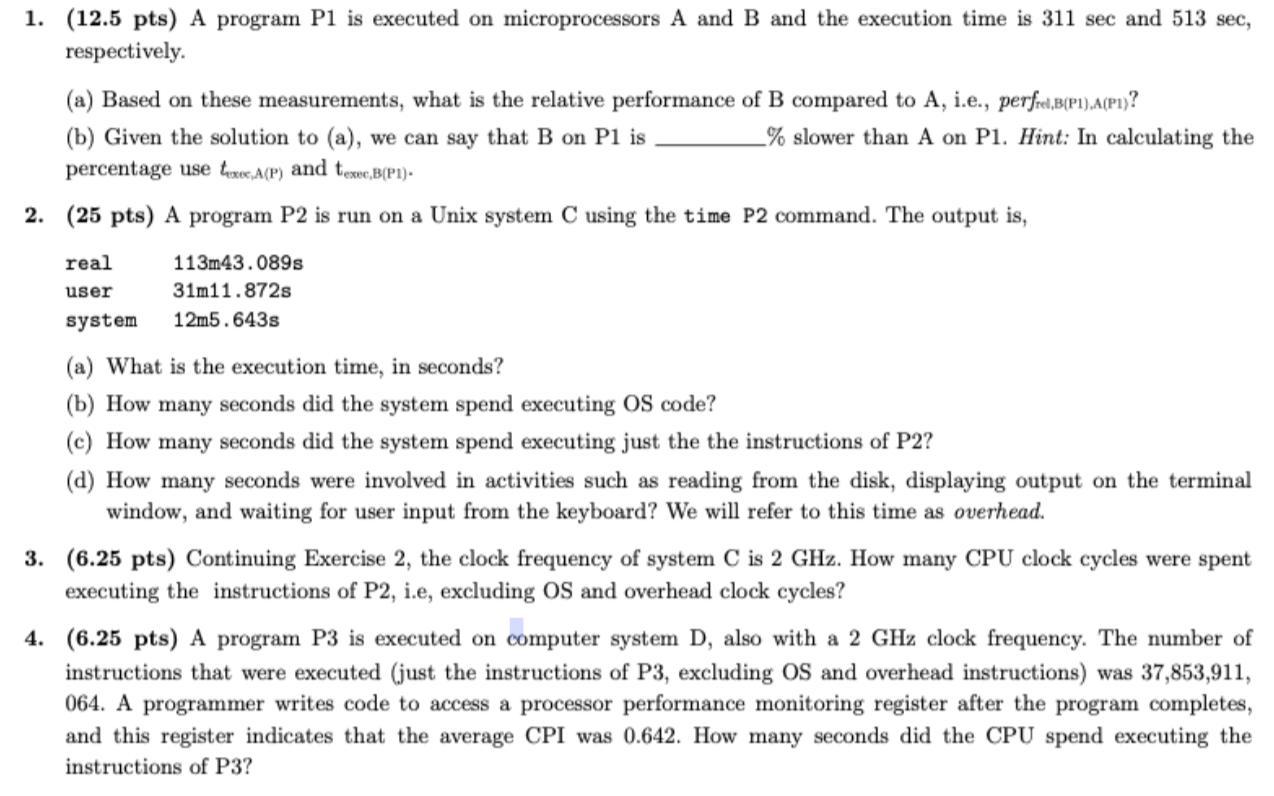
1. (12.5 pts) A program P1 is executed on microprocessors A and B and the execution time is 311 sec and 513 sec, respectively. (a) Based on these measurements, what is the relative performance of B compared to A, i.e., perfrel,B(P1),A(PI)? (b) Given the solution to (a), we can say that B on P1 is - % slower than A on P1. Hint: In calculating the percentage use tuxe,A(P) and tex B(P1). 2. (25 pts) A program P2 is run on a Unix system C using the time P2 command. The output is, real user system 113m43.089s 31m11.872s 12m5.643s (a) What is the execution time, in seconds? (b) How many seconds did the system spend executing OS code? (c) How many seconds did the system spend executing just the the instructions of P2? (d) How many seconds were involved in activities such as reading from the disk, displaying output on the terminal window, and waiting for user input from the keyboard? We will refer to this time as overhead. 3. (6.25 pts) Continuing Exercise 2, the clock frequency of system C is 2 GHz. How many CPU clock cycles were spent executing the instructions of P2, i.e, excluding OS and overhead clock cycles? 4. (6.25 pts) A program P3 is executed on computer system D, also with a 2 GHz clock frequency. The number of instructions that were executed (just the instructions of P3, excluding OS and overhead instructions) was 37,853,911, 064. A programmer writes code to access a processor performance monitoring register after the program completes, and this register indicates that the average CPI was 0.642. How many seconds did the CPU spend executing the instructions of P3? 1. (12.5 pts) A program P1 is executed on microprocessors A and B and the execution time is 311 sec and 513 sec, respectively. (a) Based on these measurements, what is the relative performance of B compared to A, i.e., perfrel,B(P1),A(PI)? (b) Given the solution to (a), we can say that B on P1 is - % slower than A on P1. Hint: In calculating the percentage use tuxe,A(P) and tex B(P1). 2. (25 pts) A program P2 is run on a Unix system C using the time P2 command. The output is, real user system 113m43.089s 31m11.872s 12m5.643s (a) What is the execution time, in seconds? (b) How many seconds did the system spend executing OS code? (c) How many seconds did the system spend executing just the the instructions of P2? (d) How many seconds were involved in activities such as reading from the disk, displaying output on the terminal window, and waiting for user input from the keyboard? We will refer to this time as overhead. 3. (6.25 pts) Continuing Exercise 2, the clock frequency of system C is 2 GHz. How many CPU clock cycles were spent executing the instructions of P2, i.e, excluding OS and overhead clock cycles? 4. (6.25 pts) A program P3 is executed on computer system D, also with a 2 GHz clock frequency. The number of instructions that were executed (just the instructions of P3, excluding OS and overhead instructions) was 37,853,911, 064. A programmer writes code to access a processor performance monitoring register after the program completes, and this register indicates that the average CPI was 0.642. How many seconds did the CPU spend executing the instructions of P3
Step by Step Solution
There are 3 Steps involved in it

Get step-by-step solutions from verified subject matter experts
 Study Help