



Question: 1. (18 points) Suppose that two players are playing the following game. Player A can either choose Top or Bottom, and Player B can either
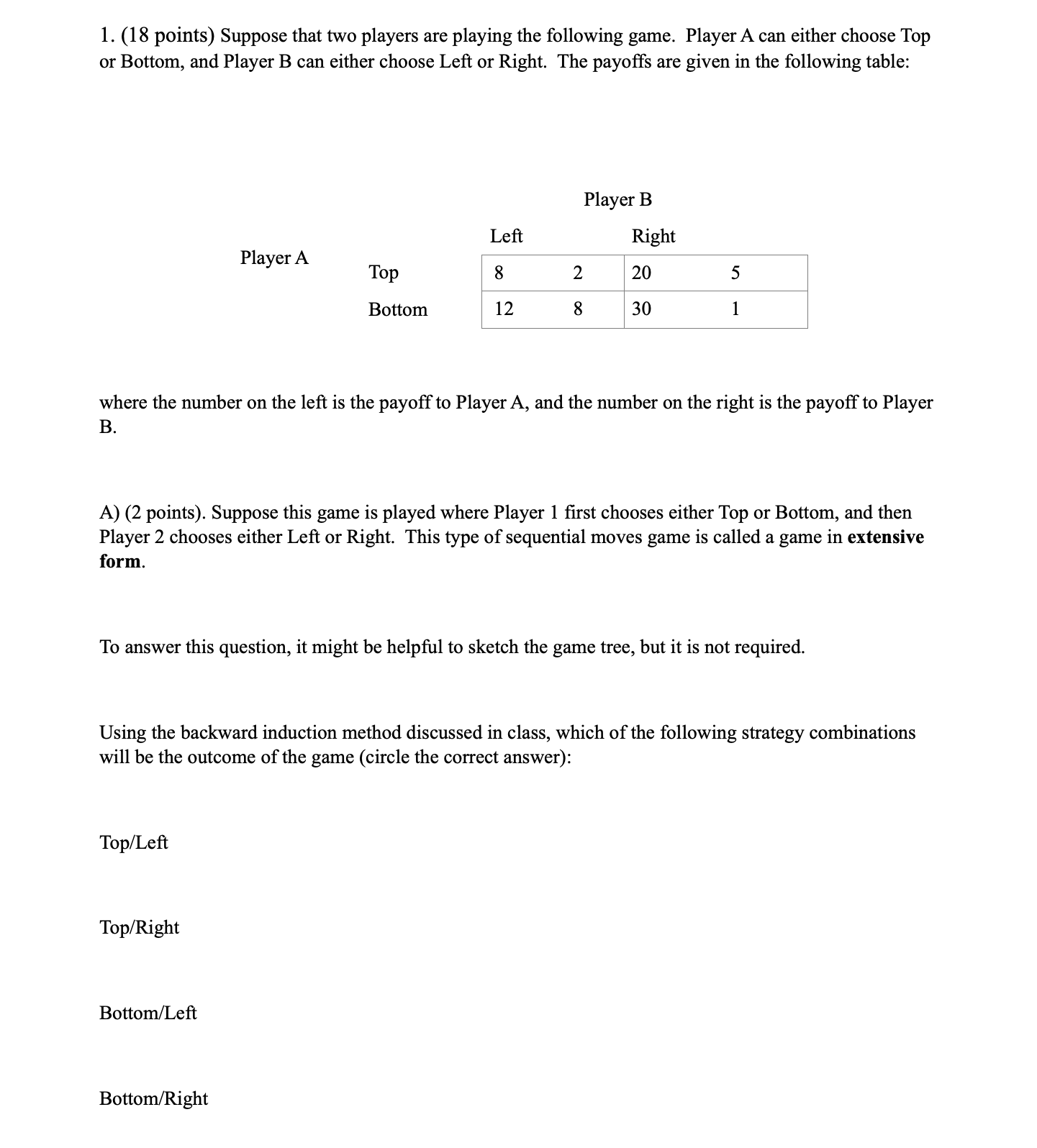
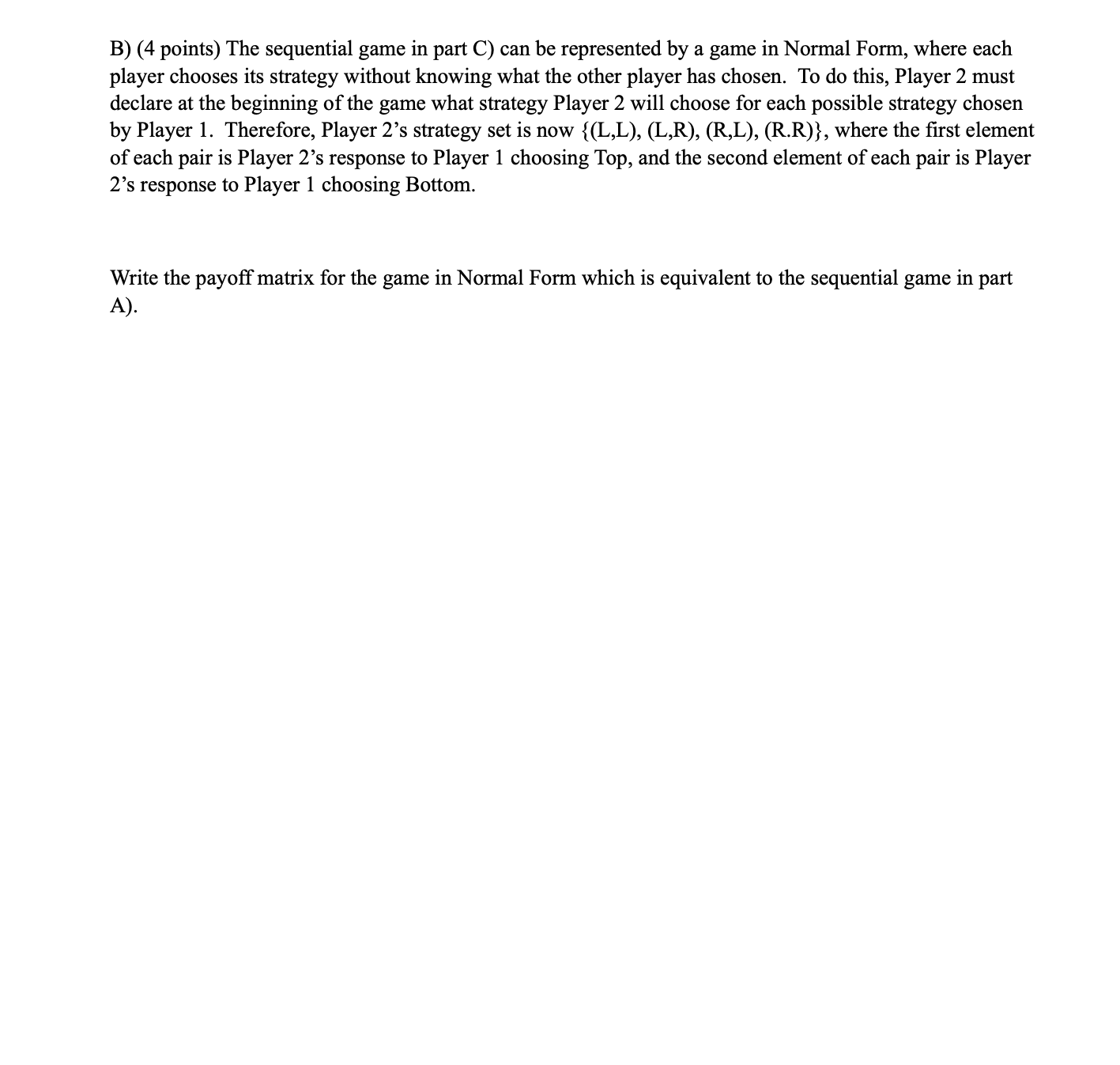

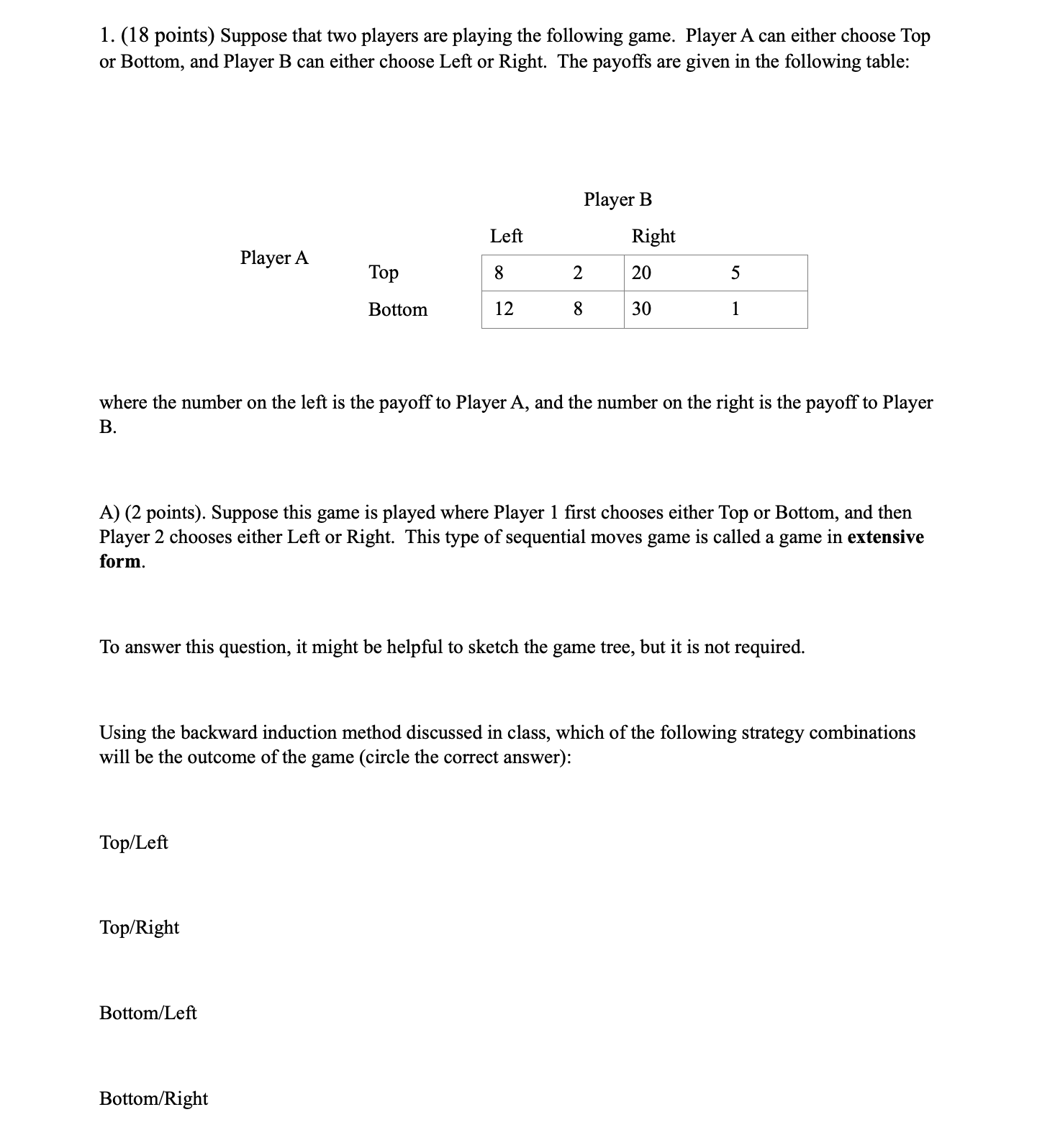
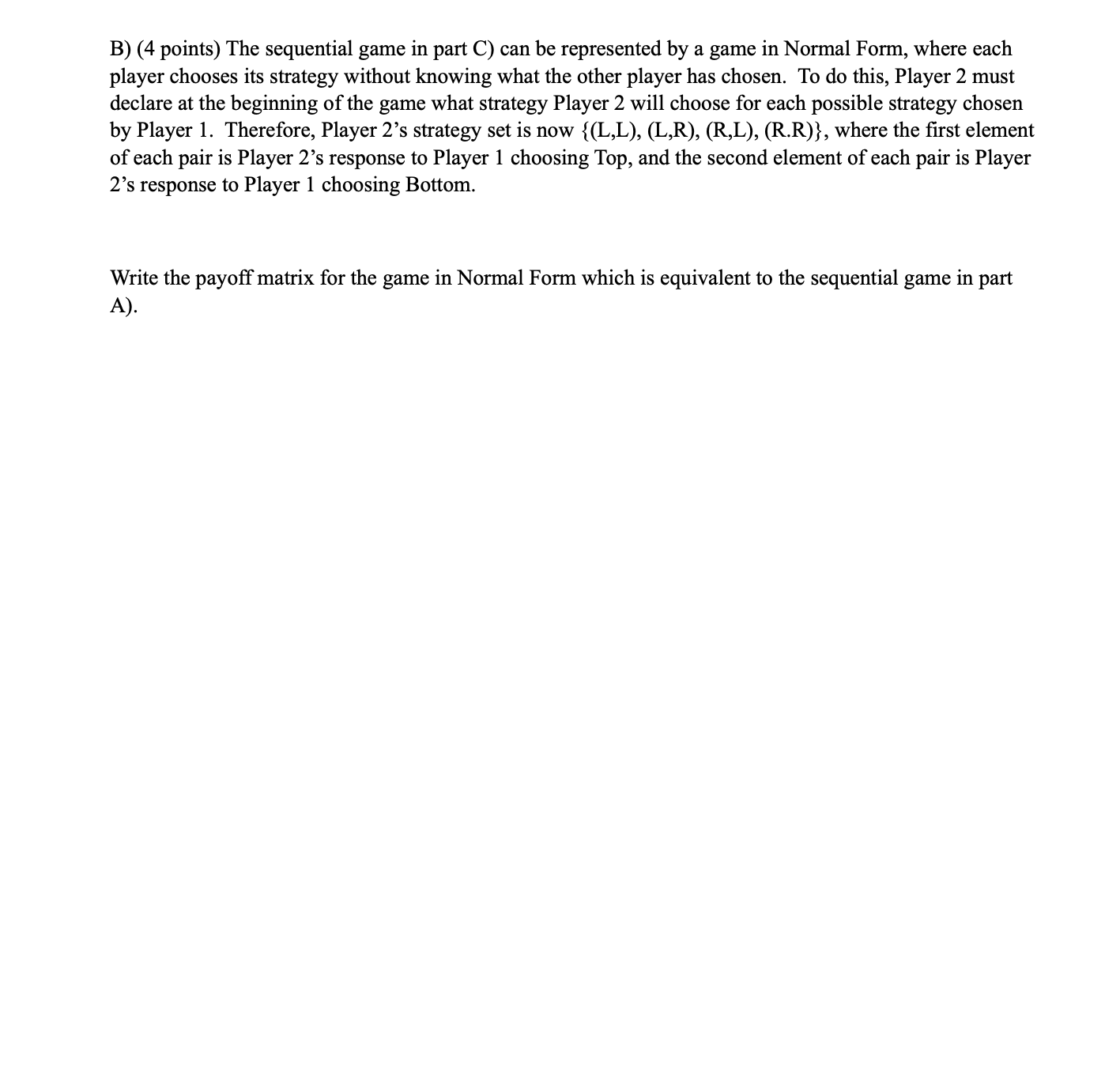

1. (18 points) Suppose that two players are playing the following game. Player A can either choose Top or Bottom, and Player B can either choose Left or Right. The payoffs are given in the following table: Player B Left Right Player A Top 8 2 2O 5 Bottom 12 8 3O 1 where the number on the left is the payoff to Player A, and the number on the right is the payoff to Player B. A) (2 points). Suppose this game is played where Player 1 rst chooses either Top or Bottom, and then Player 2 chooses either Left or Right. This type of sequential moves game is called a game in extensive form. To answer this question, it might be helpful to sketch the game tree, but it is not required. Using the backward induction method discussed in class, which of the following strategy combinations will be the outcome of the game (circle the correct answer): Top/Left Top/Right Bottom/Left Bottom/Right B) (4 points) The sequential game in part C) can be represented by a game in Normal Form, where each player chooses its strategy without knowing what the other player has chosen. To do this, Player 2 must declare at the beginning of the game what strategy Player 2 will choose for each possible strategy chosen by Player 1. Therefore, Player 2's strategy set is now {(L,L), (L,R), (R,L), (R.R)}, where the first element of each pair is Player 2's response to Player 1 choosing Top, and the second element of each pair is Player 2's response to Player 1 choosing Bottom. Write the payoff matrix for the game in Normal Form which is equivalent to the sequential game in part A). C) (6 points) Identify all of the Nash Equilibria of the game given in B) by marking a single star in each box that is a Nash Equilibrium. D) (6 points) Identify all of the Subgame Perfect Nash Equilibria of the game given in B) by marking a second star in each box that is a Subgame Perfect Nash Equilibrium
Step by Step Solution
There are 3 Steps involved in it

Get step-by-step solutions from verified subject matter experts