







Question: : 1 - 2 = 0 Ha: 1 - 2 > O To address the hypotheses above, data were collected from two small independent
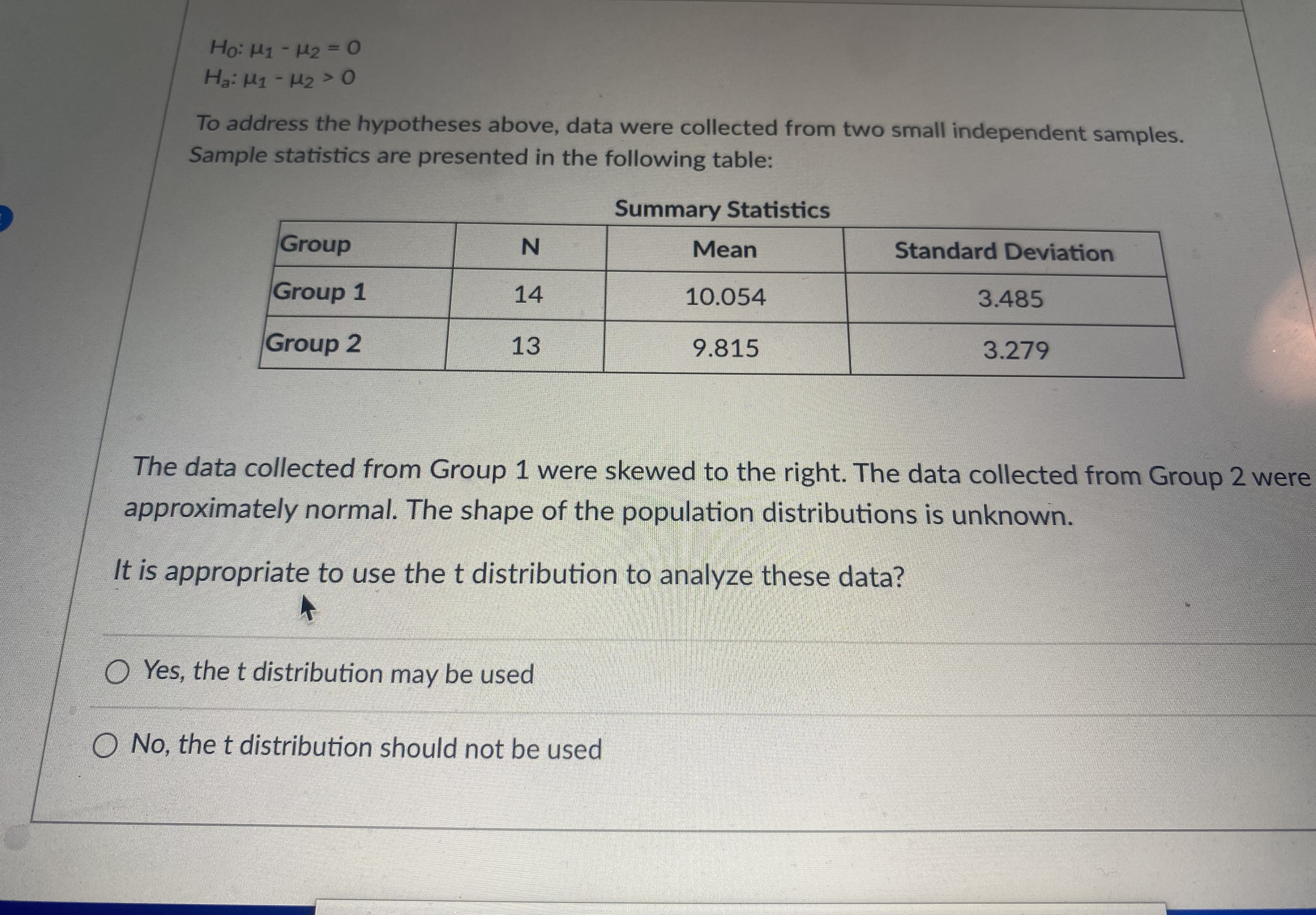
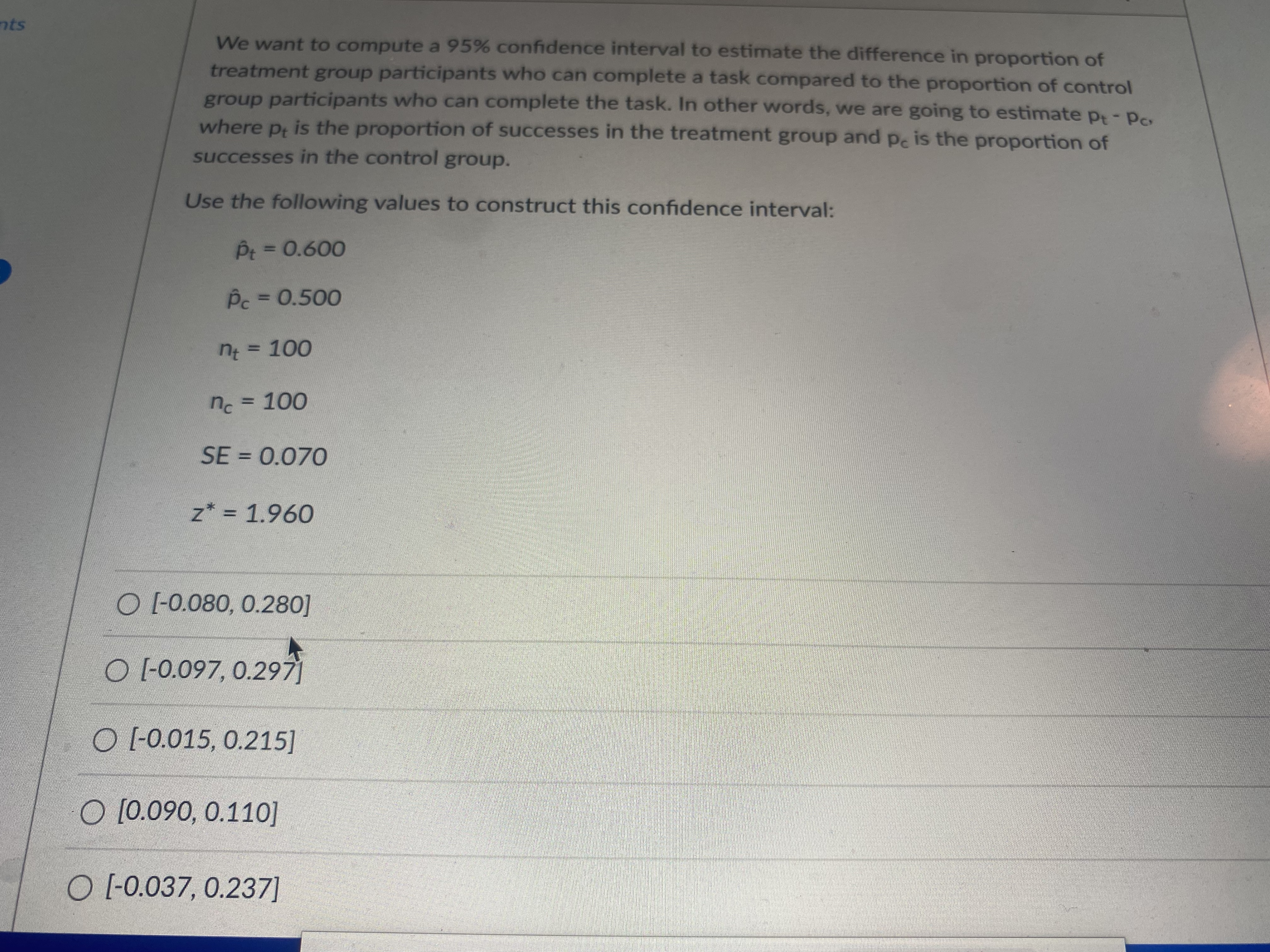
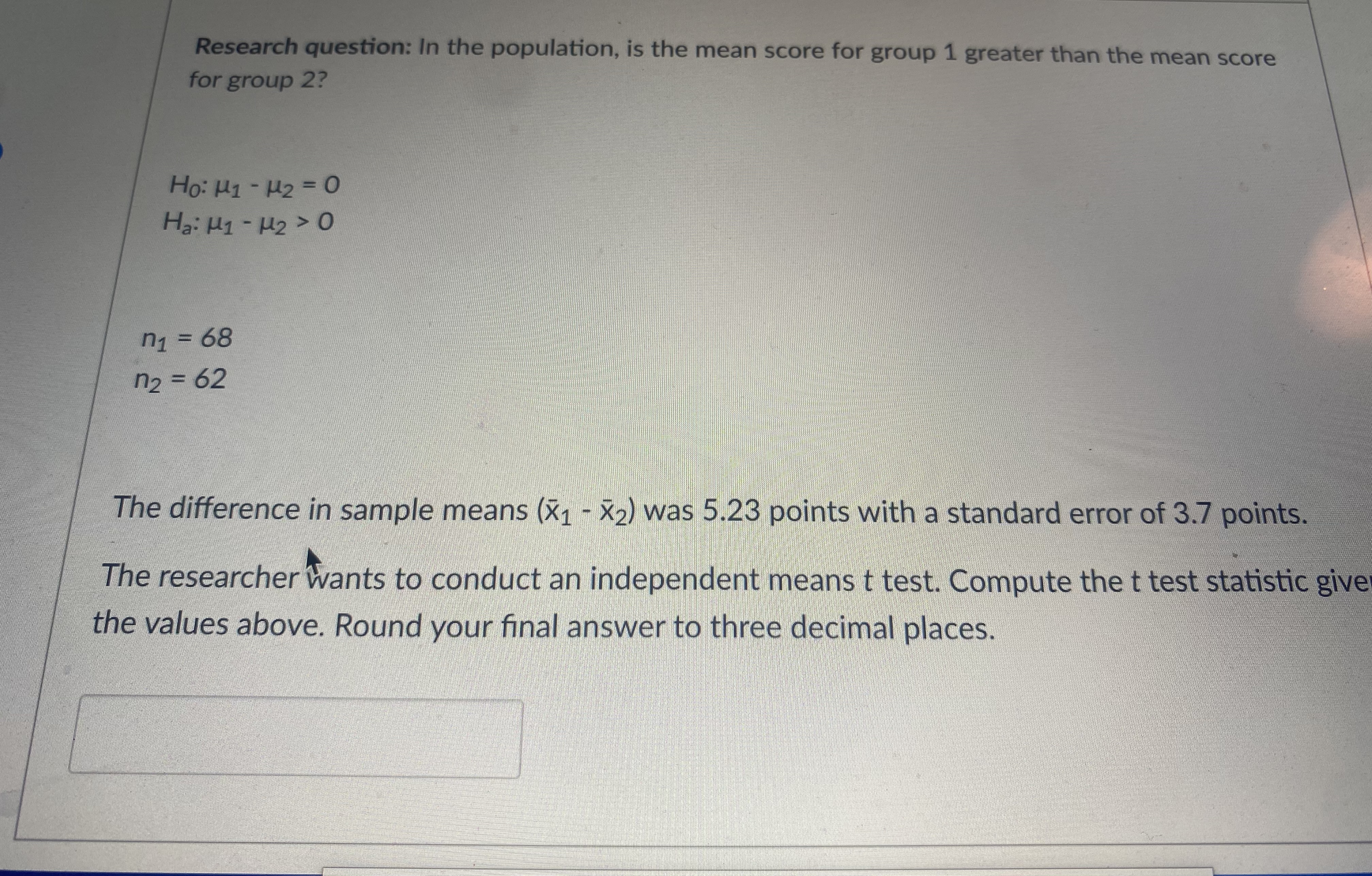
: 1 - 2 = 0 Ha: 1 - 2 > O To address the hypotheses above, data were collected from two small independent samples. Sample statistics are presented in the following table: Summary Statistics Group N Mean Standard Deviation Group 1 14 10.054 3.485 Group 2 13 9.815 3.279 The data collected from Group 1 were skewed to the right. The data collected from Group 2 were approximately normal. The shape of the population distributions is unknown. It is appropriate to use the t distribution to analyze these data? O Yes, the t distribution may be used O No, the t distribution should not be used nts We want to compute a 95% confidence interval to estimate the difference in proportion of treatment group participants who can complete a task compared to the proportion of control group participants who can complete the task. In other words, we are going to estimate pt - Po where pt is the proportion of successes in the treatment group and pc is the proportion of successes in the control group. Use the following values to construct this confidence interval: pt = 0.600 pc = 0.500 nt = 100 nc = 100 SE = 0.070 z* = 1.960 O [-0.080, 0.280] O [-0.097, 0.297 O [-0.015, 0.215] O [0.090, 0.110] O [-0.037, 0.237] Research question: In the population, is the mean score for group 1 greater than the mean score for group 2? o: - = 0 Ha H1 H2O n = 68 n = 62 The difference in sample means (X1 X2) was 5.23 points with a standard error of 3.7 points. The researcher wants to conduct an independent means t test. Compute the t test statistic giver the values above. Round your final answer to three decimal places.
Step by Step Solution
There are 3 Steps involved in it

Get step-by-step solutions from verified subject matter experts
 Study Help