







Question: 1 . ( 2 0 points ) Problem 1 2 . 7 on Textbook, page 5 9 9 , also attached below. Note that Problem
points Problem on Textbook, page also attached below. Note that Problem ask you to solve the problem use both design equation and the design chart.
points Problem on Textbook, page also attached below.
points Use Caltrans design procedure to determine a JPCP concrete pavement layers thickness for a Traffic Index of Assume the pavement will be located in an climate zone of Central Coast area, with the soil of CL inorganic clays of low to medium plasticity with a Rvalue of Assume there is not lateral support along the longitudinal joints.
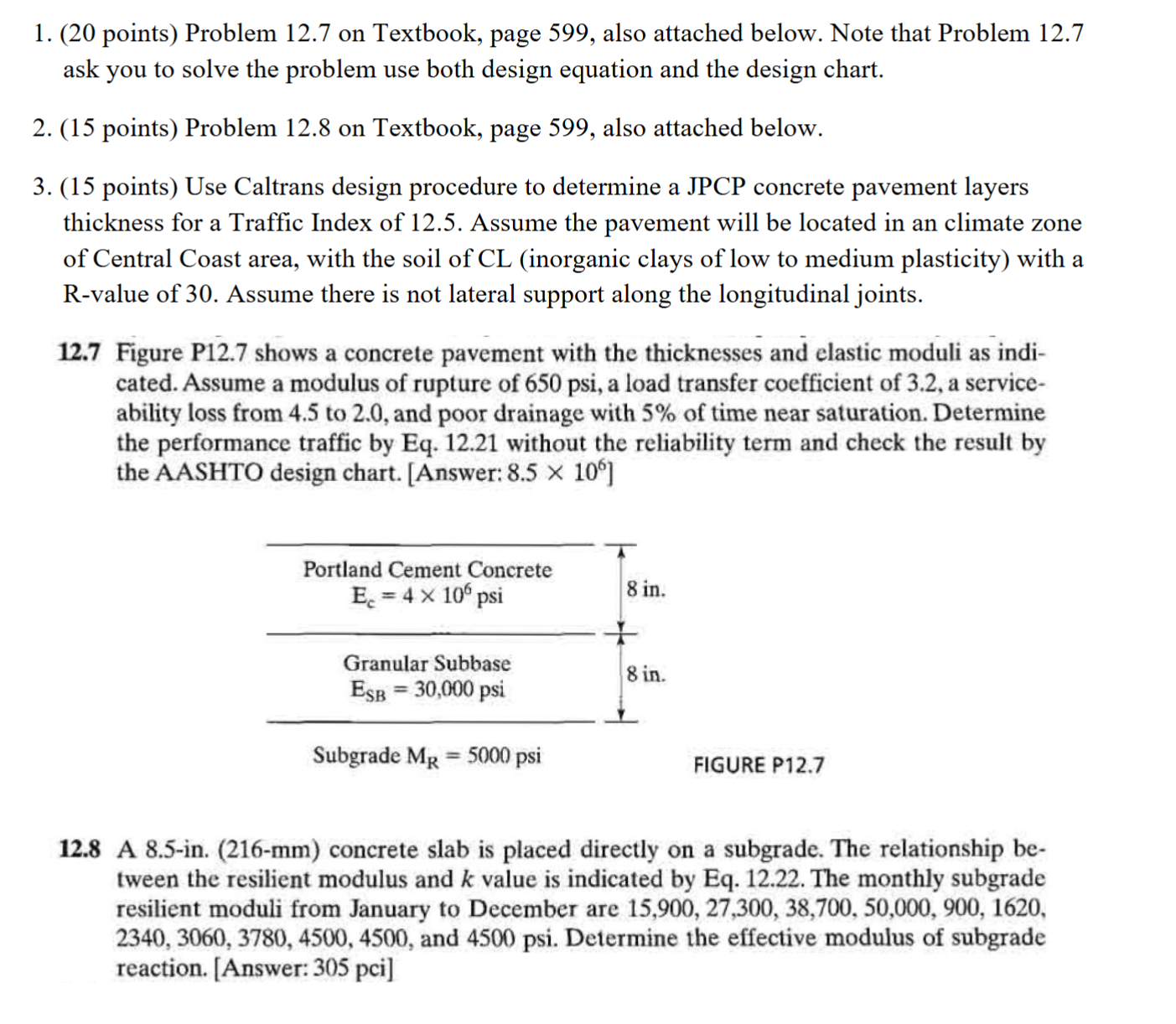
Figure P shows a concrete pavement with the thicknesses and elastic moduli as indicated. Assume a modulus of rupture of psi, a load transfer coefficient of a serviceability loss from to and poor drainage with of time near saturation. Determine the performance traffic by Eq without the reliability term and check the result by the AASHTO design chart. Answer: times
GURE P
A mathrminmathrmmm concrete slab is placed directly on a subgrade. The relationship between the resilient modulus and k value is indicated by Eq The monthly subgrade resilient moduli from January to December are and psi Determine the effective modulus of subgrade reaction. Answer: pci
Step by Step Solution
There are 3 Steps involved in it
1 Expert Approved Answer
Step: 1 Unlock

Question Has Been Solved by an Expert!
Get step-by-step solutions from verified subject matter experts
Step: 2 Unlock
Step: 3 Unlock
 Study Help