







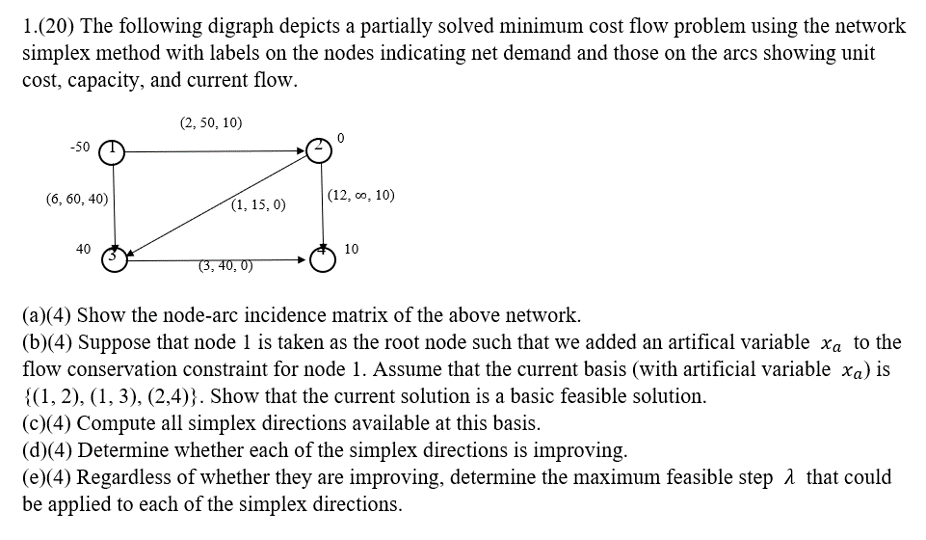
Question: 1 . ( 2 0 ) The following digraph depicts a partially solved minimum cost flow problem using the network simplex method with labels on
The following digraph depicts a partially solved minimum cost flow problem using the network simplex method with labels on the nodes indicating net demand and those on the arcs showing unit cost, capacity, and current flow.
a Show the nodearc incidence matrix of the above network.
b Suppose that node is taken as the root node such that we added an artifical variable xa to the flow conservation constraint for node Assume that the current basis with artificial variable xa is Show that the current solution is a basic feasible solution.
c Compute all simplex directions available at this basis.
d Determine whether each of the simplex directions is improving.
e Regardless of whether they are improving, determine the maximum feasible step lambda that could be applied to each of the simplex directions.
Step by Step Solution
There are 3 Steps involved in it
1 Expert Approved Answer
Step: 1 Unlock

Question Has Been Solved by an Expert!
Get step-by-step solutions from verified subject matter experts
Step: 2 Unlock
Step: 3 Unlock
 Study Help