







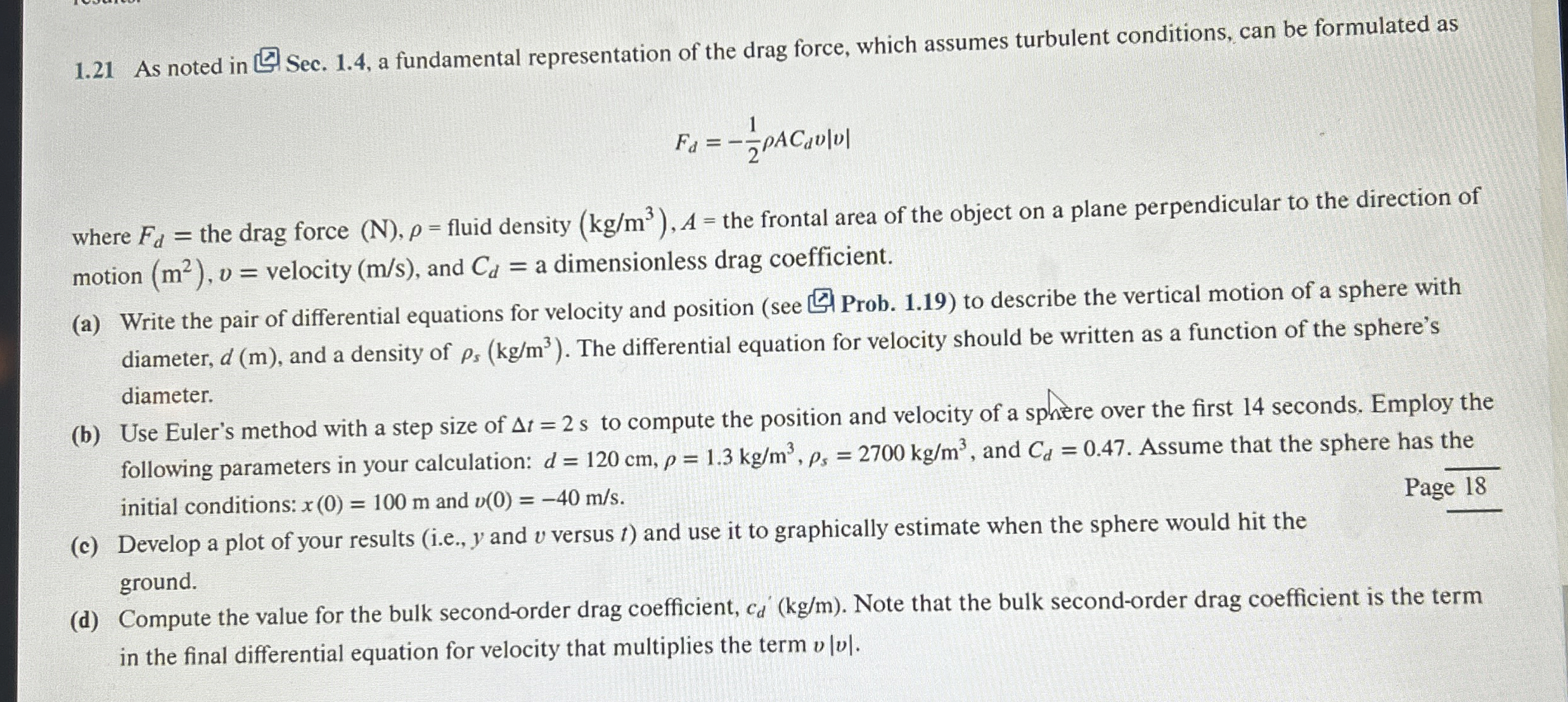
Question: 1 . 2 1 As noted in Sec. 1 . 4 , a fundamental representation of the drag force, which assumes turbulent conditions, can be
As noted in Sec. a fundamental representation of the drag force, which assumes turbulent conditions, can be formulated as
where the drag force fluid density the frontal area of the object on a plane perpendicular to the direction of motion velocity and a dimensionless drag coefficient.
a Write the pair of differential equations for velocity and position see Prob. to describe the vertical motion of a sphere with diameter, and a density of The differential equation for velocity should be written as a function of the sphere's diameter.
b Use Euler's method with a step size of to compute the position and velocity of a sphere over the first seconds. Employ the following parameters in your calculation: and Assume that the sphere has the initial conditions: and
c Develop a plot of your results ie and versus and use it to graphically estimate when the sphere would hit the
Page
ground.
d Compute the value for the bulk secondorder drag coefficient, Note that the bulk secondorder drag coefficient is the term in the final differential equation for velocity that multiplies the term
Step by Step Solution
There are 3 Steps involved in it
1 Expert Approved Answer
Step: 1 Unlock

Question Has Been Solved by an Expert!
Get step-by-step solutions from verified subject matter experts
Step: 2 Unlock
Step: 3 Unlock
 Study Help